


Structure for private equity fund





Try Before you Buy Download Free Sample Product
 Impress Your
 Audience
 100%
100% Editable
 Save Hours
 of Time


Decide on your actions with our Structure For Private Equity Fund. Choose the course you desire to follow.
People who downloaded this PowerPoint presentation also viewed the following :
Content of this Powerpoint Presentation
Description:
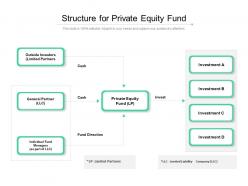
The image depicts the organizational and financial structure of a private equity fund. The elements show the flow of funds from investors to various investments and the roles of different entities within the fund.
The text elements explained:
1. Structure for Private Equity Fund:
This is the title of the slide, clearly stating its purpose.
2. Outside Investors (Limited Partners):
These are the sources of capital for the fund, contributing cash to the private equity fund (LP).
3. General Partner (LLC):
This entity manages the private equity fund and typically has unlimited liability.
4. Individual Fund Managers (as part of LLC):
They are responsible for making decisions on investments and managing the private equity fund's portfolio.
5. Private Equity Fund (LP):
This is the main fund where the capital from Limited Partners and the General Partner is pooled.
6. Investment A, Investment B, Investment C, Investment D:
These represent the individual assets or companies that the private equity fund invests in.
7. Fund Direction:
This signifies the strategic management and oversight of the fund, usually exercised by the general partner.
8. *LP Limited Partners and *LLC Limited Liability Company (LLC):
Denote the abbreviations used in the diagram for clarity.
Use Cases:
Seven industries where this slide could be relevant:
1. Finance:
Use: Illustrating private equity fund structure.
Presenter: Financial analyst or fund manager.
Audience: Potential investors or finance students.
2. Consulting:
Use: Advising on private equity setups.
Presenter: Senior consultant.
Audience: Investment or wealth management firms.
3. Education:
Use: Teaching financial concepts.
Presenter: Professor or finance instructor.
Audience: Business or finance students.
4. Legal:
Use: Explaining legal structuring of investments.
Presenter: Attorney specializing in business law.
Audience: Clients or junior attorneys.
5. Fundraising:
Use: Demonstration of funds' operational mechanisms.
Presenter: Professional fundraiser or capital raising specialist.
Audience: High-net-worth individuals or institutional investors.
6. Venture Capital:
Use: Comparing venture capital and private equity structures.
Presenter: Venture capitalist.
Audience: New entrepreneurs or startup owners.
7. Corporate Training:
Use: Training new employees on company investment strategies.
Presenter: Corporate trainer or internal financial advisor.
Audience: New hires or internal team members.
Structure for private equity fund with all 2 slides:
Choose the course you desire with our Structure For Private Equity Fund. They enable you to decide your actions.

FAQs for Structure for
So you've got the General Partner running the show, then Limited Partners who throw in all the money. There's also this management company doing the boring daily stuff. The fund itself? Usually just a limited partnership - nothing fancy there. GPs get their cut through carried interest (that's the 20% everyone mentions), plus they charge 2% management fees yearly. Hence the whole "2 and 20" thing you hear about constantly. When you're going through those fund documents, honestly just zero in on the fee structures and what governance rights you're getting. That's where all the real negotiating actually happens anyway.
Ok so limited partners are basically the money people - pension funds, rich individuals, endowments. They throw in most of the cash but can't touch day-to-day stuff. General partners? They're running everything with maybe 1-2% of their own money. GPs get management fees plus carried interest, which is honestly pretty nice work if you can get it. LPs take home most returns but zero control - that's why they're "limited." My cousin actually works at a fund and says the GP track record is what really matters when you're looking at these deals.
Most PE funds have about 10-12 years to work with, sometimes stretching to 15. First few years you're buying companies left and right. Then comes the hard part - actually making them better. Final stretch is all about exits through sales or going public. Honestly, those last couple years get pretty intense when you're watching the clock tick down! You can't just sit on underperforming assets hoping they'll magically improve. That's actually not the worst thing though - forces you to really know what you're buying upfront and move fast on improvements.
So PE funds usually hit you with 2% annually - that's on committed capital while they're investing, then switches to net asset value later. Fund size matters a lot here. Bigger funds can push that down to 1.5% or even lower because they have more negotiating power. European funds tend to be cheaper than US ones for some reason. Most funds will step down the fees over time, and if you're putting in serious money, you might get a break. Oh and don't just look at management fees - the carry is where they really make their money, so factor that in too.
So carried interest is basically how fund managers get paid the big money. They take around 20% of profits once the fund hits a certain return threshold. If the fund sucks, they're stuck with just basic management fees - which honestly serves them right. But when investments do well, managers can make bank. The whole setup actually works pretty well because it aligns everyone's interests. You want returns, they want their 20% cut, so they're incentivized to pick winners instead of just coasting on fees. It's like having your financial advisor's paycheck tied directly to whether you actually make money or not.
So PE funds get their money from limited partners who commit capital upfront, then actually wire it as deals come up. Most LPs are big institutional players - pension funds, endowments, insurance companies, family offices. Rich individuals can get in too but minimums are usually $1M+, which is pretty brutal honestly. The general partners throw in 1-2% of the total fund size to show they're committed. Here's the thing - when you're looking at funds, pay attention to who the LPs are. Quality matters because it tells you about fund stability and you might get co-investment opportunities later.
So you've got a few big things to worry about. Investment Advisers Act kicks in over $150M, plus all the securities stuff around fundraising. Tax planning is critical - nobody wants to get hit with corporate-level taxes. Most people go with the LP structure and GP/LP setup because honestly it just works better from a regulatory angle. ERISA gets messy fast if you want pension money (and who doesn't?). There's also international considerations if you're dealing with offshore investors. My advice? Get fund counsel involved super early. I've seen people have to restructure mid-raise because they missed something basic, which is a nightmare you don't want.
So time horizons are huge here. Buyout funds run about 10 years, but VC needs way longer - like 12-15 years since startups are painfully slow to exit. Distressed is the opposite, usually 5-7 years because those deals need fast turnarounds. Fee structures get interesting too. VC funds charge higher management fees since they're basically babysitting companies, while distressed funds grab higher carry (honestly makes sense given how specialized that work is). Oh and distressed funds call your capital way faster than the others. Just something to plan for.
Okay so fund structures basically determine how much you'll actually make. High management fees? Your returns get crushed. The waterfall thing is huge too - some funds pay you back first, others let the GP take their cut earlier (which honestly can be annoying). Tax-wise, partnerships are way better than corporate structures since you avoid getting taxed twice. Oh and fund life matters more than people think - longer funds mean your money's tied up forever, which totally screws with your IRR calculations. Seriously though, read those fund docs. Most people just skim them but the structure details will make or break your investment.
Look, your fund structure is basically the rulebook for diversification - it dictates what you can actually buy. Most PE funds have concentration limits and sector restrictions written into their LPAs, so you can't just go crazy acquiring everything that catches your eye. Size matters too. Smaller funds often can't diversify meaningfully across industries or deal sizes (honestly, it's pretty limiting). Plus geographic mandates will box you in regionally. Before you nail down your investment strategy, definitely check those GP-LP agreement provisions - they'll spell out exactly what constraints you're dealing with.
Get a good lawyer in each country first - trust me on this one. The regulatory stuff is completely different everywhere (AIFMD in Europe vs SEC rules here), and it's honestly such a pain to figure out solo. Most smart investors I know set up holding companies in places like Luxembourg or Ireland for tax reasons. You really want to map out your whole investment flow before you start anything. Think withholding taxes, approvals you'll need, reporting requirements - all that fun stuff. Yeah it costs upfront to get proper advice, but way cheaper than having to restructure everything later when you realize you messed up the initial setup.
Man, complex PE structures are such a pain during fundraising. You end up explaining mechanics instead of actually selling the opportunity. LPs get lost in multi-tiered waterfalls and parallel fund stuff - I've seen seasoned investors just zone out mid-presentation. Due diligence drags on forever while their lawyers pick apart every detail. Honestly, smaller investors will bail rather than deal with the headache. My advice? Get really clear docs and maybe some visual diagrams showing money flow. Makes a huge difference when people can actually see what you're talking about.
So the LPA is basically your fund's rulebook - covers management fees, carry splits, who decides what, all that stuff. GPs get their investment powers laid out. LPs get approval rights on big moves, though most stay out of the weeds unless things get messy. It also handles reporting schedules and how you can exit (spoiler: usually you can't for years). My advice? Actually read the damn thing before you sign. I know it's boring legal stuff, but you're stuck with whatever's in there for the next decade plus. Those terms matter way more than people think.
Your fund's decision-making structure basically controls who calls the shots and how fights get settled. GPs handle daily investment calls, but LPs keep veto power over big stuff - key person changes, strategy pivots, that kind of thing. The LPAC deals with conflicts of interest (honestly the most awkward conversations happen there). Get this all hammered out in your partnership agreement before you launch. Last thing you want is everyone arguing about who decides what when there's already a crisis brewing and tempers are running hot.
PE funds are getting a major tech makeover right now. Blockchain's making investor reporting way more transparent, and AI is completely changing deal sourcing - honestly pretty wild stuff. Digital platforms handle those messy waterfall structures so much better than before, plus LPs get real-time portfolio data instead of waiting for quarterly reports (which feel so outdated at this point). The real game-changer though? Tokenization of fund interests. That's gonna flip ownership transfers and secondary markets upside down. You should definitely start looking at how digital tools could clean up your current operations - even small changes make a huge difference.
No Reviews