


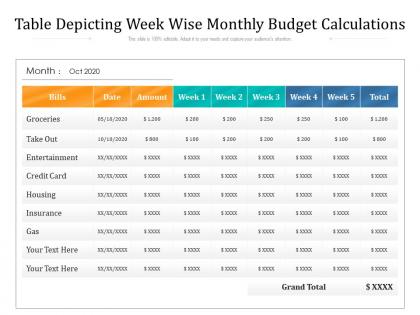
Table depicting week wise monthly budget calculations




Try Before you Buy Download Free Sample Product
 Impress Your
 Audience
 100%
100% Editable
 Save Hours
 of Time


Our Table Depicting Week Wise Monthly Budget Calculations are topically designed to provide an attractive backdrop to any subject. Use them to look like a presentation pro.
People who downloaded this PowerPoint presentation also viewed the following :
Table depicting week wise monthly budget calculations with all 2 slides:
Use our Table Depicting Week Wise Monthly Budget Calculations to effectively help you save your valuable time. They are readymade to fit into any presentation structure.
FAQs for Table depicting week wise
Honestly, I'd start with your sales team - they bring in the money, obviously. But don't totally ignore the back-office stuff that keeps things from falling apart. Look at what each department actually contributes to your main goals, then check your spending from last year as a starting point. Performance matters too - if a team's crushing their targets, throw more budget their way. Oh, and factor in any big projects coming up or compliance stuff you can't dodge. It's kinda messy balancing act, not gonna lie. Part numbers, part gut feeling about what'll actually move the needle.
Start with the obvious stuff - compare what you actually spent versus what you planned. Pretty basic reality check. Did those budget categories actually work though? That's where most people mess up. Track your ROI, project completion rates, whatever matters for your situation. Look at where you went over or under budget and figure out why. I'd probably set up a simple spreadsheet (or use whatever tools you already have) to review this quarterly instead of scrambling once a year like everyone else does. Way less stressful that way.
Get stakeholder input early - it's what separates good budget decisions from disasters. Department heads and team leads know where the real problems are hiding. I made this mistake once by ignoring our field team's feedback, and wow did that come back to bite me. Their insights help you spend smarter and get everyone on board later. Don't just ask "what do you need?" though - that's too vague. Set up proper feedback sessions with specific questions about pain points and constraints. Trust me, actually listening to what they tell you saves so much headache down the road.
Real-time dashboards are a game changer - you can literally watch where money goes as it's being spent. Cloud tools let you set up approval workflows so there's always a paper trail of who okayed what. Your stakeholders get instant access to data instead of waiting around for those monthly reports that end up in everyone's spam folder anyway. The trick is finding software that's actually intuitive. Otherwise your team won't use it consistently and you're back to square one. Automated reporting saves tons of time too, which is honestly the best part.
Look, I'd go with the 80/20 thing first - figure out which expenses actually move the needle and protect those. After that, try zero-based budgeting where you justify every single dollar instead of just copying last year's numbers. Those impact vs effort grids help too, though honestly most people way overthink the whole process. Just be brutal about cutting the nice-to-haves so your must-haves get proper funding. List everything out, then rank them against what you're actually trying to accomplish. Works way better than trying to be clever about it.
First thing - match your budget to what actually matters. Customer retention a big goal? Then put real money behind customer success, don't just cross your fingers. Look at where you're spending now and be brutal about whether it's moving you forward. So many companies I've seen just keep throwing money at old projects that made sense three years ago but don't anymore. You'll want quarterly check-ins to shift funds around as things change. Bottom line: your budget should follow your strategy, not drive it.
Yeah, external economic stuff can totally mess with your budget priorities. Inflation hits and suddenly you're scrambling to cover higher costs everywhere. Interest rates go up? Your loans get pricier and borrowing becomes harder. Market chaos usually means ditching risky investments for safer spending - honestly, I've watched whole business plans get trashed overnight because of this. During downturns, you cut the nice-to-haves but protect what actually keeps things running. Best thing you can do is build some wiggle room into your budget upfront. That way you're not panicking when everything shifts.
Dude, looking at your spending data is like having a cheat code for budgeting. Pull up your last year of expenses and you'll see patterns you never noticed. Historical stuff shows what actually worked vs what flopped. Predictive models sound fancy but they're just spotting future costs before they smack you in the face. Way better than just copying last year's numbers or winging it, honestly. I used to hate this kind of analysis but it's actually pretty satisfying once you get going. You'll make decisions based on real trends instead of guesswork.
Honestly, transparency is everything here. People don't freak out as much when they actually understand WHY the budget got slashed. I'd send a written summary first, then do face-to-face meetings for the bigger changes - getting news like that through email just sucks. Let them ask questions and figure out their next moves. Here's the thing though: don't just focus on what they're losing. Talk about what they can still pull off with what's left. Oh, and definitely check back in a week to see how they're handling it and help with any issues.
Look, the formula's pretty straightforward: (gains - cost) / cost x 100. But here's where it gets messy - you've gotta figure out what "gains" actually means first. Revenue bump? Cost savings? New customers? Define that upfront or you're basically guessing later. Get your baseline numbers before spending anything, then track consistently. I'd set up monthly check-ins to see how reality matches your projections - trust me, it rarely does exactly what you expect. The math part's easy, honestly. It's the "what should I even be measuring" question that'll trip you up.
Ugh, nonprofit budgeting is such a pain compared to regular businesses. Donors tie up your money for specific things, so you can't just shift funds around when needed. The worst part? Everyone obsesses over that program expense ratio - God forbid you spend "too much" on admin even when your ancient computers are literally dying. Grant requirements change every year too, which makes planning impossible. Oh, and funding is super unpredictable. I'd say try to build wiggle room into your budget categories wherever you can. Also, don't be afraid to explain to donors why operational stuff actually matters for your mission.
Figure out which revenue streams matter most and protect those like your life depends on it. I'd pull money from anything non-essential - sucks when you've already planned stuff, but whatever. Grab maybe 10-15% from each department's fun money to build a quick emergency fund. Put everything into whatever responds to this market shift. Digital marketing, product pivots, keeping customers happy - you know the drill. Move fast but don't freak out completely. Oh, and check your moves weekly so you can fix things if they're not working.
Honestly, start with ROI and variance - those will tell you if your budget's actually doing anything. Cost per acquisition matters too, plus revenue growth by department. Budget variance is huge (and usually pretty shocking when you first look at it lol). Pipeline growth and customer acquisition rates are solid leading indicators - they'll warn you before things go sideways. Set up some kind of monthly dashboard so you're not scrambling at year-end wondering where everything went wrong. Way better to catch issues early than deal with surprises later.
Honestly, scenarios are like your safety net for budgeting. Run a few "what if" situations - maybe revenue tanks 20%, or you get hit with surprise costs. See how each one messes with your numbers. I always do at least 3 versions: best case, worst case, and something realistic in the middle. Once you spot which budget areas are gonna hurt most, you can build in some cushion there. Way better than just crossing your fingers and hoping everything works out perfectly, you know? It's basically stress-testing your money plan before you're actually stressed.
Honestly, budget stuff gets political fast if you're not careful. People will absolutely notice if certain departments keep getting favored while others get screwed. Document everything - seriously, cover your ass on this one. When you make cuts, think about actual humans, not just spreadsheets. Short-term savings that tank morale? Not worth it. Be upfront about why you're making these calls so people don't think you're playing favorites. Oh, and definitely bounce big decisions off someone you trust before announcing them. I learned that one the hard way at my last job.
-
Unique research projects to present in meeting.
-
Excellent template with unique design.
-
Really like the color and design of the presentation.
-
Use of different colors is good. It's simple and attractive.