


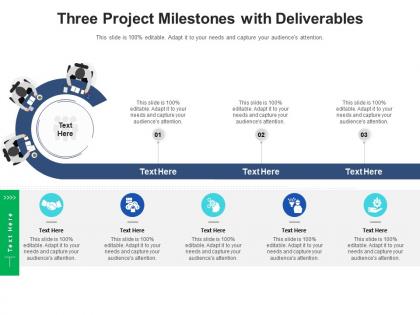
Three project milestones with deliverables infographic template




Try Before you Buy Download Free Sample Product
 Impress Your
 Audience
 100%
100% Editable
 Save Hours
 of Time


Our Three Project Milestones With Deliverables Infographic Template are topically designed to provide an attractive backdrop to any subject. Use them to look like a presentation pro.
People who downloaded this PowerPoint presentation also viewed the following :
Three project milestones with deliverables infographic template with all 2 slides:
Use our Three Project Milestones With Deliverables Infographic Template to effectively help you save your valuable time. They are readymade to fit into any presentation structure.
FAQs for Three project milestones with
So project milestones are basically your big checkpoints - like major wins you hit throughout the project. They're clutch for tracking if you're actually on schedule and give your team something concrete to aim for. Honestly, they're lifesavers when you need to update your boss or clients because you can point to real progress. The trick is making them specific enough that you'll know for sure when you've nailed one. Oh, and they catch problems early too - way better than dealing with a disaster at the end. Just don't make them too vague or you'll be guessing whether you hit them.
Honestly, milestones are game-changers because they give everyone something concrete to work toward. Breaking big projects into specific chunks with actual deadlines just makes everything click better. Your team starts talking more openly about progress, and nobody has to do that awkward "hey, where are we on this?" dance. There's also something weirdly satisfying about checking stuff off together - like, people actually get excited about hitting those markers. Course corrections happen naturally too since everyone knows what's expected by when. Next time, try making one super specific with a clear deliverable and date. You'll be surprised how much smoother things run.
Honestly, most people go overboard with milestones - like they're planning a wedding or something. Too many just creates chaos. Keep it to maybe 3-7 max that actually mean something measurable. Don't make them super vague either ("improve user experience" tells you nothing). Space them out properly instead of dumping them all at the end when you're panicking. Each milestone should tie to real deliverables, not random dates you picked. Oh, and don't just copy what worked on your last project - that never goes well. Focus on "what gets done and when" and you'll be fine.
Honestly, I usually stick to 3-7 milestones - more than that and you're basically babysitting the project. Break yours into natural phases where you'd actually want to stop and check how things are going. Every 2-4 weeks works well for me, though it depends on what you're dealing with. A 3-month project? Maybe 4-5 tops. Each milestone should be something real - like a deliverable or major decision - not just random dates on a calendar. Oh, and start with your big deliverables first, then figure out the checkpoints from there.
Think of milestones as your safety net - they force you to actually look at where things stand instead of just hoping everything's fine. Honestly, most people set them up wrong though. You want them tied to real deliverables, not random dates on a calendar. Each checkpoint lets you catch the ugly stuff early: budget creep, timeline mess, scope that's wandering off into la-la land. Way better to find out you're behind schedule at week 4 than week 12, you know? The key is being brutal about what you're really seeing versus what you hoped would happen.
Honestly, you should try Asana or Monday - they've saved my butt so many times. Set up visual timelines and automated reminders so you don't forget stuff. Gantt charts are weirdly addictive once you get into them, plus they show dependencies super clearly. Your team can update progress in real time, which is clutch. Everyone sees the same deadlines and gets alerts before things go sideways. I'd start simple though - just map your main milestones in whatever tool you're already using. Then add those automated check-ins gradually.
Dude, don't wait for things to blow up before updating people. I learned this the hard way on my last project. Send quick weekly emails - what's good, what's sketchy, any roadblocks. Those visual dashboards with progress bars are clutch too, people eat that stuff up. Figure out how each person wants info - some need the full breakdown, others just want bullet points in Slack. Better to overdo it than have everyone wondering what's happening. Oh and be consistent about it, not just when you remember to hit send.
Start by figuring out how your milestones actually connect to what your company's trying to achieve this year. I literally take our OKRs and draw lines between my project stuff and their targets - super dorky but honestly it helps me see the gaps. Your timeline needs to play nice with other big initiatives too, otherwise you'll be fighting for the same people and budget. That's always a mess. Oh, and definitely loop in your stakeholders early to make sure you're not totally off base with these connections. Better to catch that stuff upfront than halfway through.
Track delivery stuff first - timeline, budget, scope. Basic but necessary. Quality and stakeholder happiness matter way more though, honestly. Also check if your team's moving at a good pace and whether this milestone actually gets you closer to the finish line. Oh, and risk mitigation is huge - good milestones should make you feel less anxious about what's coming next, not more. Pick maybe 3-4 metrics that actually make sense for your project and don't overthink it. Consistency beats perfection here.
Okay so when stuff goes sideways with your project timeline, don't panic and make everything worse. Figure out what's actually broken vs. what just feels scary right now. Honestly, sometimes the fear makes you think the whole thing is doomed when maybe only one piece got delayed. Prioritize the must-haves over the nice-to-haves. Then redo your timeline properly - none of this "let's just push everything back two weeks and pray" nonsense. Most crucial thing? Tell your stakeholders what happened before they come hunting for answers. Write down what changed, why, and your new game plan. Gets messy if you wait too long.
So deliverables are basically the stuff you actually make - like reports, prototypes, presentations, whatever. Milestones? Those are more like checkpoints along the way. I totally used to confuse these two lol. Think of it this way: deliverables are tangible things stakeholders can look at and approve. Milestones just mark that you've hit an important stage in your timeline. They're not necessarily something you hand over to anyone. Here's what works well though - connect your milestones to when key deliverables get finished. Makes tracking so much simpler.
Honestly, milestones are just checkpoints that keep you sane during big projects. Break everything down into 3-5 key delivery dates - way less overwhelming than staring at one massive deadline months away. They're like those GPS stops on a road trip (who drives cross-country blind?). When stuff goes sideways - and it will - you'll catch delays early instead of panicking at the end. Your team stays focused on actual targets. Stakeholders love getting updates at these points too, which saves you from constant "how's it going" emails. Trust me on this one. Pick your anchor dates first, then build everything else around them.
Honestly, you just need to be super clear about who owns what. Give each milestone to a specific person with real deadlines. Weekly check-ins are clutch - make people actually report their status out loud. I swear by those shared project boards where everyone can see who's doing what and how behind they are (nothing motivates people like a little public shame, lol). Set up alerts when stuff's gonna be late - like two weeks before a deadline hits. When people know their work is visible to everyone else, they don't want to be the one holding things up.
Match the celebration to how big the win actually is. Small stuff? Team shoutouts, coffee runs, or quick thank-you notes work great. Big milestones deserve team lunches or happy hours. Pizza honestly fixes everything though - I've seen it turn around entire team moods. Don't wait forever to celebrate either. Do it within a day or two while people still care. Focus on the team's effort, not just what you achieved. Oh, and ask them what they'd actually want instead of guessing. You'll probably be surprised by their answers.
Think of milestones as your financial reality checks. They let you track spending vs actual progress - super helpful for catching budget problems early. I usually tie payments to milestone completion because it keeps everyone honest and helps with cash flow. When you hit a milestone behind schedule, that's your cue to rethink how much money you're throwing at the rest of the project. Honestly? I've watched way too many projects completely tank their budgets just because nobody bothered checking these markers. Set financial targets for each one and actually review them - trust me, it beats explaining to your boss why you're suddenly 90% over budget.
-
Excellent work done on template design and graphics.
-
Awesomely designed templates, Easy to understand.
-
Qualitative and comprehensive slides.
-
Illustrative design with editable content. Exceptional value for money. Highly pleased with the product.
-
Great product with highly impressive and engaging designs.
-
Very unique, user-friendly presentation interface.
-
Use of icon with content is very relateable, informative and appealing.