


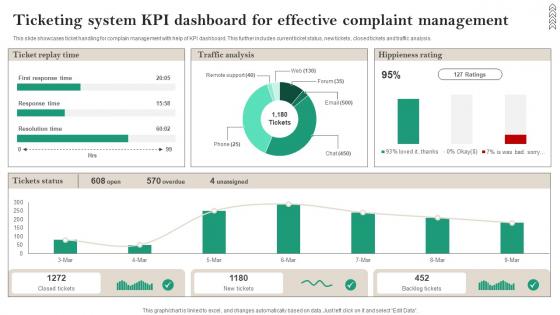
Ticketing System KPI Dashboard For Effective Complaint Management




Try Before you Buy Download Free Sample Product
 Impress Your
 Audience
 100%
100% Editable
 Save Hours
 of Time


This slide showcases ticket handling for complain management with help of KPI dashboard. This further includes current ticket status, new tickets, closed tickets and traffic analysis.
People who downloaded this PowerPoint presentation also viewed the following :
Ticketing System KPI Dashboard For Effective Complaint Management with all 10 slides:
Use our Ticketing System KPI Dashboard For Effective Complaint Management to effectively help you save your valuable time. They are readymade to fit into any presentation structure.








FAQs for Ticketing System KPI Dashboard For
Critical ticketing system KPIs include first response time, resolution time, customer satisfaction scores, ticket volume trends, and agent productivity metrics. These indicators enhance service delivery by identifying bottlenecks, optimizing resource allocation, and improving response efficiency, with many organizations finding that tracking these metrics ultimately delivers faster customer resolutions and competitive advantage.
Response time significantly impacts customer satisfaction by directly influencing perceived service quality, trust levels, and overall user experience, with faster responses leading to higher satisfaction scores and improved customer retention rates. In customer service environments, organizations consistently find that reducing response times from hours to minutes enhances customer loyalty, minimizes frustration, and ultimately delivers competitive advantage through superior support experiences.
Key metrics include first response time, average resolution time, ticket backlog size, resolution rate by priority level, and customer satisfaction scores. These indicators streamline performance evaluation by identifying bottlenecks, measuring agent productivity, and tracking service quality trends, with many support organizations finding that balanced scorecards ultimately deliver faster customer experiences and operational efficiency.
First contact resolution rates significantly enhance ticketing system performance by reducing operational costs, minimizing customer effort, and streamlining resource allocation across support teams. Higher resolution rates enable organizations to handle increased ticket volumes more efficiently, improve customer satisfaction scores, and reduce escalation burdens, with many service organizations finding that improving first contact resolution by even 10% delivers measurable competitive advantage and operational efficiency.
Ticket volume serves as a foundational metric for assessing support team capacity, workload distribution, and resource allocation needs, while also indicating customer engagement levels and system adoption rates. However, volume alone presents both opportunities and challenges, as high volumes might signal growing user bases or system issues, with many organizations finding that combining volume with resolution times, satisfaction scores, and first-contact resolution rates delivers more comprehensive team performance insights.
Customer feedback can be quantified through satisfaction scores, Net Promoter Scores, sentiment analysis ratings, resolution quality assessments, and follow-up survey responses. These metrics enhance ticketing KPIs by identifying service gaps, measuring agent performance effectiveness, and tracking resolution satisfaction trends, with many organizations finding that structured feedback integration ultimately delivers improved customer experiences and streamlined support operations.
High ticket escalation rates indicate potential gaps in first-level resolution capabilities, agent training deficiencies, knowledge base inadequacies, and workflow bottlenecks that can significantly impact team morale and operational costs. While escalations ensure complex issues reach specialized expertise, excessive rates often result in longer resolution times, decreased customer satisfaction, and resource strain, with many organizations finding that addressing root causes through enhanced training and streamlined processes ultimately delivers improved efficiency and competitive advantage.
Organizations balance support quality with resolution speed by implementing tiered support systems, establishing clear escalation protocols, and using automated routing for simple issues while reserving complex cases for specialized agents. Through strategic resource allocation and performance metrics that measure both customer satisfaction and resolution times, companies in sectors like financial services and healthcare deliver faster initial responses, maintain thorough problem-solving standards, and ultimately enhance customer experiences while optimizing operational efficiency.
Key metrics include ticket deflection rates, self-service completion rates, resolution time reduction, customer satisfaction scores, and cost per ticket reduction. These indicators streamline support operations by measuring how effectively customers resolve issues independently, reducing agent workload while improving response times, with many organizations finding that successful self-service implementations deliver significantly lower operational costs and enhanced customer experiences.
Average handle time inversely correlates with team productivity when balanced with resolution quality, as shorter handle times typically indicate streamlined processes, better knowledge management, and efficient resource allocation. However, organizations like financial services and healthcare find that optimizing handle time alongside first-contact resolution rates enhances overall productivity, ultimately delivering faster customer service and improved operational efficiency without compromising solution quality.
**INPUT**: What strategies can be employed to reduce ticket backlog, and which KPIs are most relevant? **OUTPUT**: Effective backlog reduction strategies include automated ticket routing, priority classification systems, self-service portals, workforce optimization, and proactive monitoring tools. Key KPIs to track include average resolution time, first-call resolution rate, ticket volume trends, and agent utilization rates, with many organizations finding that these metrics enable faster customer service delivery and significantly improved operational efficiency.
Ticket categorization enhances data analysis by enabling precise segmentation of issues, identifying patterns across departments, and measuring resolution times by category type. This structured approach allows organizations to track specific KPIs like category-based performance metrics, resource allocation efficiency, and customer satisfaction scores, ultimately delivering actionable insights that streamline support operations and improve service quality.
Tracking ticket resolution trends reveals patterns in support workload, seasonal demand fluctuations, team performance improvements, and recurring issue categories that require systematic solutions. These insights enable organizations to optimize staffing levels, proactively address common problems, and enhance resource allocation, with many customer service teams finding that trend analysis ultimately delivers faster resolution times and improved customer satisfaction.
Seasonal fluctuations require establishing baseline metrics for different periods and adjusting KPI targets accordingly, rather than using static benchmarks throughout the year. Organizations should analyze year-over-year trends, implement rolling averages, and create seasonal staffing models that accommodate predictable volume changes, with many companies finding that proactive capacity planning during peak periods ultimately delivers improved customer satisfaction and operational efficiency.
Technologies for automating ticketing system KPI tracking include AI-powered analytics platforms, business intelligence dashboards, machine learning algorithms, automated reporting tools, and real-time monitoring systems. These solutions streamline performance measurement by continuously analyzing response times, resolution rates, and customer satisfaction scores, with many organizations finding that automated KPI tracking reduces manual oversight while delivering faster insights and improved service quality.
-
Thank you for offering such fantastic custom design services. The team is really helpful and innovative. In a very short time, I received my personalized template.
-
“Excellent service from the customer support team when I wanted a slide that was a bit different from those on their standard menu. Super helpful.”