


Total cost management powerpoint presentation slides




Try Before you Buy Download Free Sample Product
 Impress Your
 Audience
 100%
100% Editable
 Save Hours
 of Time


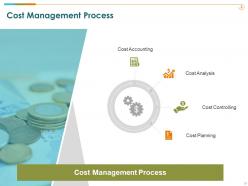
Create an effective strategy for minimizing the excess expenditure of your organization using our content ready Total Cost Management PowerPoint Presentation Slides. Utilize these cost assessment PPT templates to showcase the components of financial strategy such as cost leadership, differentiation, cost focus, and differentiation focus. Take the assistance of these cost accounting PowerPoint visuals to depict various product costs like material costs, material over-heads, manufacturing structure costs, etc. Illustrate the steps to undertake short term decisions, strategic investment decisions, budget and financial planning using this cost analysis PowerPoint deck. Unveil the four responsibility centers like a cost center, revenue center, profit, and revenue center. Explain the cost management process that includes cost accounting, cost analysis, cost controlling and cost planning using these financial management PowerPoint infographics. Present the cost reduction and procurement ROI, balanced scorecard strategy and numerous employee reward systems with this cost analysis PPT slideshow. Download these cost management PPT layouts to increase revenue and decrease costs.
People who downloaded this PowerPoint presentation also viewed the following :
Content of this Powerpoint Presentation
Slide 1: This slide introduces Total Cost Management. State your company name and begin.
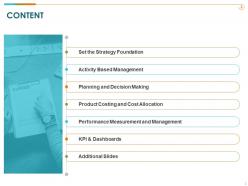
Slide 2: This slide displays the Content of the presentation.
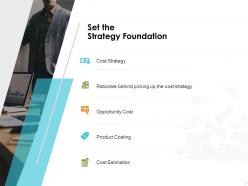
Slide 3: This slide describes to Set the Strategy Foundation containing- Cost Strategy, Rationale behind picking up the cost strategy, Opportunity Cost, Product Costing, Cost Estimation.
Slide 4: This slide displays Cost Strategy with- Differentiation, Differentiation Focus, Cost, Focus, Cost Leadership, Board, Narrow, Differentiation, Cost, Scope.
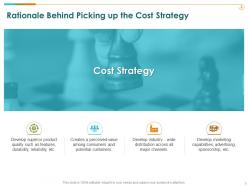
Slide 5: This slide depicts Rationale Behind Picking up the Cost Strategy.
Slide 6: This slide represents the Opportunity Cost.
Slide 7: This slide describes Opportunity Cost.
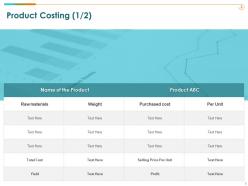
Slide 8: This slide represents Product Costing.
Slide 9: This slide also represents Product Costing.
Slide 10: This slide displays the Cost Estimation.
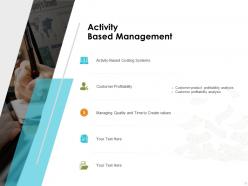
Slide 11: This slide depicts Activity Based Management with- Activity-Based Costing Systems, Managing Quality and Time to Create values, Customer Profitability, Customer-product profitability analysis, Customer profitability analysis.
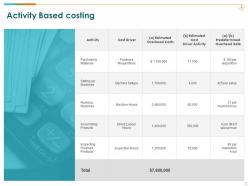
Slide 12: This slide showcases Activity Based costing.
Slide 13: This slide showcases Customer-Product Profitability Analysis with- Customers, Products.
Slide 14: This slide describes Customer Profitability Analysis.
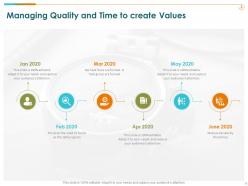
Slide 15: This slide displays Managing Quality and Time to create Values.
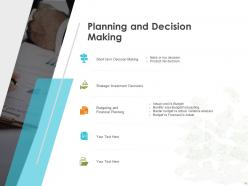
Slide 16: This slide showcases Planning and Decision Making.
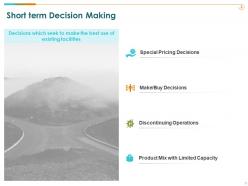
Slide 17: This slide represents Short term Decision Making containing- Decisions which seek to make the best use of existing facilities, Special Pricing Decisions, Product Mix with Limited Capacity, Discontinuing Operations.
Slide 18: This slide describes Make or Buy Decision.
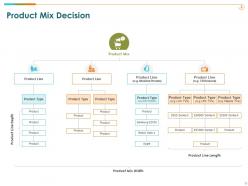
Slide 19: This slide discusses about Product Mix Decision.
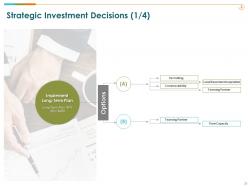
Slide 20: This slide presents Strategic Investment Decisions.
Slide 21: This slide displays Strategic Investment Decisions.
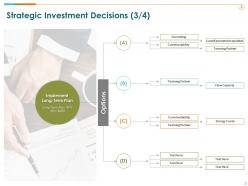
Slide 22: This slide describes Strategic Investment Decisions.
Slide 23: This slide represents Strategic Investment Decisions.
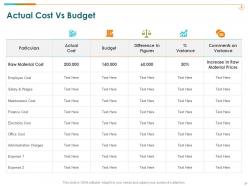
Slide 24: This slide displays Actual Cost Vs Budget.
Slide 25: This slide showcases Monthly wise Budget Forecasting.
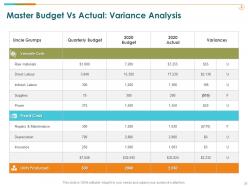
Slide 26: This slide depicts Master Budget Vs Actual: Variance Analysis.
Slide 27: This slide describes Budget Vs Forecast Vs Actual.
Slide 28: This slide presents Product Costing and Cost Allocation with- Job Order Costing, Managing and Allocating Support Service Costs, Cost Allocation.
Slide 29: This slide showcases Job Order Costing.
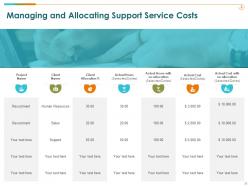
Slide 30: This slide represents Managing and Allocating Support Service Costs.
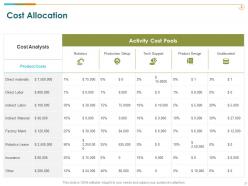
Slide 31: This slide displays Cost Allocation.
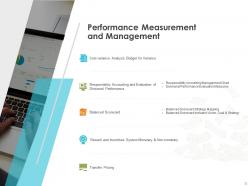
Slide 32: This slide displays Performance Measurement and Management.
Slide 33: This slide depicts Cost Variance Analysis: Budget Vs Variance.
Slide 34: This slide displays Responsibility Accounting Management Chart.
Slide 35: This slide represents Divisional Performance Evaluation Measures.
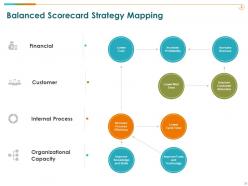
Slide 36: This slide depicts Balanced Scorecard Strategy Mapping.
Slide 37: This slide represents Balanced Scorecard Indicator Vision, Goal & Strategy.
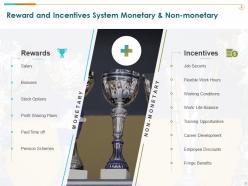
Slide 38: This slide showcases Reward and Incentives System Monetary & Non-monetary.
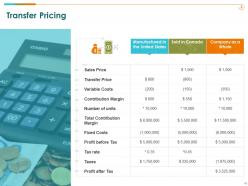
Slide 39: This slide showcases Transfer pricing.
Slide 40: This slide displays Transfer Pricing
Slide 41: This slide displays KPI & Dashboards.
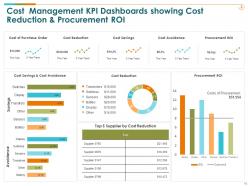
Slide 42: This slide depicts Cost Management KPI Dashboards showing Cost Reduction & Procurement ROI.
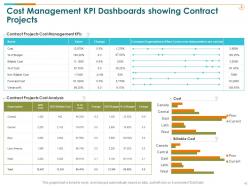
Slide 43: This slide describes Contract Projects Cost Management KPIs.
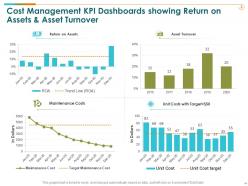
Slide 44: This slide represents Cost Management KPI Dashboards showing Return on Assets & Asset Turnover.
Slide 45: This slide showcases Cost Management KPI Metrics showing Cost Entity Summary.
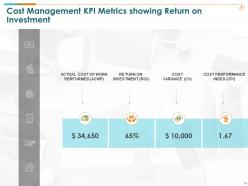
Slide 46: This slide showcases Cost Management KPI Metrics showing Return on Investment.
Slide 47: This slide is titled as Additional Slides for moving forward.
Slide 48: This slide depicts Cost Management with- Continuous Improvement, Performance Management, Planning & Allocation, Monitoring & Reporting, Analysis & Decision Support.
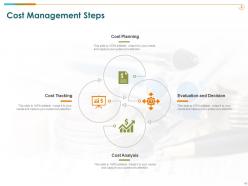
Slide 49: This slide displays Cost Management Steps such as- Cost Planning, Evaluation and Decision, Cost Analysis, Cost Tracking.
Slide 50: This slide depicts Cost Management with- Estimating, Project Planning, Project Cost Control, Financial Management.
Slide 51: This slide showcases Cost Management Process.
Slide 52: This slide presents Cost Management Four Primary Phases describing- Resource Planning, Cost Estimating, Cost Budgeting, Cost Control.
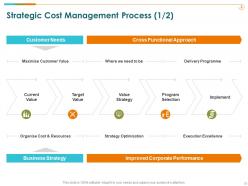
Slide 53: This slide displays Strategic Cost Management Process with- Cross Functional Approach, Improved Corporate Performance, Current Value, Target Value, Value Strategy, Program Selection, Implement, Delivery Programme.
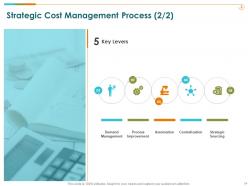
Slide 54: This slide describes Strategic Cost Management Process with- Demand Management, Process Improvement, Centralization, Automation, Strategic Sourcing, Key Levers.
Slide 55: This is Total Cost Management Icons Slide.
Slide 56: This is Our Mission & Vision slide.
Slide 57: This is Our Team slide with names and designation.
Slide 58: This is Our Goal slide. Showcase your company goals.
Slide 59: This is SWOT Analysis slide to analyze strengths, weaknesses, opportunities and threats.
Slide 60: This is Financial slide. Showcase finance related stuff here.
Slide 61: This is About Us slide to showcase company specifications.
Slide 62: This is Idea Generation slide to showcase ideas, facts and information.
Slide 63: This slide is titled as Post it Notes. Post your important notes here.
Slide 64: This is Quotes slide to convey message, beliefs etc.
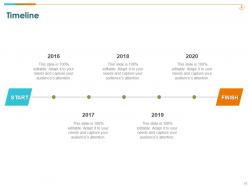
Slide 65: This is Timeline slide.
Slide 66: This is Venn slide.
Slide 67: This is Thank You slide with address, email address and contact number.
Total cost management powerpoint presentation slides with all 67 slides:
Our Total Cost Management Powerpoint Presentation Slides ensure you don't judge in a hurry. Deliberate deeply about every issue.



























FAQs for Total cost management
So TCM has four main parts: cost estimating, budgeting, cost control, and performance measurement. Get your initial estimates locked down first, then build realistic budgets that match what you're actually doing. Cost control is honestly where everything falls apart if you're not careful - I've seen so many projects crash here because nobody's watching the variances. Performance measurement connects the dots by comparing real costs to your baseline (earned value metrics are clutch for this). Oh, and don't make the mistake most people do - start tracking this stuff from day one, not when you're already bleeding money.
Here's what I'd do - get your finance people in those early strategy meetings so they can run different scenarios before you're locked into anything. Don't just tack on cost planning at the end. Set realistic cost targets that actually match where you want to go business-wise. During quarterly reviews, focus on metrics that matter (seriously, most companies drown in pointless data). The whole point is having a clear picture of what things will actually cost long-term before you commit. Otherwise you're just crossing your fingers and hoping it works out, which... yeah, that rarely goes well.
So value engineering is basically questioning every cost in your project - does this thing actually add value or are we just throwing money around? Map out your biggest expenses first. Then dig into alternatives and cut the fluff without hurting quality or function. Honestly, most projects have so much unnecessary stuff it's ridiculous. You'll want to do this early when changes are still possible, not when you're already locked in. Think of it like editing a paper - you're trimming fat while keeping the good parts. The goal is same results, way less cash.
Honestly, TCO is way trickier than most people think. You've gotta track everything - purchase price, setup, training staff, ongoing maintenance, support calls, future upgrades, even disposal costs when you're done. The real pain is getting cost data from different departments who don't even realize they're spending money on your project. I'd start by mapping out your whole lifecycle first, then figure out what each phase actually costs. Use the same template everywhere or you'll get inconsistent data. Regular cost check-ins help too. Trust me, it's better to be obsessive upfront than get blindsided by hidden expenses later.
Honestly, the worst part is dealing with messy data and getting everyone on board. Finance tracks costs one way, but then procurement does something totally different - it's like they're speaking different languages. People hate change too, which you probably saw coming. Oh, and defining "total cost" is trickier than it sounds since every company's different. I'd say pick one small area first, maybe just one department or product category. Get some wins there to prove it works, then slowly expand. Way less headache that route.
So TCM basically flips procurement on its head - you're not just chasing the lowest sticker price anymore. Instead you're looking at what something actually costs over its whole life. Maintenance, energy bills, training your team, even disposal costs down the road. Honestly changed how I think about buying anything for work. Your decisions get way more strategic when you're thinking years ahead instead of just this quarter's budget. Pro tip: always make vendors break down total costs, not just that shiny unit price they lead with.
So technology basically gives you this crazy real-time view of costs everywhere in your operation. AI spots patterns you'd never see manually - honestly, it's pretty wild what it catches. Routine tracking gets automated, which saves you tons of time. Plus you get predictive stuff about where expenses are going. Cloud platforms pull data from different departments without the usual headache. Your field teams can access cost data instantly through mobile apps too. Just make sure whatever tools you pick actually work together - learned that one the hard way. Otherwise you're just creating more disconnected data to deal with.
Start with workshops that mix people from different departments - procurement, ops, finance, sales. Show them how their choices affect costs everywhere, not just their own budgets. Make it hands-on with real company numbers, none of that PowerPoint torture we all hate. Let teams dig into actual scenarios and find hidden costs they missed before. Honestly, people get way more engaged when they're solving real problems instead of sitting through another boring presentation. Set up regular coaching after and find some internal champions to keep pushing the mindset. Give them tools so they can see the bigger financial picture.
So for tracking TCM success, you'll definitely want financial stuff - cost reductions, ROI on projects, unit cost changes. That's the obvious part. But honestly? The operational metrics tell you way more about what's actually working. Process cycle times, quality scores, how engaged your team is with cost initiatives. Oh and don't forget supplier performance - that one's sneaky important. Customer satisfaction matters too since you don't want to cut costs just to piss off clients. Pick maybe 4-5 metrics that match your goals and stick with them. Trust me, tracking everything just creates noise.
So TCM basically makes you look at the real cost of stuff - not just what you pay upfront, but all the hidden expenses down the line. Energy usage, waste disposal, how long things actually last. That "cheap" supplier suddenly doesn't seem like such a bargain when they're wasting tons of resources, you know? Your company starts picking materials and vendors based on the whole lifecycle instead of just the initial price tag. Honestly, try mapping out the complete cost chain for just one major process first. You'll probably find some eye-opening stuff you never considered before.
Oh dude, you should totally get your departments talking to each other about money stuff. Those silos are where cash just disappears into thin air. Have procurement share what they know about vendors with ops, and get finance to actually give people budget updates in real time instead of those awful month-end "surprise, you're over budget" moments. You wouldn't believe how much duplicate spending happens when teams don't communicate. The best part? People actually want to cut costs when they help make the plan themselves rather than having cuts shoved down their throats. Try monthly cross-department meetings - even 30 minutes works. Trust me on this one.
Look, benchmarking basically gives you that outside view to see how your costs stack up against everyone else in your industry. You'll spot which processes are totally draining your budget and find opportunities you probably missed. It's honestly like a reality check for your spending - sometimes brutal but necessary. Just make sure you're comparing similar companies though, not some tiny startup against a Fortune 500. Pick 2-3 areas where costs feel off, grab some solid benchmark data, then set targets that actually make sense. Way better than guessing what "good" looks like.
Okay so risk management is like having a crystal ball for your budget - you're spotting trouble before it hits. Use risk registers and probability stuff to map out what could tank your costs. Honestly, most people skip this step and regret it later. Build those risks right into your budget models upfront with some contingency cash. When things inevitably go sideways (they always do), you'll actually be ready instead of scrambling. It's way better than just tracking expenses after the fact. Try doing a quick risk check on your next project's biggest money drains.
Stop cutting costs everywhere - that's amateur hour. Figure out what your customers actually value most first. Maybe they don't care about fancy packaging but go crazy for fast shipping, you know? Pour money into those things that set you apart. Everything else? Cut it to the bone. I've watched companies gut their customer service teams thinking they're being smart, then wonder why sales tank six months later. Track your cost savings AND customer happiness at the same time. If customers start complaining, you've probably gone too far.
Okay so Toyota's probably your best bet - their lean manufacturing thing is pretty much the blueprint for TCM. Basically they cut waste everywhere, not just the obvious stuff. Boeing did something similar with the 787 (even though that project was kinda messy at first lol). They used TCM to fix their supplier mess and dropped lifecycle costs by around 20%. Apple's worth looking at too since they bake TCM into design decisions super early. That's honestly the biggest thing - don't wait until you're already manufacturing to start thinking about total costs.
No Reviews