


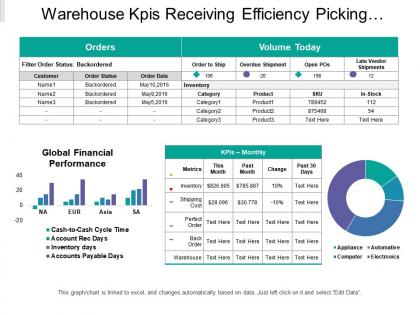
Warehouse kpis receiving efficiency picking accuracy backorder rate inventory




Try Before you Buy Download Free Sample Product
 Impress Your
 Audience
 100%
100% Editable
 Save Hours
 of Time


Advocate adherence to healthy diets with our Warehouse Kpis Receiving Efficiency Picking Accuracy Backorder Rate Inventory. It will help hold off illnesses.
People who downloaded this PowerPoint presentation also viewed the following :
Warehouse kpis receiving efficiency picking accuracy backorder rate inventory with all 5 slides:
Give it to them first hand with our Warehouse Kpis Receiving Efficiency Picking Accuracy Backorder Rate Inventory. Avoid distortions created by go betweens.




FAQs for Warehouse kpis receiving efficiency picking accuracy
Track your inventory turnover rate, order accuracy, and pick/pack times first. Warehouse capacity utilization too. Honestly, there's like 50 different metrics you could get lost in, but these are your money makers. Cost per shipment and employee productivity - those matter big time since labor eats up most of your budget anyway (we're talking 60-70%). I'd benchmark where you're at with these basics first. You can always add the fancy stuff later once you've got a handle on the fundamentals. Short sentences work better for this kind of thing.
Dude, automation is a game-changer for warehouses. You'll see huge speed boosts with things like robotic picking arms and automated sorting - way faster than doing everything by hand. The error rates drop like crazy too. RFID scanners give you real-time tracking of everything, which is honestly pretty cool to watch in action. Labor costs go down enough that most places break even in 2-3 years. My advice? Don't go all-in right away though. Pick your biggest time-waster process and automate that first. Build momentum from there.
Honestly, training makes a huge difference - I've watched places cut their screw-ups in half just from doing it right. Your team moves way faster when they actually know what they're doing with equipment and safety stuff. The cool thing is trained workers spot problems you might miss and come up with solid fixes since they get how everything flows together. People work better when they're not second-guessing themselves constantly. Oh and confident employees definitely take more pride in getting things right. Start with whatever's driving you crazy right now and build training around those specific headaches first.
Dude, a WMS will totally save your sanity. No more hunting around for missing pallets - you get real-time tracking of everything. The system optimizes your picking routes too, so workers aren't walking marathons all day. Barcode scanning cuts way down on shipping mistakes, which keeps customers happy. Oh, and the labor reports? Super helpful for seeing who's crushing it and who might need some extra training. Most places see payback within a year, which isn't bad. I'd map out your biggest headaches first though - makes implementation way smoother.
Look at your picking data and see where your fastest-moving stuff is sitting. Half the time it's buried in some random corner while slow movers are taking up prime real estate. Move your high-volume items close to packing - even shifting a few key SKUs can cut your travel time big time. Group related products together too, that's huge for efficiency. I swear this is such low-hanging fruit but warehouses miss it constantly. Map out what you're actually picking versus your current layout. You'll probably spot some obvious wins right away that don't cost much to fix.
Honestly, start with rearranging your warehouse layout - that's the biggest bang for your buck without spending anything. Put your fast-moving stuff close to packing stations. Batch picking is a game changer too, where one person grabs items for multiple orders in a single trip instead of wandering around like crazy. Zone picking works well - assign each picker to their own area so they're not bumping into each other. Those fancy pick-to-light systems are pretty sweet but yeah, management hates the upfront cost. Oh, and train people on smart picking routes. I know it sounds basic but you'd be surprised how much time gets wasted on inefficient paths.
So basically, fast inventory turnover makes your warehouse way more efficient. Items flying off the shelves means less storage space needed and lower handling costs. Plus your cash flow improves since money isn't tied up in stuff just sitting there collecting dust. Workers get super familiar with popular items, which speeds up picking. Oh and track turnover by category - focus your layout optimization on the fastest movers first. Makes a huge difference honestly. You'll see results pretty quick once you reorganize around what's actually selling.
So you've got a few solid options here. RFID tags are honestly the best if you can swing the upfront cost - everything gets tracked automatically without anyone having to scan stuff. Way less room for human error. Barcode systems are cheaper though, and they work great as long as your team actually remembers to scan things consistently (which... yeah, good luck with that sometimes). There's also IoT sensors that update everything in real-time, plus some warehouses are trying beacon tech now. I'd figure out what's driving you crazy first, then test out a couple systems to see what actually works for your setup.
So cross-docking is basically skipping the whole warehouse storage thing - stuff comes in one door and goes right out the other. Instead of receive, store, pick, pack, you're just doing receive, sort, ship. Way faster. Your team isn't wandering around a massive warehouse hunting for products, and you need way less space overall. Honestly, it's like the express lane of logistics. Labor costs drop since there's less handling involved. Start with your fastest-moving products first - they're the obvious choice. Your inventory turns over quicker and you'll see the benefits pretty fast.
Oh man, the worst thing you can do is try fixing everything at once - total disaster waiting to happen. Your warehouse crew should be in on the planning from day one since they actually know where stuff breaks down. I made the mistake of throwing tech at problems without figuring out what was really wrong first (expensive lesson there). People also get obsessed with the wrong numbers or completely ignore how crazy things get during busy seasons. Honestly? Pick one process that's driving everyone nuts and perfect that first. Then move on once you've got solid results.
Pull your WMS data and check pick times, travel distances, and inventory turnover by zone. Heat maps are great for spotting problem areas - you'll see patterns like certain aisles always slowing people down or specific products creating bottlenecks. Track error rates by shift too, that usually tells a story. Order fulfillment times by location will show you where things get stuck. Labor productivity varies way more than most people realize. Once you dig into the numbers, the inefficiencies jump out pretty fast. Start with whatever's eating up the most time first.
Look at where your customers are first - that's gonna tell you a lot. Nationwide spread? Centralized probably works better for keeping costs down and inventory manageable. But if you need quick delivery or you're hitting really different regional markets, decentralized makes way more sense. Transportation costs will eat you alive if you get this wrong - sometimes it's cheaper to pay for multiple warehouses than ship everything cross-country. Honestly though, most companies I know don't go full one-way-or-the-other anymore. Map your current shipping patterns first, then crunch numbers on both setups.
Dude, communication in warehouses is seriously underrated - can bump productivity up 20-25% without breaking a sweat. Your picking team won't sit around waiting on receiving anymore. Shipping actually knows which orders matter. I swear, some places I've been to are just pure madness because departments never talk. Daily 10-minute huddles between leads? Total game changer. Problems get solved faster. Handoffs between shifts don't suck. Way fewer expensive screwups too. Honestly think most managers overlook this because it seems too simple, but it works.
LED lights are a no-brainer - they'll save you tons on electricity. Same with getting your HVAC tuned up properly. Solar's actually pretty cheap now if your roof can handle it. Honestly, the electric forklifts are way quieter than those propane monsters too. Go paperless where you can and set up some decent recycling stations. Oh, and check out the biodegradable packaging options - they're not as expensive as they used to be. Get an energy audit done first though. That'll show you exactly where you're hemorrhaging cash so you know what to fix.
Look, I get why it seems backwards, but you gotta bake safety right into your processes from day one. Don't just slap it on later. Here's the thing - accidents actually kill productivity way more than safety measures do. You're looking at downtime, paperwork, retraining... it's a mess. Better lighting cuts down on mistakes AND helps people work faster. Clear walkways mean less stumbling around. Even proper lifting techniques - yeah, they prevent injuries, but they're also just more efficient ways to move stuff. Map out what you're doing now and find spots where safety actually makes things smoother.
-
Very unique, user-friendly presentation interface.
-
Very unique, user-friendly presentation interface.