


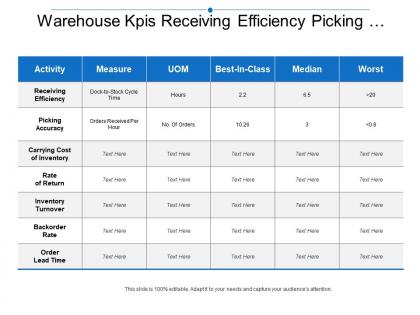
Warehouse kpis receiving efficiency picking accuracy carrying inventory




Try Before you Buy Download Free Sample Product
 Impress Your
 Audience
 100%
100% Editable
 Save Hours
 of Time


Conquer your inhibitions with our Warehouse Kpis Receiving Efficiency Picking Accuracy Carrying Inventory. Acquire the advantage of free flowing expression.
People who downloaded this PowerPoint presentation also viewed the following :
Warehouse kpis receiving efficiency picking accuracy carrying inventory with all 5 slides:
Folks freely express genuine appreciation due to our Warehouse Kpis Receiving Efficiency Picking Accuracy Carrying Inventory. They are bound to give you credit.




FAQs for Warehouse kpis receiving efficiency picking
Order accuracy and pick rates are your bread and butter - track those religiously. Inventory turnover shows if you're moving product efficiently or just hoarding expensive dust. Order cycle time matters big time when customers expect everything yesterday. Dock door utilization is weirdly overlooked but can drain your budget fast. Receiving accuracy is just as critical as shipping - mess up there and everything downstream goes sideways. Honestly, pick whichever one's causing you the most headaches right now and hammer that first. Don't try fixing everything at once or you'll just stress yourself out.
Just divide cost of goods sold by your average inventory value - higher numbers are better since you're moving stuff faster. I'd track it monthly and break it down by product categories too. Most places I've worked at honestly sucked at this because they'd hang onto slow-moving crap forever. ABC analysis helps a ton - focus on your fast movers first. Set up automatic reorder points based on actual demand patterns. Oh, and definitely review dead stock every quarter. Either discount it heavy or donate it for the tax write-off. Sitting inventory just eats your cash flow.
Dude, order accuracy is huge for your warehouse - it's how often you ship the right stuff without screwing up. When it drops, you're dealing with pissed off customers and returns galore. Plus you end up doing everything twice, which costs a fortune. Your satisfaction scores tank too, and honestly, explaining that to management sucks. Even dropping 1-2% can mess up your whole operation. I'd track it every day and set up checks during picking and packing. Way easier to catch mistakes early than deal with the aftermath later.
Just take your total warehouse costs and divide by orders shipped. So $50k in costs ÷ 2,000 orders = $25 per order. This number matters way more than people think - it'll show you if you're actually making money or just spinning your wheels. I always tell people to track it monthly because you'll catch trends early. Breaking it down by order size is pretty eye-opening too. Like, you might discover those tiny orders are killing your profits while the big ones basically pay for themselves. It's honestly one of those metrics that separates successful operations from the ones that struggle.
Start with tracking how much your pickers walk per order and their route completion times. Pick density matters too - items per hour should go up with better layout. I'd also watch order cycle times from receipt to shipping. Walking distance is honestly where most places lose tons of time without even knowing it. Check your space utilization rates and spot congestion areas where people get stuck. Oh, and make sure you measure everything now before changing anything - you need that baseline. If the layout's actually working, pick rates improve and fulfillment gets faster. Pretty straightforward stuff but easy to overlook.
Track your lead time from when orders come in until they ship out - that's where you'll spot the real bottlenecks. Most warehouses lose time on picking routes, where inventory sits, and being understaffed during busy periods. Moving your bestsellers closer to packing stations is honestly a game-changer - some places cut their lead time by 30% doing just that. Different products take different amounts of time, so measure each category separately. Map out your whole process first and time every single step. You'll be surprised where the delays actually happen versus where you think they are.
Look, productivity metrics are basically what make or break your warehouse operations. Pick rates, pack times, accuracy - when these are solid, everything else falls into place. Your throughput goes up, labor costs come down, customers are happy. Makes sense, right? But here's what I've learned the hard way - don't just focus on individual numbers. Sometimes what looks like a person problem is actually your process being screwed up. I'd start with whatever's causing you the biggest headaches right now, then figure out which metrics tie back to those issues. Way easier than trying to track everything at once.
Honestly, tech makes a huge difference with warehouse metrics. Start with a good WMS - it'll clean up your inventory accuracy big time. Barcode scanning cuts down picking mistakes, and automated sorting speeds everything up. IoT sensors are where it gets interesting though - they'll actually predict when equipment's about to crap out, which saves you from those nightmare downtime situations. Analytics dashboards let you see bottlenecks as they happen instead of finding out too late. Don't go crazy and install everything at once though, that's just asking for headaches. Pick one system and build from there.
Track two things: order accuracy (% of shipments correct) and line-item accuracy for individual products. Daily audits work best - randomly check 5-10% of what goes out the door against original orders. Most places aim for 99.5% but honestly? Even 99% feels rough with high volume. I'd categorize errors too - wrong item, wrong quantity, missing stuff. Makes patterns way easier to spot. Oh, and get your team logging customer-reported errors right away. Real-time visibility is clutch for catching problems before they blow up.
Dude, safety incidents absolutely wreck your warehouse numbers. You lose worker hours obviously, but then investigations slow everything down and mandatory retraining pulls more people off the floor. Workers comp claims are expensive as hell, plus you're paying overtime to catch up and hiring temps who mess up accuracy rates. Honestly the stress factor alone makes everyone perform worse. I've seen one bad incident trigger a domino effect where like three different metrics tank simultaneously. You should definitely track incident rates with your other KPIs - they're usually connected when stuff starts going sideways.
Dude, you really need to track space utilization - it's straight cash being thrown away otherwise. Measure your cubic footage usage and slot occupancy rates. I've literally seen warehouses thinking they're maxed out when they're only hitting 60% capacity! Wild, right? Track vertical space efficiency too since most places totally ignore going up. These numbers help you fix your layout and figure out if you actually need more space or just better organization. Honestly, just start by measuring what you're using now. You'll probably be shocked at how much room you're wasting.
Honestly, start with your picking routes and warehouse layout - that's where you'll see the biggest wins. Put your fast-moving stuff closer to packing stations. Zone picking works way better than having people walk all over the place (seriously, those extra steps kill you). Batch similar orders together too. Time everything first so you know your baseline. Then go after the worst time wasters. Oh and if you can swing it, a good WMS will automatically create better pick paths for you. But yeah, focus on the layout stuff first - it's usually the low-hanging fruit.
Start with the big three: energy per unit moved, waste rates, and carbon footprint per shipment. Then add packaging waste reduction, water usage, and recycling rates. The energy numbers will probably blow your mind at first - they did mine! Once you've got baseline data, set some realistic targets. Oh, and measure this stuff monthly with your other metrics, otherwise you'll just forget about it. Making sustainability part of regular performance reviews is honestly the only way it sticks. Can't just be an afterthought.
Honestly, start with the basics - order accuracy, on-time delivery, and how much stuff gets damaged in transit. Those numbers tell you a lot right away. Customer complaints are obvious too (though hopefully rare!). I'd also look at cycle times and return rates. But here's the thing - you really need to ask customers directly what they think. Send short surveys about delivery speed and product condition. The magic happens when you compare those satisfaction scores to your warehouse metrics. That's how you figure out what actually makes customers happy vs. what you think does.
Honestly, the hardest part is not getting distracted by vanity metrics that look cool but don't actually help. Everyone wants to track EVERYTHING - total nightmare for decision-making. I'd stick with maybe 3-5 KPIs max that your team can actually control and that tie back to real business outcomes. Start backwards: what does "winning" look like for your warehouse? Then figure out which numbers predict that success. Don't pick metrics your people can't influence though, that's just setting everyone up to be frustrated. Been down that road before and it sucks.
-
Great quality slides in rapid time.
-
Presentation Design is very nice, good work with the content as well.