

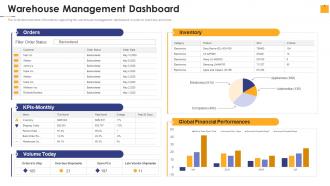
Warehouse Management Inventory Control Warehouse Management Dashboard





Try Before you Buy Download Free Sample Product
 Impress Your
Audience
 100%
Editable
 Save Hours
of Time


The slide demonstrates information regarding the warehouse management dashboard in order to track key activities.
People who downloaded this PowerPoint presentation also viewed the following :
Warehouse Management Inventory Control Warehouse Management Dashboard with all 7 slides:
Use our Warehouse Management Inventory Control Warehouse Management Dashboard to effectively help you save your valuable time. They are readymade to fit into any presentation structure.






FAQs for Warehouse Management Inventory Control
Honestly, start with the basics - inventory accuracy and order fulfillment time are your bread and butter. Picking accuracy matters too because wrong orders = angry customers calling you at 6am (learned that one the hard way). Warehouse capacity utilization tells you if you're actually using your space well. Labor productivity and shipping accuracy will save you so many headaches later. Management always wants to know cost per shipment, so track that too. Don't try measuring everything at once though - you'll go crazy. Pick 3-4 KPIs first, focus on what's easiest to track, then build from there.
So here's the thing - warehouse tech is a total game changer if you do it right. Robots absolutely crush humans at picking and packing speed, plus they don't make those dumb mistakes we all do when we're tired. Your space gets used way better with automated storage too. Yeah, the upfront costs suck, but honestly? The payback is pretty solid. Order accuracy goes through the roof, deliveries get faster, and labor costs drop. Your people can actually do interesting work instead of mind-numbing repetitive stuff. I'd say pick one process to automate first, see how it goes.
Look, inventory control is honestly what makes or breaks your whole warehouse setup. Without it, you're flying blind on stock levels and your picking accuracy goes to hell. Good control helps you lay out storage smartly, catch trends early, and avoid those panic moments when you suddenly realize you're out of bestsellers. Seasonal stuff becomes way easier to manage too. I'd start with cycle counts if you haven't already - gives you real visibility into what's actually on your shelves versus what the system thinks. Trust me, the numbers rarely match up perfectly at first, but that's totally normal.
Focus on flow efficiency first - put your fastest items near shipping and group similar stuff together. Your zones should make sense: receiving → storage → picking → shipping. Don't create a maze! Walk the current routes with your team to find bottlenecks you'd never notice from your office. Wide aisles are crucial for equipment, and honestly, most people underuse vertical space for high-volume items. The floor walk is huge - your team knows where things get messy way better than any layout software will tell you.
Honestly, start planning like 4-6 months out - way earlier than feels normal. Dig into your last 2-3 years of sales data to spot those demand spikes, then work backwards from there to figure out reorder points. My first Black Friday was a complete disaster because I didn't do this prep work. Find suppliers who aren't total jerks about scaling up fast when things get crazy. You'll also want backup plans for both scenarios - selling way more than expected or sitting on dead inventory. Oh, and temporary storage or drop-shipping can be lifesavers during peak season. Building those supplier relationships early makes all the difference.
Honestly, start with fixing your layout - that's usually the biggest bang for your buck and doesn't cost much upfront. Cross-train your people so you're not stuck with super specialized roles (plus most folks actually enjoy picking up new skills). Better inventory management will stop you from sitting on too much stock. Automation's worth it in some spots, just don't go crazy. Oh, and definitely do predictive maintenance on your equipment - way cheaper than dealing with breakdowns when you're swamped. Consolidating shipments helps you negotiate better shipping rates too.
Training your warehouse crew is seriously worth it. Proper lifting techniques and equipment training cuts down on injuries big time - and nobody wants to deal with workers comp headaches. Your productivity goes up too since people actually know what they're doing instead of fumbling around. I've watched places fall apart from skip-the-training mentality, honestly it's painful to see. Don't just do it once though - make it regular. Figure out where your biggest problems are first (safety issues, workflow mess-ups, whatever) then train specifically for those things. Way more effective than generic stuff.
So a WMS gives you real-time tracking of where everything is and how much you've got. Your picking accuracy jumps to 99%+ which honestly makes a huge difference. The system optimizes storage and routes so workers aren't wandering around forever hunting for stuff. Labor costs drop because everything runs smoother. You also get way better forecasting data and can actually measure what matters. Oh, and storage space gets used way more efficiently too. I'd say start by figuring out what's driving you crazy right now - that'll help you choose the right system and know what ROI to track.
Dude, analytics basically gives you x-ray vision into your warehouse ops. You can catch bottlenecks before they screw you over and figure out the best picking routes. Plus it shows demand patterns - like which products fly off shelves and when you need extra hands scheduled. Honestly, the predictive stuff is clutch because you'll avoid those nightmare stockout situations while not drowning in inventory costs. Oh, and you can see exactly where your team's wasting time (which is always eye-opening). My advice? Start with just 3-4 metrics though. Don't go crazy trying to track everything right away.
Oh man, inventory allocation is gonna be your biggest headache. You're dealing with online orders that need to ship fast, but then retail wants bulk quantities. Your warehouse guys will hate switching between picking single items and then grabbing full cases - trust me on this one. Visibility becomes a mess real quick when you can't track what's promised to which channel. Different packaging, different shipping rules, different everything. Most places I've worked with totally bomb this at first. Get your inventory segments sorted out early and don't cheap out on a WMS that actually handles multi-channel stuff properly.
Yeah so reverse logistics is wild - basically everything flows backwards into your warehouse instead of just going out. Returns come in, stuff needs repairs, recycling, the whole mess. You can't just wing it either because returned products are super unpredictable, not like your normal inventory patterns. Set up separate areas for inspecting what's sellable vs total junk. Don't mix this with your regular outbound stuff or you'll hate life. Honestly the inspection part takes way longer than you'd think. Clear workflows are key though - otherwise it turns into complete chaos real quick.
Start with an energy audit - that's where you'll find the biggest wins for both costs and going green. LED lights and smart HVAC are no-brainers now. Solar panels? The payback is honestly wild these days, like way better than even 2 years ago. Layout optimization helps cut down transport emissions too. For packaging, ditch single-use stuff when you can and go recyclable. Electric forklifts are solid if your budget allows. Oh and more companies are tracking carbon footprint as an actual metric now. Energy efficiency really is the sweet spot though - saves money while helping the planet.
Honestly, your suppliers are probably your best untapped resource here. Get them to send advance shipping notices so you're not scrambling when trucks show up. Regular check-ins help you nail down delivery windows - trust me, surprise deliveries are the worst productivity killers. Work with them on standardized packaging too. They might have packaging ideas you haven't considered (some of these guys are surprisingly creative). This whole approach lets you prep your receiving areas ahead of time and actually schedule staff properly. Start with your biggest suppliers first - they'll make the biggest impact on your day-to-day chaos.
Dude, real-time tracking is like having eyes everywhere in your warehouse. You'll know exactly where stuff is and what's going down as it happens. Problems get caught before they turn into disasters - no more hunting around for missing pallets like it's some weird scavenger hunt. Your picking routes become way more efficient, you won't run out of stock randomly, and customers actually get accurate delivery times. Honestly, the productivity boost alone makes it worth it. Start with barcode scanning or RFID systems - that's what feeds you all the good data you need.
First figure out what rules actually hit your warehouse - OSHA stuff, EPA regs, plus whatever's specific to your industry. Do regular audits, both your own and outside ones to catch what you miss. Your staff will make or break this whole thing, so train them constantly. Document literally everything - training, incidents, maintenance records, all of it. I'd set up automated alerts for renewals and deadlines because that stuff always sneaks up on you. Make a compliance calendar and get someone to actually own it. Honestly, the paperwork is annoying but it'll save your butt later.
-
Excellent template with unique design.
-
Very unique and reliable designs.