


Working Of The Internet Of Things Iot Data Acquisition And Processing Iot Data Analytics




Try Before you Buy Download Free Sample Product
 Impress Your
 Audience
 100%
100% Editable
 Save Hours
 of Time


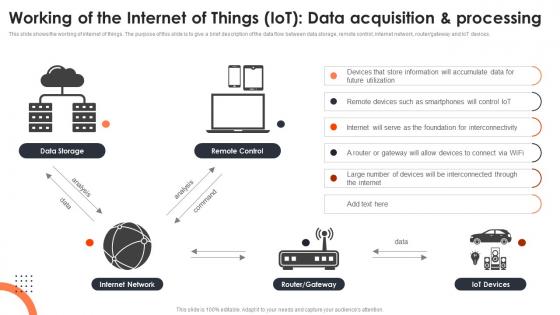
This slide shows the working of internet of things. The purpose of this slide is to give a brief description of the data flow between data storage, remote control, internet network, router or gateway and IoT devices.
People who downloaded this PowerPoint presentation also viewed the following :
Working Of The Internet Of Things Iot Data Acquisition And Processing Iot Data Analytics with all 6 slides:
Use our Working Of The Internet Of Things Iot Data Acquisition And Processing Iot Data Analytics to effectively help you save your valuable time. They are readymade to fit into any presentation structure.





FAQs for Working Of The Internet Of Things Iot Data Acquisition And Processing
Primary IoT ecosystem components include sensors and devices, connectivity networks, data processing platforms, cloud storage systems, and user applications. These technologies work together by collecting real-time data, transmitting information securely, and enabling automated responses, with many organizations finding that this integration streamlines operations and delivers enhanced monitoring capabilities across manufacturing, healthcare, and smart city infrastructures.
IoT devices communicate through various wireless protocols including Wi-Fi, Bluetooth, Zigbee, cellular networks, and Low Power Wide Area Networks (LPWAN), enabling seamless data exchange across connected ecosystems. These communication methods streamline operations by facilitating real-time monitoring, automated responses, and centralized control, with manufacturing plants and smart buildings finding that integrated IoT networks ultimately deliver enhanced operational efficiency and reduced maintenance costs.
IoT security challenges include weak authentication protocols, inadequate encryption, unpatched firmware vulnerabilities, insecure data transmission, and device identity management across networks. These risks can be mitigated through robust encryption standards, regular firmware updates, multi-factor authentication systems, and network segmentation, with many organizations finding that proactive security frameworks ultimately deliver enhanced operational resilience and customer trust.
Data from IoT devices is processed through cloud platforms, edge computing systems, and analytics engines that filter, aggregate, and interpret massive datasets in real-time. These systems enable manufacturers to predict equipment failures, retailers to optimize inventory management, and healthcare providers to monitor patient vitals continuously, ultimately delivering faster decision-making and operational efficiency.
Edge computing enhances IoT functionality by processing data closer to devices, reducing latency, minimizing bandwidth usage, and enabling real-time decision-making. Through localized processing, manufacturing plants achieve faster equipment monitoring, healthcare systems deliver immediate patient alerts, and retail stores optimize inventory management instantly, ultimately improving operational efficiency while reducing cloud dependency costs.
IoT transforms healthcare through remote patient monitoring and predictive diagnostics, revolutionizes agriculture with precision farming and automated irrigation systems, and enhances manufacturing via predictive maintenance and real-time production optimization. These connected technologies streamline operations, reduce costs, and improve decision-making across sectors, with many organizations finding that IoT integration delivers significant competitive advantages and operational efficiency gains.
Successful IoT implementations include smart city traffic management in Barcelona, predictive maintenance systems in manufacturing plants, connected healthcare devices monitoring patient vitals remotely, agricultural sensors optimizing crop yields, and retail inventory tracking systems. These deployments streamline operations, reduce costs, and enhance decision-making capabilities, with many organizations finding that IoT integration delivers measurable efficiency gains and competitive advantages across diverse sectors.
Regulations and standards significantly influence IoT development by establishing security protocols, data privacy requirements, interoperability frameworks, and safety compliance measures that manufacturers must integrate from design phase. While these requirements can extend development timelines and increase initial costs, they ultimately enable broader market adoption, enhance consumer trust, and create competitive advantages for compliant solutions across healthcare, automotive, and industrial sectors.
IoT devices face power consumption challenges including limited battery life, energy-intensive wireless transmission, frequent sensor data collection, processing overhead, and connectivity maintenance requirements. These constraints particularly impact remote deployments in agriculture, environmental monitoring, and smart city infrastructure, where battery replacement is costly and impractical, ultimately requiring strategic power management solutions to ensure scalable, long-term operational efficiency.
Interoperability between IoT devices is achieved through standardized communication protocols like MQTT, CoAP, and HTTP, unified data formats, API integration, and cloud-based platforms that serve as intermediaries. These approaches enable seamless device communication across manufacturers and networks, with many organizations finding that strategic protocol selection and middleware solutions ultimately deliver enhanced operational efficiency and scalable IoT ecosystems.
IoT significantly impacts data privacy through continuous data collection, cross-device tracking, limited user visibility into data practices, and complex consent management across interconnected devices. These challenges create opportunities for organizations to differentiate through transparent privacy frameworks, granular consent controls, and robust data governance, with many companies finding that proactive privacy measures ultimately enhance customer trust and competitive positioning.
AI integration with IoT enhances predictive maintenance by analyzing real-time sensor data, identifying patterns before failures occur, and automatically scheduling optimal maintenance windows. Manufacturing plants, power grids, and transportation fleets leverage this strategic combination to reduce unexpected downtime by up to 70%, minimize maintenance costs, and ultimately deliver seamless operations while gaining significant competitive advantage.
Large-scale IoT deployments present both environmental challenges and opportunities, including increased electronic waste, energy consumption from devices and data centers, raw material extraction, and carbon emissions from manufacturing. However, these systems ultimately deliver significant environmental benefits by optimizing resource usage, reducing energy waste, and enabling smart grid management, with many cities finding that IoT-driven efficiency gains substantially outweigh initial environmental costs.
Businesses leverage IoT for improved customer experience through personalized services, predictive maintenance, real-time monitoring, and seamless connectivity across touchpoints. Smart sensors enable retailers to optimize inventory, hotels to automate room preferences, and healthcare providers to monitor patients remotely, ultimately delivering faster response times, reduced downtime, and enhanced satisfaction.
Key trends shaping IoT evolution include edge computing, 5G connectivity, AI integration, enhanced security protocols, and sustainability initiatives. These advancements enable real-time processing, ultra-low latency communications, and predictive analytics, with manufacturing and healthcare sectors finding that enhanced automation and remote monitoring deliver significant operational efficiency and competitive advantage.
-
Extensive range of templates! Highly impressed with the quality of the designs.
-
The templates are the best in class. Very clear and innovative graphics! I am excited to explore and download more presentations.