


Build a minimum viable product powerpoint presentation slides
Introducing Build A Minimum Viable Product PowerPoint Presentation Slides to build, pivot and improve your product. This minimum viable product diagram complete deck can be employed to collect the maximum amount of the learning about the prospects with the least amount of effort involved. MVP has mainly 3 fundamentals: build, measure and learn. Discuss all of these in detail and develop strategies to improve your existing product. Furthermore, you can provide a detailed description of the core functionalities, benefits, steps of building an MVP in your organization, etc. with this visually appealing MVP development PowerPoint slideshow. Having a total of 21 editable templates, this build an MVP PowerPoint presentation can be used by any organization, no matter which field it belongs to. Gather actionable insights for your own product and help improve it rather than developing a new one with this minimum viable product complete deck. Therefore, without any extra thought download it now, to accelerate learning and build your brand very quickly.







-

- Google Slides is a new FREE Presentation software from Google.
- All our content is 100% compatible with Google Slides.
- Just download our designs, and upload them to Google Slides and they will work automatically.
- Amaze your audience with SlideTeam and Google Slides.
-

Want Changes to This PPT Slide? Check out our Presentation Design Services
-

- WideScreen Aspect ratio is becoming a very popular format. When you download this product, the downloaded ZIP will contain this product in both standard and widescreen format.
-

- Some older products that we have may only be in standard format, but they can easily be converted to widescreen.
- To do this, please open the SlideTeam product in Powerpoint, and go to
- Design ( On the top bar) -> Page Setup -> and select "On-screen Show (16:9)” in the drop down for "Slides Sized for".
- The slide or theme will change to widescreen, and all graphics will adjust automatically. You can similarly convert our content to any other desired screen aspect ratio.
Compatible With Google Slides

Get This In WideScreen
You must be logged in to download this presentation.


Do you want to remove this product from your favourites?
PowerPoint presentation slides
Presenting this set of slides with name - Build A Minimum Viable Product Powerpoint Presentation Slides. We bring to you to the point topic specific slides that are fully editable and customizable. Download in standard and widescreen sizes. Save in formats like PDF, PNG, and JPG. Adaptable to Google Slides making it easily accessible.

People who downloaded this PowerPoint presentation also viewed the following :
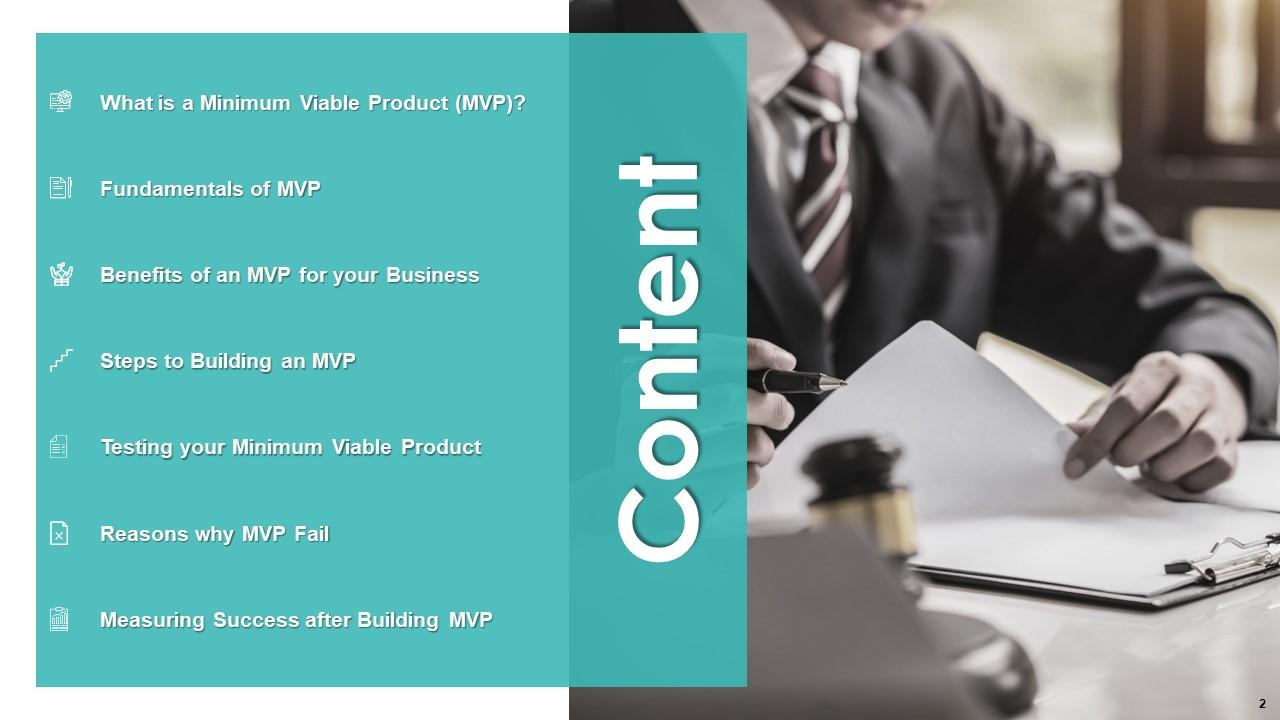
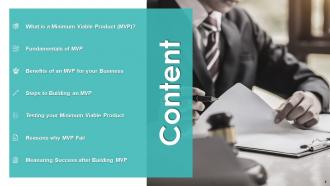
Content of this Powerpoint Presentation
A Minimum Viable Product (MVP) is a concept from Lean Startup that emphasizes gathering feedback from early adopters to launch a functional product to the market with the least effort and resources. Thus, the development team is directed to learn from real user interactions and iterate based on feedback.
To get the best templates to build an MVP Plan, click here!
With an MVP, you can take an initial step at a low risk for a business that you can test, refine, and grow step-by-step. This will help uncover the market’s interest in your product, so you will get an idea about where you need to make improvements, scale back, or add extra features to make the product saleable. To conduct the MVP procedure, it is of utmost importance to have a Minimum Viable Product (MVP) Development Timeline that outlines the steps and estimated timeframes for creating and launching a minimum viable product version.
Having an MVP in place can be one of the most challenging aspects of your business strategy. At SlideTeam, we have simplified this complicated process with our well-designed and innovative MVP PowerPoint presentation templates. These PPT Templates are 100% editable and customizable, serving as reference guides to ensure the best results.
Let’s check out each of these well-designed templates: -
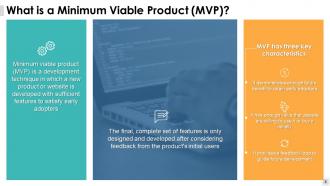
Template 1 - What is a Minimum Viable Product?
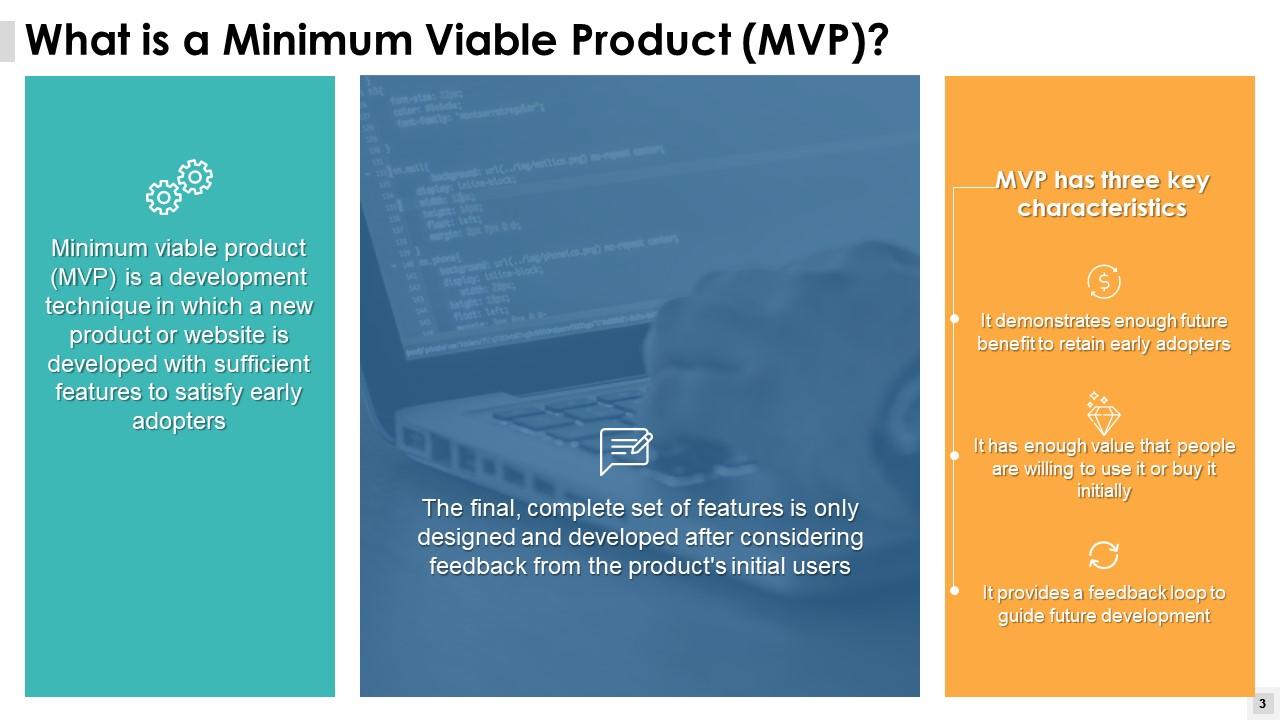
Before starting any discussion, it is essential to understand the core of the concept. This PPT Slide defines Minimum Viable Product.(MVP). As a concept, MVP is described as a development technique in which a new product or website is developed with sufficient features to satisfy early adopters. Here, you can also see MVP has three characteristics such as it demonstrates enough future benefits to retain early adopters, has enough value that people are willing to use or buy initially, and provides a feedback loop to guide future development.
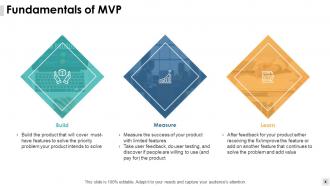
Template 2 – Fundamentals of MVP
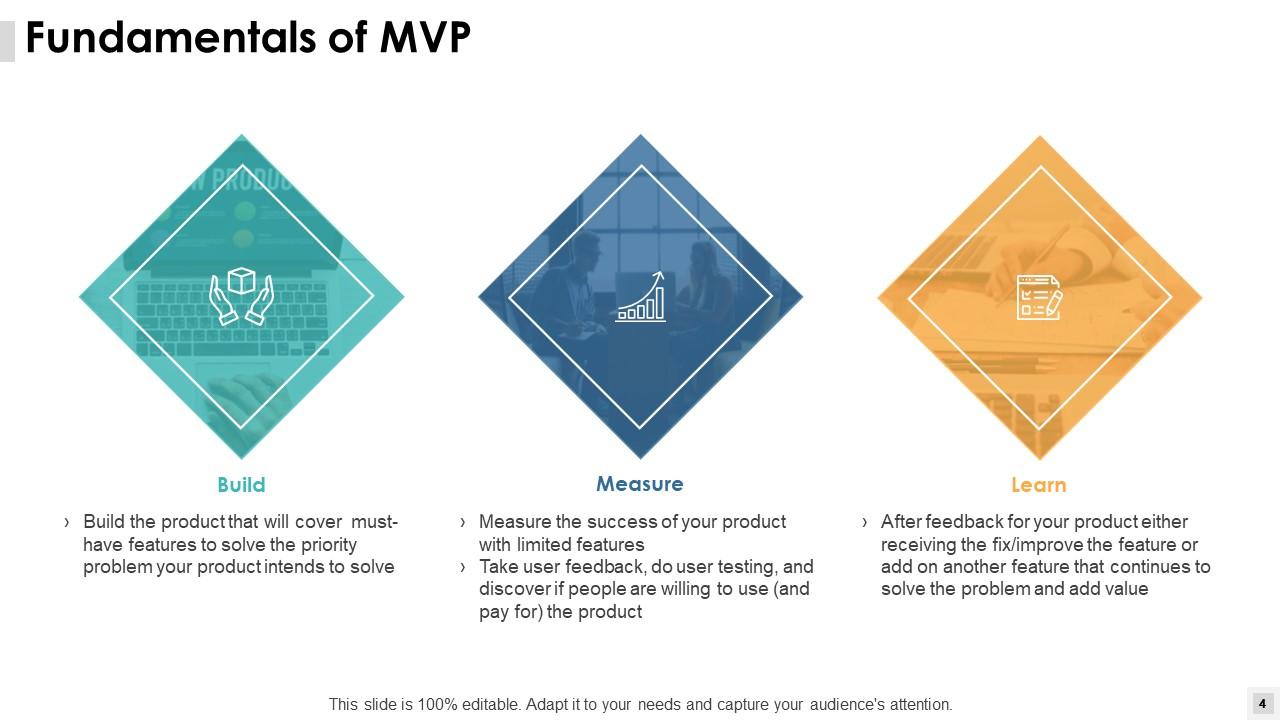
The explanation of the MVP should have a mention about the fundamentals of MVP. In this PPT Design, you can see three of them such as Build, Measure and Learn. Build the product step will cover must-have features to solve the priority problem your product intends to solve. Measure means to measure the success of your product with limited features. The last one is Learn which suggests that after feedback either receive the fix or improve the feature or add on another feature that continues to solve the problem and add value. Download this presentation slide to enhance knowledge regarding Minimal Viable Product.
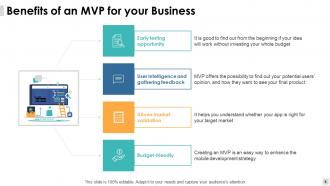
Template 3 - Benefits of an MVP for your Business
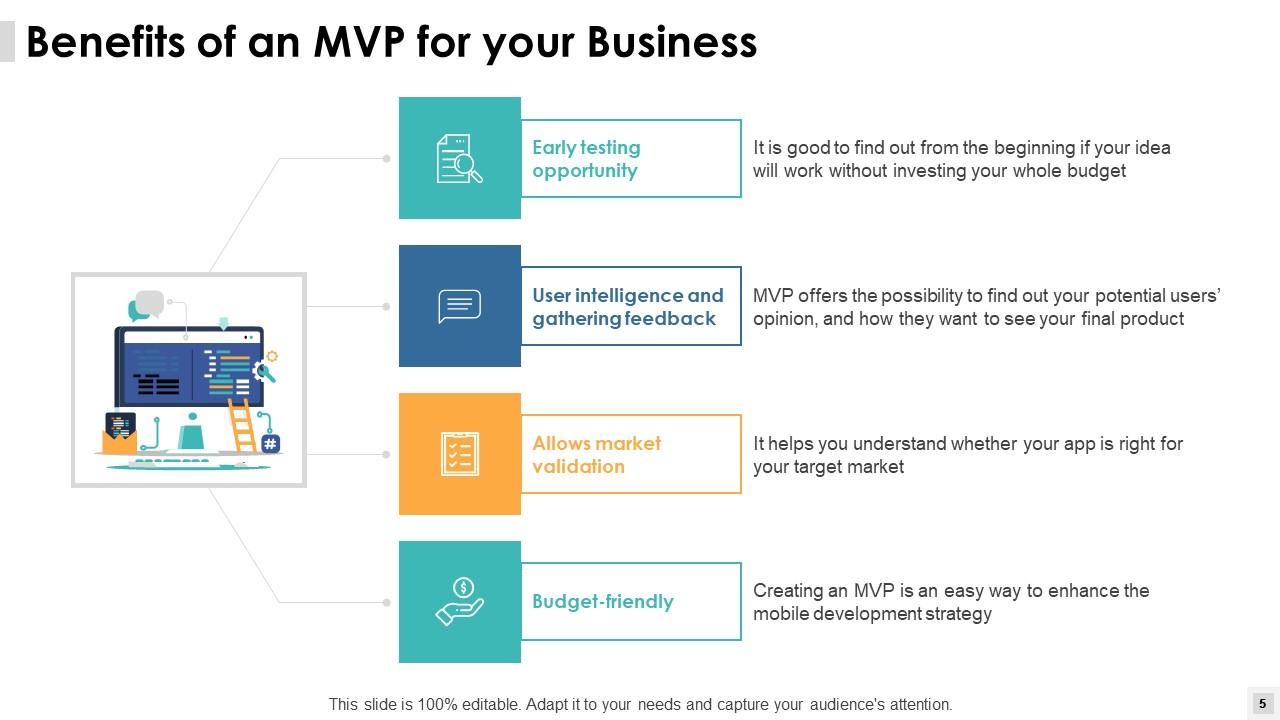
Every business strategy is aimed towards a particular objective that eventually leads to success of business. MVP also has various benefits as illustrated in this PPT Slide. For example, it offers early testing opportunities. It is good to find out right from the beginning whether your idea will work or not without investing your complete budget. MVP also provides the possibility to find out your potential users’ opinion and how they want to see your final product. Use this PPT Layout to showcase MVP’s benefits.
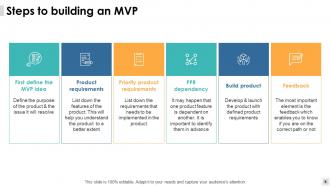
Template 4 – Steps to Building an MVP
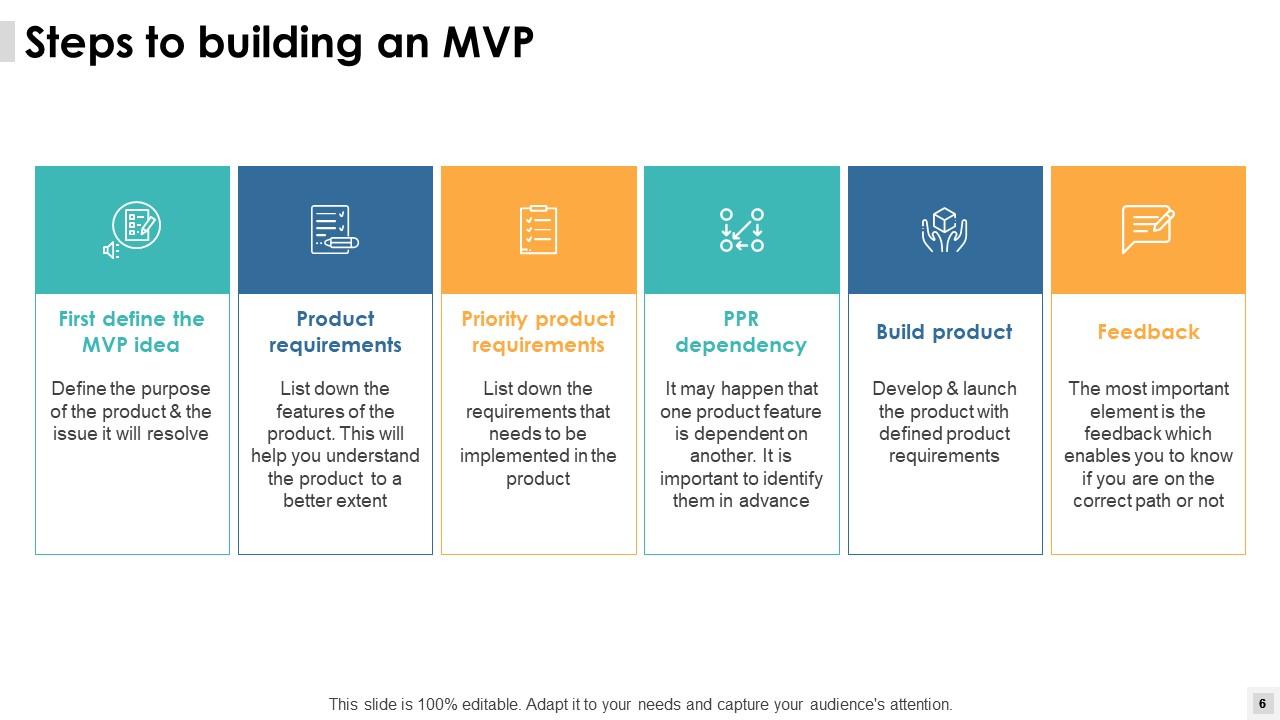
Building an MVP involves several key steps to ensure its success. Here, in this PPT Preset you can check out all the important steps. To begin with, define the purpose of the product and the issue it will resolve. Next step is listing down the features of your product to understand it to a better extent. After that, list down the requirements that need to be implemented in the product. Others include identifying the PPR Dependency, Build Product and Feedback. Get this presentation template to demonstrate the crucial steps to building an MVP!
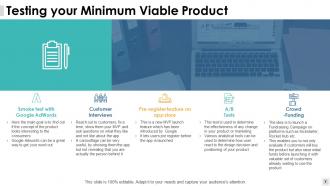
Template 5 – Testing Your Minimal Viable Product
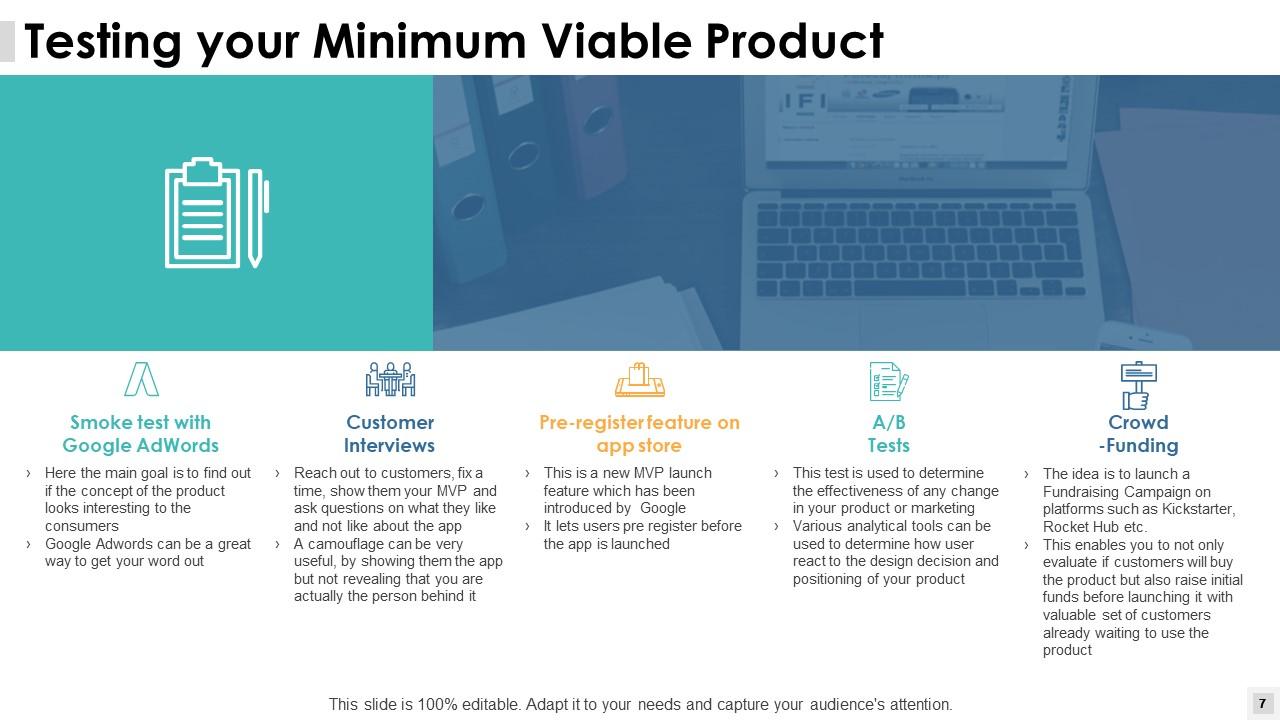
Testing your Minimum Viable Product (MVP) involves evaluating the core functionality of your product or service with real users with an objective to gather feedback and validate assumptions. In this PPT Layout, there is demonstration of the methodologies that go into testing. For instance, Smoke test with Google Adwords in which the main goal is to find out whether the concept of the product appears interesting to the consumers. Other ways are by conducting Customer Interviews which involves asking questions about their likes and dislikes of the product. Here, in this presentation template, you can also showcase the Pre-Register feature on the app store, A/B Tests and Crowd Funding, all of these help test your MVP.
Template 6 – Reasons why MVP Fail
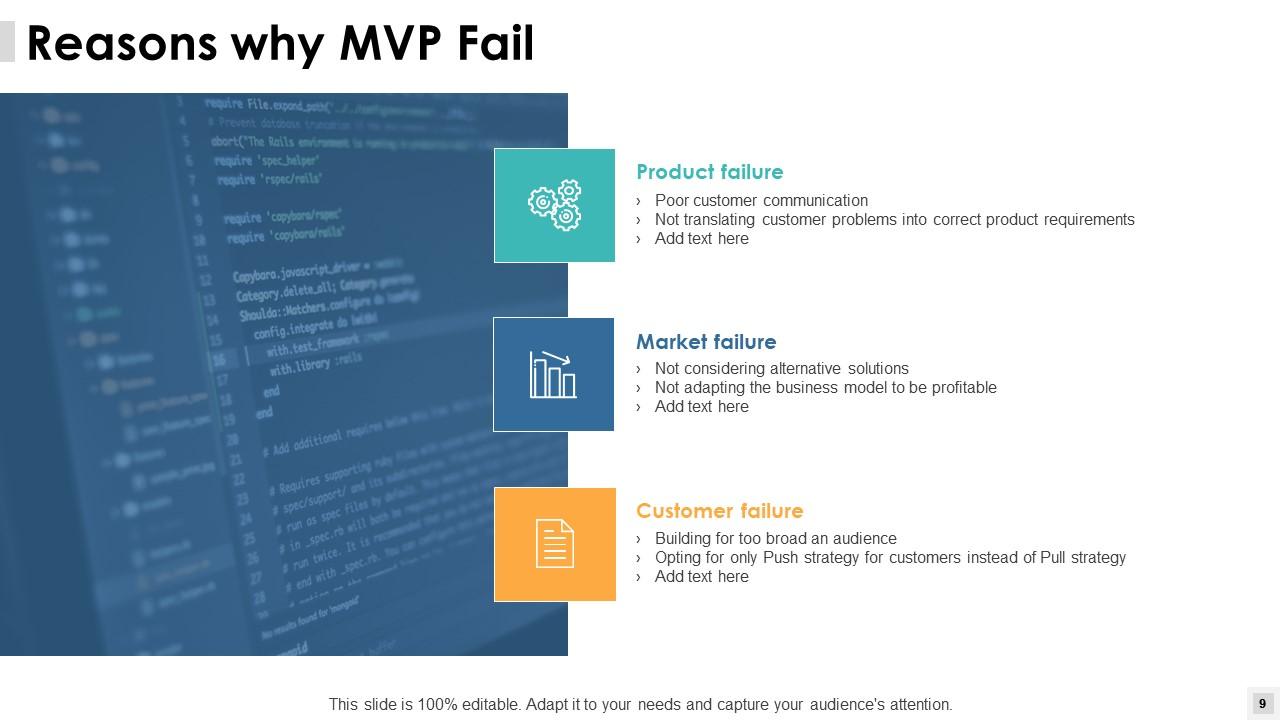
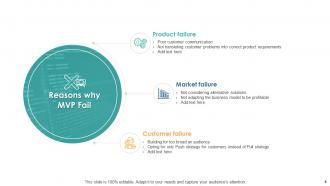
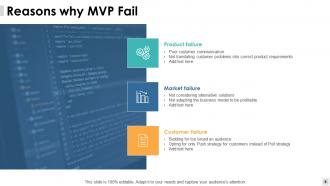
MVPs can fail for various reasons. Using the above PPT Framework, you can point out these causes for failure which are Product Failure. It can happen due to poor customer communication, not translating customer problems into correct product requirements, etc. Other reasons are Market Failure when there is lack of alternate solutions, business model is not designed for profit and Customer Failure when opting for inappropriate strategy.
Template 7 - Measuring Success after Building MVP
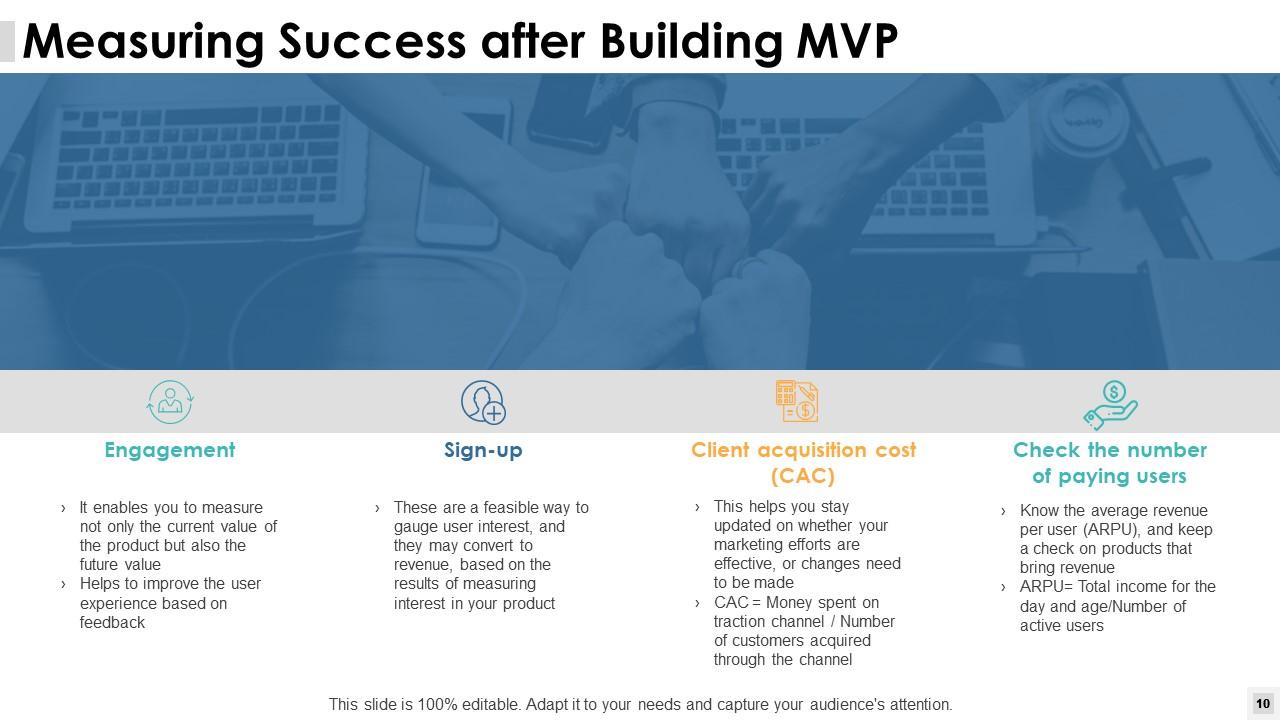
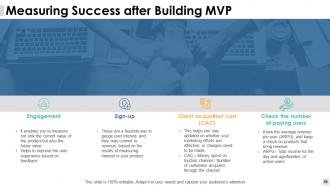
It is important to measure success after building an MVP. Doing so will help gain valuable insights to guide future development efforts and ensure the long-term success of the product. Measuring the success involves assessing several metrics to determine how well the product is meeting its goals and delivering value to users. These metrics are User Engagement which helps to find out how actively users are interacting with the product as listed in this presentation layout. Then there is Sign up. It is a feasible way to gauge user’s interest which may convert to revenue based on user’s engagement. Client Acquisition Cost (CAC) and checking the number of paying users are other essential metrics. Use this PPT Template to educate your target audience about MVP.
Template 8 – Measuring Success after Building MVP (Continued)

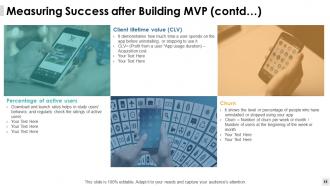
Measuring Success after Building MVP is a crucial step. Determining it using essential metrics also includes estimating the Percentage of active users, Client Lifetime Value(CLV) and Churn as depicted in this slide. Describe each of these metrics to elaborate the concept of MVP. Get the PPT Slide today!
Benefits of Building a Good MVP
Building an MVP allows companies to test their business ideas and product concepts. In addition, a successful MVP proves a product's viability and benefits and helps create a monetization strategy, save resources, and enable cost efficiency. Using this complete deck as a guide, you can easily navigate your MVP pursuits in the most rewarding way possible.
PS: Here is another educational PPT Presentation on Minimum Viable Products that will be useful.
Build a minimum viable product powerpoint presentation slides with all 21 slides:
Use our Build A Minimum Viable Product Powerpoint Presentation Slides to effectively help you save your valuable time. They are readymade to fit into any presentation structure.
-
Innovative and Colorful designs.
-
Commendable slides with attractive designs. Extremely pleased with the fact that they are easy to modify. Great work!
