

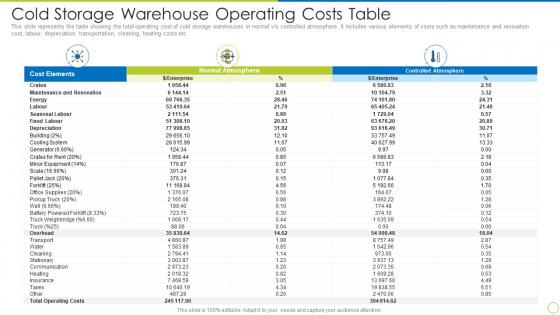
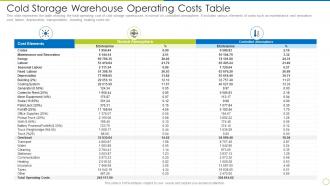
Cold Storage Warehouse Operating Costs Table




Try Before you Buy Download Free Sample Product
 Impress Your
 Audience
 100%
100% Editable
 Save Hours
 of Time


This slide represents the table showing the total operating cost of cold storage warehouses in normal vs controlled atmosphere. It includes various elements of costs such as maintenance and renovation cost, labour, depreciation, transportation, cleaning, heating costs etc.
People who downloaded this PowerPoint presentation also viewed the following :
Cold Storage Warehouse Operating Costs Table with all 6 slides:
Use our Cold Storage Warehouse Operating Costs Table to effectively help you save your valuable time. They are readymade to fit into any presentation structure.





FAQs for Cold Storage Warehouse
Key factors influencing cold storage warehouse operational costs include energy consumption for temperature control, specialized refrigeration equipment maintenance, insulation quality, facility size and layout efficiency, and labor requirements for temperature-controlled environments. These factors significantly impact profitability through electricity expenses, equipment upgrades, and skilled workforce needs, with many logistics companies finding that strategic investments in energy-efficient systems and automated handling ultimately deliver substantial cost reductions and competitive advantages.
Energy efficiency measures significantly reduce cold storage operating expenses by lowering electricity consumption, minimizing equipment wear, and reducing maintenance requirements through advanced insulation, LED lighting, and smart temperature controls. These improvements deliver substantial cost savings, with many warehousing companies finding that strategic energy investments enhance operational efficiency while ultimately providing competitive advantages in an increasingly cost-conscious logistics environment.
Common refrigeration systems in cold storage warehouses include ammonia-based systems, freon systems, CO2 cascade systems, glycol systems, and direct expansion units. These systems significantly affect operational costs through energy efficiency variations, maintenance requirements, and installation complexity, with ammonia systems typically offering lower operating costs but higher upfront investment, while many facilities find that CO2 systems deliver enhanced sustainability and long-term cost savings.
Cold storage warehouse location significantly impacts shipping and logistics expenses through proximity to suppliers and customers, transportation infrastructure access, and regional labor costs. Strategic placement near major distribution hubs or customer bases reduces last-mile delivery expenses and transportation time, while locations with robust rail and highway networks enable more cost-effective bulk shipments, ultimately delivering lower operational costs and improved supply chain efficiency.
Initial investment costs for cold storage warehouses include land acquisition, specialized insulation systems, refrigeration equipment, backup power systems, and temperature monitoring technology. These facilities require significantly higher capital investment than standard warehouses, with many developers finding that strategic location selection and energy-efficient designs ultimately deliver operational savings and competitive advantage in temperature-sensitive logistics markets.
Different temperature zones significantly impact operational costs through varying energy consumption, specialized equipment requirements, and maintenance demands, with frozen zones consuming 40-60% more energy than refrigerated zones. Multi-temperature facilities enable operational efficiency by consolidating diverse product storage, though they require strategic zone management and advanced monitoring systems, ultimately delivering cost optimization through improved inventory turnover and reduced product spoilage.
Technology significantly reduces cold storage warehouse costs through automated temperature controls, IoT sensors for real-time monitoring, energy-efficient refrigeration systems, and predictive maintenance tools. These innovations streamline operations by minimizing energy consumption, preventing costly product spoilage, and optimizing space utilization, with many food distributors and pharmaceutical companies finding that smart warehouse management ultimately delivers 20-30% operational cost reductions.
Labor costs in cold storage facilities typically run 15-25% higher than traditional warehousing due to specialized training requirements, protective equipment needs, harsh working conditions, and higher employee turnover rates. These facilities require workers trained in temperature-sensitive handling, safety protocols, and specialized equipment operation, with many cold storage operators finding that investing in comprehensive training programs and competitive compensation packages ultimately reduces turnover costs and enhances operational efficiency.
Hidden cold storage costs include energy fluctuations during peak demand periods, specialized maintenance for refrigeration systems, staff training for temperature-controlled environments, regulatory compliance audits, and product loss from temperature variations. These overlooked expenses can significantly impact operational budgets, with many food distributors and pharmaceutical companies finding that proactive monitoring systems and preventive maintenance strategies ultimately reduce total ownership costs while ensuring product integrity.
Effective inventory management significantly reduces cold storage warehouse costs by optimizing energy consumption, minimizing product spoilage, and streamlining space utilization through strategic rotation systems. Advanced tracking technologies enable facilities to maintain precise temperature zones, reduce handling time, and improve order accuracy, with many food distributors and pharmaceutical companies finding that automated inventory systems deliver 15-20% operational cost savings.
Cold storage warehouse leasing costs typically range from $8-15 per square foot annually, varying significantly based on temperature requirements, location, and facility specifications. These rates reflect the specialized infrastructure needed for refrigeration systems, insulation, and energy management, with many logistics companies finding that strategic cold storage partnerships ultimately deliver supply chain efficiency and reduced spoilage costs despite higher per-square-foot investments.
Industry-specific regulations significantly impact cold storage costs through mandatory temperature monitoring systems, specialized equipment requirements, and enhanced facility certifications across pharmaceutical, food, and biotechnology sectors. These compliance measures, while increasing operational expenses through energy consumption, staff training, and audit processes, ultimately deliver reduced liability risks, improved product quality, and competitive market positioning for regulated industries.
Third-party cold storage services offer reduced capital investment, access to specialized expertise, operational flexibility, and shared technology costs, while private facilities provide greater control and long-term cost predictability. Many food manufacturers and pharmaceutical companies find that third-party partnerships enable faster market expansion and risk mitigation, ultimately delivering scalable solutions without substantial infrastructure commitments.
Seasonal demand fluctuation presents both challenges and opportunities for cold storage warehouses, requiring strategic capacity planning, flexible staffing models, and diversified client portfolios across multiple industries. Many facilities enhance financial viability by serving agricultural producers during harvest seasons, pharmaceutical companies year-round, and holiday retailers during peak periods, ultimately delivering consistent revenue streams and operational efficiency.
Financing options for cold storage infrastructure include traditional bank loans, equipment financing, SBA loans, sale-leaseback arrangements, and specialized cold chain investment funds. These financing mechanisms enable businesses to spread capital costs while accelerating market entry, with many food distributors and pharmaceutical companies finding that strategic financing partnerships ultimately deliver faster expansion and improved cash flow management.
-
Excellent design and quick turnaround.
-
Definitely a time saver! Predesigned and easy-to-use templates just helped me put together an amazing presentation.