


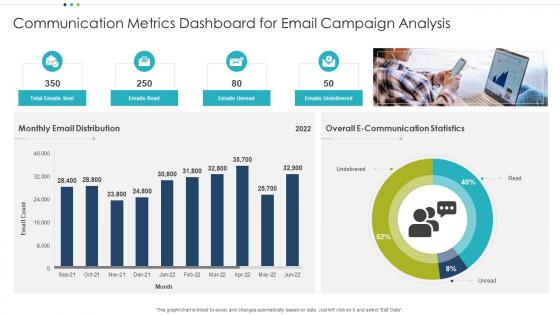
Communication Metrics Dashboard for Email Campaign Analysis




Try Before you Buy Download Free Sample Product
 Impress Your
 Audience
 100%
100% Editable
 Save Hours
 of Time


Our Communication Metrics Dashboard for Email Campaign Analysis are topically designed to provide an attractive backdrop to any subject. Use them to look like a presentation pro.
People who downloaded this PowerPoint presentation also viewed the following :
Communication Metrics Dashboard for Email Campaign Analysis with all 7 slides:
Use our Communication Metrics Dashboard for Email Campaign Analysis to effectively help you save your valuable time. They are readymade to fit into any presentation structure.






FAQs for Communication Metrics Dashboard for
Businesses should prioritize open rates, click-through rates, conversion rates, bounce rates, and unsubscribe rates when analyzing email campaigns. These metrics enhance marketing effectiveness by measuring engagement levels, delivery success, and revenue impact, with many organizations finding that tracking these indicators together delivers deeper customer insights and ultimately drives higher ROI through strategic campaign optimization.
A/B testing enhances email marketing effectiveness by comparing different versions of subject lines, content, send times, and call-to-action buttons to identify top-performing elements. Through systematic testing of these variables, businesses streamline their messaging, increase open rates, boost click-through rates, and improve conversions, with many organizations finding that data-driven optimization delivers significantly higher ROI and customer engagement.
Open rate serves as a foundational metric for measuring initial subscriber engagement, indicating how compelling your subject lines are and whether your emails reach active inboxes. While open rates provide valuable baseline insights, they work best when combined with click-through rates and conversion metrics, ultimately helping businesses optimize email timing, content relevance, and subscriber segmentation strategies.
Segmentation improves email analytics accuracy by dividing subscribers into distinct groups based on demographics, behavior, purchase history, and engagement patterns, enabling more precise measurement of campaign performance. This targeted approach allows marketers to identify specific trends within customer segments, optimize content for different audiences, and ultimately deliver higher open rates and conversion metrics across industries.
Email analytics tools best suited for tracking CTR include Mailchimp, Constant Contact, HubSpot, Campaign Monitor, and Sendinblue, each offering comprehensive click tracking capabilities. These platforms enhance marketing effectiveness by providing real-time analytics, heat mapping, and audience segmentation insights, with many organizations finding that detailed CTR analysis ultimately delivers improved campaign performance and higher conversion rates.
Analyzing bounce rates contributes to email health by identifying deliverability issues, maintaining sender reputation, and ensuring messages reach intended recipients effectively. High bounce rates signal problems with email lists, authentication settings, or content quality, with many marketing teams finding that monitoring these metrics enables proactive list cleaning, improved engagement rates, and ultimately stronger customer relationships across campaigns.
Analyzing unsubscribe rates reveals audience engagement patterns, content relevance issues, campaign frequency problems, segmentation effectiveness, and seasonal behavior trends. These insights enable marketers to refine targeting strategies, optimize send frequencies, and improve content personalization, with many organizations finding that strategic unsubscribe analysis ultimately reduces churn while enhancing overall campaign performance and subscriber satisfaction.
Time-of-day analysis significantly optimizes email delivery and engagement by identifying when recipients are most active and responsive, enabling strategic scheduling for maximum open rates and click-throughs. Through automated timing algorithms, organizations enhance campaign performance by 15-30%, with retail and financial services finding that personalized send times ultimately deliver higher conversions and improved customer interactions.
Integrating CRM data with email analytics delivers personalized targeting, comprehensive customer journey mapping, improved segmentation capabilities, enhanced lead scoring, and unified performance tracking across touchpoints. This strategic combination enables organizations to streamline marketing workflows, accelerate sales cycles, and deliver more relevant customer experiences, with many businesses finding that integrated approaches significantly boost conversion rates and revenue attribution accuracy.
Mobile vs. desktop metrics differ significantly in email performance analysis, with mobile typically showing higher open rates but lower click-through rates due to smaller screens and touch interactions. Desktop users demonstrate longer engagement times and higher conversion rates, while mobile users favor quick scanning and immediate actions, with many marketers finding that optimizing for both platforms through responsive design and device-specific content strategies ultimately delivers better overall campaign performance and broader audience reach.
Common email analytics pitfalls include focusing solely on open rates, ignoring segmentation analysis, neglecting mobile performance metrics, and failing to track long-term customer lifetime value. These oversights limit strategic insights, with many marketers finding that comprehensive analysis across deliverability, engagement patterns, and conversion attribution ultimately delivers more accurate campaign optimization and sustainable revenue growth.
Predictive analytics enhances email campaigns by forecasting subscriber behavior, identifying optimal send times, predicting content preferences, and anticipating unsubscribe risks through historical data analysis. These insights enable marketers to personalize messaging, improve segmentation strategies, and optimize timing across campaigns, with many organizations finding that predictive models increase engagement rates and reduce churn significantly.
GDPR and privacy regulations significantly limit email tracking capabilities, requiring explicit consent for cookies, restricting personal data collection, and mandating transparent opt-out mechanisms. While these regulations present compliance challenges, they also encourage businesses to focus on permission-based marketing and first-party data strategies, ultimately delivering stronger customer trust and more sustainable engagement models.
Heat maps enable businesses to visualize email engagement by tracking clicks, scrolls, and hover patterns, revealing which content areas, links, and call-to-action buttons generate the most interaction. This data helps organizations optimize email layouts, improve content placement, and enhance conversion rates, with many marketing teams finding that heat map insights significantly increase click-through rates and campaign effectiveness.
Best practices for maintaining a clean email list include regular list hygiene audits, implementing double opt-in processes, segmenting inactive subscribers, removing hard bounces immediately, and monitoring engagement metrics consistently. These strategies streamline deliverability by reducing spam complaints, improving sender reputation, and enhancing open rates, with many organizations finding that clean lists ultimately deliver higher conversion rates and better customer insights.
-
“I've always gotten excellent slides from them and the customer service is up to the mark.”
-
SlideTeam was so customer-centric and quick service-provider that I doubted the amount I was paying and literally re-checked the transaction.