


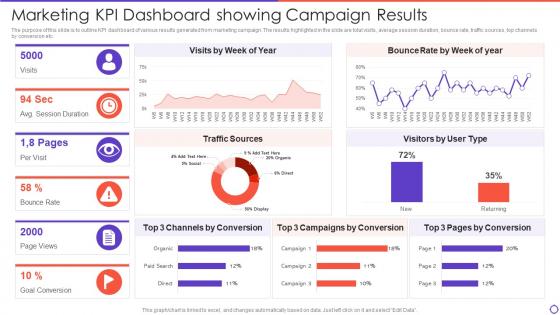
Marketing Kpi Dashboard Showing Campaign Results




Try Before you Buy Download Free Sample Product
 Impress Your
 Audience
 100%
100% Editable
 Save Hours
 of Time


The purpose of this slide is to outline KPI dashboard of various results generated from marketing campaign. The results highlighted in the slide are total visits, average session duration, bounce rate, traffic sources, top channels by conversion etc.
People who downloaded this PowerPoint presentation also viewed the following :
Marketing Kpi Dashboard Showing Campaign Results with all 7 slides:
Use our Marketing Kpi Dashboard Showing Campaign Results to effectively help you save your valuable time. They are readymade to fit into any presentation structure.





FAQs for Marketing Kpi Dashboard
Focus on conversion rate, CAC, and ROAS first - those actually tell you if you're making money. Click-through rates and cost per lead are solid too for seeing if your content hits right. I swear, so many people get obsessed with impressions and stuff that doesn't matter. Revenue-driving metrics should be your priority. Obviously depends if you're pushing brand awareness vs direct sales, but those core ones I mentioned? That's your starting point. From there you can tweak and optimize whatever's not working.
Honestly, start with what actually matters to your business - if you're trying to make money, track conversion rates and customer lifetime value instead of just Instagram followers. Sure, followers feel good but they don't pay rent! Pick maybe 3-5 metrics tops or you'll drown in spreadsheets. Also depends where you're at - new businesses probably care more about getting noticed while established ones should focus on keeping customers happy and selling them more stuff. I'd say check these every few months and don't be afraid to switch things up when your priorities change.
Honestly, conversion rates are everything for your marketing funnel. Better rates mean you're squeezing more value from every ad dollar - higher ROI, cheaper customer acquisition costs, the whole deal. Bad conversion rates though? You're just burning cash on visitors who bounce immediately (trust me, I've watched thousands disappear into the void). Here's the thing - they show you if your messaging actually resonates with people. Track them by channel so you know which campaigns are crushing it and which ones need work. Way better than guessing what's broken.
CAC and LTV are your best friends for figuring out what's actually working. Anything with a 3:1 ratio or better? Pour more money there. Below that and you're probably bleeding cash - trust me on this one. I'd calculate these for each channel first, then move like 20-30% of your budget toward the winners next quarter. Don't forget payback period though, cash flow can bite you if you're not careful. The underperforming channels aren't hopeless either - just need some tweaks before you write them off completely.
Think of website traffic like foot traffic at a store - shows how many people actually visit your site. Google Analytics is your best friend here (and it's free). Track your total visitors, page views, and where people are coming from so you know which marketing stuff actually works. Quality beats quantity though - honestly, I'd rather have 100 visitors who buy something than 1000 who bounce immediately. You could build the prettiest site ever, but if no one sees it... yeah, that's not gonna help your business. Focus on the visitors who stick around and engage with your content.
Honestly, don't get hung up on follower counts - they're pretty meaningless now. Instead, dig into what's actually working. Like if your videos get way more comments than photos, lean into that. I always tell people to check when their engagement spikes too. Maybe your audience is super active Tuesday mornings? Perfect time for announcements. The real gold is tracking saves and shares since that shows people actually find your stuff valuable. Oh and definitely do monthly check-ins - you'll spot trends you'd totally miss otherwise. Kill whatever isn't working and double down on what is.
Honestly, ROI is the one metric that'll actually save your ass in budget meetings. Take your marketing revenue, subtract what you spent, then divide by those costs - boom, you've got your answer. Other metrics are cool and all, but executives only care about one thing: did we make money or not? I track it religiously across every campaign now because it's literally the only way to prove marketing isn't just burning cash. Plus you can figure out which channels are worth doubling down on. Trust me, start measuring this consistently and you'll never have to justify your marketing spend again.
So retention rate is pretty straightforward - take your customers at period end, divide by customers at start, but subtract any new ones you picked up. Monthly or quarterly works best. Weekly tracking is kind of a waste honestly, creates way too much noise. Segment by customer type and where they came from - that's where you'll actually learn something useful. Your CRM should handle the math automatically. The real trick is tagging everything properly from the beginning, otherwise you're screwed trying to figure out who's who later. Oh, and start tracking it consistently before you even think about optimization.
Google Analytics is probably your best starting point - it's free and does the job. HubSpot's solid too if you want something more comprehensive. Honestly, Google Data Studio surprised me with how decent it is for basic dashboards. Mixpanel and Amplitude are where you go when you need the fancy customer behavior stuff. Klipfolio makes those pretty charts that look good in presentations (you know the ones). The main thing? Pick whatever plays nice with your current tools. I learned this the hard way - don't get stuck manually uploading CSV files every damn week. Start small with your must-have metrics, then build out.
So brand awareness is like "do people actually know who we are?" - stuff like brand recognition surveys, social mentions, that kind of thing. Performance KPIs are your hard numbers. Conversion rates, ROI, leads generated. Awareness feels squishy sometimes but it matters for the long game. Performance shows what's working right now. I always get annoyed when people only focus on one or the other. You really need both though - track awareness for those big brand campaigns and performance metrics when you're trying to drive direct results. Different tools for different goals.
You'll hit your CTR goals but totally miss that people actually hate your ads - that's the real danger here. Numbers don't tell you if customers are pissed off or if your brand looks sketchy. It's like when your Fitbit says you're healthy but you feel like garbage, you know? Past metrics can't predict what's coming next nearly as well as actually talking to people. Honestly, I've seen companies celebrate great conversion rates while their reputation was falling apart. Mix in some customer calls and sentiment tracking. Your dashboard needs the full picture, not just the pretty numbers.
Monthly reviews are the bare minimum, but I'm honestly checking my main metrics weekly. When I'm running new campaigns or testing stuff, I'll peek at those numbers every couple days - you kinda have to. The trick isn't just looking though, you've got to actually do something with what you see. Big picture stuff like CAC or lifetime value? I only dig deep into those quarterly since they don't move fast anyway. I'd say start monthly and ramp up how often you check the metrics that actually affect your spending decisions.
Definitely track sentiment from social media and customer surveys - that stuff matters more than people think. NPS is clutch for seeing if customers actually love you or just put up with you. Also check your share of voice in industry convos and support effort scores. Honestly? These "soft" metrics predict future success way better than current conversion rates do. They explain the *why* behind your data. If you're just starting out, go with NPS and sentiment tracking first - those two will hit you with the biggest insights right away. Way more telling than most hard numbers.
So A/B testing is basically how you find out what actually works instead of just guessing. Pick one thing to test - maybe your subject lines suck, or your CTA isn't getting clicks. Then make two versions and see which performs better. I always start with whatever's performing worst because that's where you'll see the biggest wins. Just test one variable at a time though, otherwise you won't know what made the difference. It's way better than those "marketing gurus" who just throw spaghetti at the wall and hope something sticks.
Honestly, most teams totally skip the obvious first step - actually figuring out what the business is trying to accomplish. Start there, then work backwards to see which marketing stuff actually moves the needle. Like if they want 20% more revenue, focus on lead quality and conversion rates instead of how many Instagram followers you have (which means nothing btw). I'd map out those connections super clearly so everyone gets how your work ties to real results. Oh and definitely check in with leadership regularly - priorities shift and you don't want to be measuring the wrong things for months.
-
I didn’t expect such a good service for the money I am paying. But, they exceed my expectations. Great work SlideTeam.
-
I’ve been your client for a few years now. Couldn’t be more than happy after using your templates. Thank you!