


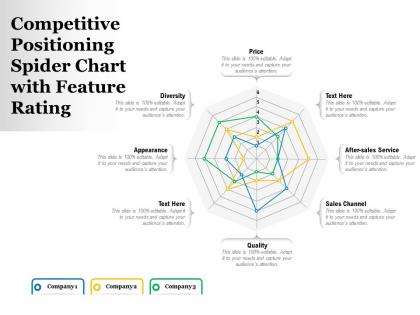
Competitive positioning spider chart with feature rating




Try Before you Buy Download Free Sample Product
 Impress Your
 Audience
 100%
100% Editable
 Save Hours
 of Time


Our Competitive Positioning Spider Chart With Feature Rating are topically designed to provide an attractive backdrop to any subject. Use them to look like a presentation pro.
People who downloaded this PowerPoint presentation also viewed the following :
Competitive positioning spider chart with feature rating with all 2 slides:
Use our Competitive Positioning Spider Chart With Feature Rating to effectively help you save your valuable time. They are readymade to fit into any presentation structure.

FAQs for Competitive positioning spider chart
Honestly, positioning is pretty straightforward once you break it down. Figure out your unique value first - what actually makes you different? Then nail down your target audience and pricing strategy. Are you the cheap option or the fancy one? Most companies I've seen totally bomb this by trying to appeal to everyone (spoiler: doesn't work). Map out where your main competitors sit, then find your own lane. The whole point is making it obvious why someone should pick you instead of them. Oh, and don't overthink the pricing thing - just be consistent with whatever image you're going for.
Figure out what your competitors suck at - that's where you'll win. Check their pricing, features, and messaging, but honestly? Their bad reviews are where the real gold is. I always look there first. What keeps pissing customers off? Those complaints show you exactly what gaps exist. Make a quick comparison chart of their weaknesses vs your strengths. The sweet spot is where you're genuinely better at something they can't or won't fix. That's your edge right there.
Look, how you position yourself basically tells customers why they should pick you instead of everyone else. Price, quality, whatever your thing is - just make it crystal clear. Customers love having an obvious reason to choose you because honestly, decision-making is exhausting. Plus it builds that emotional connection where they feel smart about their choice. Here's the catch though: you better actually deliver on whatever you're promising. If your positioning says one thing but the experience is totally different, you've just shot yourself in the foot. Consistency between what you say and do is everything.
Look, market trends are brutal - they'll make or break your competitive position faster than you think. Customer preferences change, new tech pops up, and suddenly your advantages mean nothing. I've watched companies crash from industry leaders to nobodies because they ignored what was happening around them. Honestly, some of these CEOs had their heads completely in the sand. You need to use trend analysis like an early warning system. Do regular competitor checks that focus on how new trends might flip your whole market upside down. It's the only way to stay ahead.
So here's the thing - you gotta know your customer segments before you can really compete with anyone. Think of it as spotting where your competitors are dropping the ball. Map out your top 3 competitors against your main customer groups and you'll see the gaps. Different segments want different things, right? That's where you swoop in with messaging that actually speaks to them. I always think it's kind of like chess - find the spaces they're not protecting and make your move there. The white space opportunities are usually pretty obvious once you lay it all out.
Stop with the "we're the best" garbage - nobody buys that anymore. Figure out your top 2-3 actual advantages and build simple stories around each one with real proof. Like actual customer results or data, not fluff. Meet people where they hang out already (LinkedIn, industry stuff, whatever). Honestly, most companies just spam buzzwords and then act surprised when crickets. Test your messaging on small groups first - saves you from looking dumb later. Focus on specific problems you actually solve. Short, concrete language beats fancy corporate speak every time.
Honestly, most companies just position themselves *against* competitors instead of actually speaking to what customers want. Big mistake. They also try being everything to everyone - you end up with boring, generic messages that don't hit anyone. Here's the thing that drives me crazy: businesses get obsessed with listing every single feature like it's some kind of spec sheet. But people don't care about your 47 capabilities - they want to know what problem you'll solve for them. Oh, and copying what works for other companies without understanding their audience? Recipe for disaster. Find what makes you different for YOUR specific people, then stick to that message everywhere.
SWOT analysis is basically your reality check for competition. You figure out your strengths, fix your weak spots, jump on opportunities, and prepare for threats. Do one for yourself first, then your main competitors - that's where you'll see the real gaps. Your strong points can hit their weak areas, plus you'll spot market openings before they do. Honestly, the threats part might be the most useful because it makes you think ahead about their next moves. It's not rocket science, but it works.
Honestly, perceptual maps are clutch for this - they'll show you exactly where you stack up against competitors on stuff like price vs. quality. You could also do competitive grids if you're comparing tons of features at once. Those 2x2 matrix things work well too (leaders, challengers, whatever). But here's the thing - don't go crazy with it. Stick to maybe 3-4 main competitors and only the metrics your audience actually cares about. I've seen way too many charts that look like someone threw up data all over them. Your stakeholders should take one look and instantly get why you're better than the competition.
Digital marketing totally changes how you compete - you can target audiences at crazy scale and pivot in real-time. Like, you can literally steal competitors' customers through search ads and build authority with content. The speed thing is wild honestly - I've seen companies flip their brand perception in weeks instead of months. A/B testing lets you know what messaging works immediately, so your positioning stays flexible. Oh and social proof is huge for standing out. Start with checking what your main competitors do online, then find the gaps where you can dominate the conversation.
Honestly, start with the basics - market share and how often you're winning deals against your main competitors. Customer acquisition costs are make-or-break here; if yours keeps going up while theirs doesn't, you're in trouble. Brand perception surveys will tell you what people actually think about you vs them. Also track your Net Promoter Scores and retention rates since that shows if customers really stick around. Oh, and monitor share of voice in your industry - are people even talking about you? Put it all in a monthly dashboard so you can catch problems early instead of scrambling later.
So new competitors popped up? First thing - figure out what actually sets you apart and go all-in on those strengths. Yeah, some of these new guys probably have decent ideas (annoying but true), but you've got advantages they don't. Experience, relationships, features that aren't easy to replicate. Don't just copy what they're doing or slash prices. That's reactive stuff. Instead, get crystal clear about why customers should pick you over them. I'd start by comparing your positioning to theirs this week - like really dig into it. Then communicate those differences way better than you have been.
Honestly, you've gotta treat this like maintenance on your car - check up on competitors every quarter or so. Set up Google alerts because manually stalking their websites is exhausting. Track their messaging, pricing, product changes, the usual suspects. Your sales team's probably hearing stuff from prospects too, so pump them for intel regularly. Here's the thing though - the real win is catching market shifts before everyone else does. I do monthly reviews of all this data and adjust messaging when needed. Sometimes I get paranoid and check more often, but quarterly's probably fine for most people.
Dude, forget boring feature lists - stories actually stick in people's heads. Collect examples from your sales team about customers who tried other vendors first, then switched to you. Like "Company X wasted 6 months with two competitors before we fixed their mess in three weeks." Frame it so the competitor becomes the painful "before" and you're obviously the hero "after." Your audience will remember that way better than bullet points (honestly, who even reads those anymore?). Customer transformation stories work because they show your unique strengths without sounding like you're bragging.
That positioning statement template is still gold: "For [target audience] who [need], [your product] is the [category] that [benefit] unlike [competitor]." Perceptual mapping works great too - you'll see exactly where you stack up against competitors on key stuff. There's also competitive analysis matrices, Value Proposition Canvas, all that. Honestly though? Just pick one and actually finish it. I've seen so many teams get stuck switching between frameworks instead of just figuring out what makes them different. The framework doesn't matter as much as people think - it's about getting crystal clear on your unique value.
No Reviews