

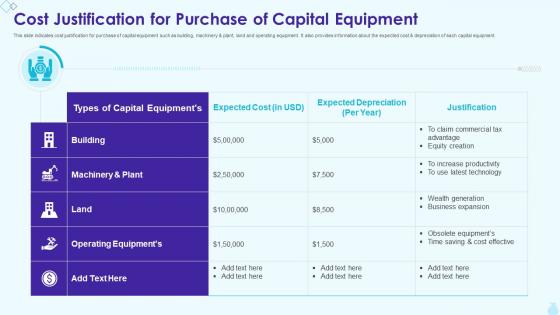
Cost Justification For Purchase Of Capital Equipment




Try Before you Buy Download Free Sample Product
 Impress Your
 Audience
 100%
100% Editable
 Save Hours
 of Time


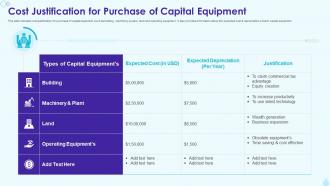
This slide indicates cost justification for purchase of capital equipment such as building, machinery and plant, land and operating equipment. It also provides information about the expected cost and depreciation of each capital equipment.
People who downloaded this PowerPoint presentation also viewed the following :
Cost Justification For Purchase Of Capital Equipment with all 6 slides:
Use our Cost Justification For Purchase Of Capital Equipment to effectively help you save your valuable time. They are readymade to fit into any presentation structure.





FAQs for Cost Justification For Purchase
Look at three things: what you're paying upfront, what it costs ongoing, and what you actually get back. Map out everything you'll spend initially - software, training, implementation, all that stuff. Don't forget the recurring expenses like maintenance and support. For benefits, put numbers on the hard savings (labor costs, efficiency) and try to quantify soft stuff too - customer satisfaction, risk reduction, whatever applies. Here's the thing though - most benefits take forever to actually show up, so be realistic about timing. Oh, and definitely pad your cost estimates. There's always something you didn't think of.
Look, cost justification basically gives you solid data to back up your funding requests instead of just winging it. When you're competing for budget, you can show exactly why your project beats the others - actual numbers on cost savings, revenue bumps, risk reduction, whatever applies. Honestly saved my butt so many times when resources are tight and everyone's scrambling. Focus on ROI, payback periods, net present value - but explain it in terms your audience gets. Map out all your costs and benefits first, then hammer home your strongest financial points. Oh and don't overthink the presentation part.
Honestly, just start with ROI and payback period - they're super easy to explain to your boss and get the point across fast. ROI shows what percentage return you're getting, payback period is basically when you'll break even. NPV is solid too since it factors in present value of future cash flows. IRR's useful if you're weighing multiple projects, but most execs honestly just care about the first two I mentioned. Oh, and don't forget to track the actual stuff that matters for your project - like cost savings or productivity bumps. Those concrete numbers make your case way stronger.
Honestly, cost justification is what makes or breaks your pitch with stakeholders. Show them solid ROI numbers and payback periods - that's what they actually care about. I've watched so many good projects die because nobody could explain why the money was worth it. Numbers talk, everything else is just noise. When you prove your thing will save cash or prevent expensive disasters, suddenly everyone's your best friend. Build that business case early though - like, way earlier than you think you need to. Keep tweaking the projections as you go.
So basically you compare what you gain versus what you spent, then multiply by 100. Most companies track the obvious stuff first - labor cuts, material savings, that kind of thing. The formula's super simple: (Benefits - Costs) / Costs × 100. But here's where it gets annoying - how do you put a price on "better team morale" or whatever? Honestly, I'd focus on the measurable wins first. You can always add conservative guesses for the fluffy benefits later. Oh, and definitely track your baseline numbers before you start anything, otherwise you're just making up impact stories after the fact.
Look, risk assessment is just your sanity check for building solid cost justifications. Map out what could tank your project - delays, scope creep, tech failures, whatever keeps you up at night. Then slap dollar amounts on each scenario and figure out how likely they are. Nobody wants to be Debbie Downer, but getting caught off guard later sucks way more. Your business case gets so much stronger when you show you've actually thought about the ugly stuff that could happen. Honestly, just start with your top 5 risks and rough cost estimates. Makes everything way more believable.
Charts and graphs are seriously your best friend here - they make people actually *see* the money impact instead of drowning in spreadsheet hell. I've watched way too many executives zone out during number dumps, but throw up a clean ROI chart? Suddenly they're paying attention. Bar charts work great for cost comparisons, line graphs for projections. Pie charts are solid for budget breakdowns too. People grasp it faster and won't forget it five minutes later. Pro tip: lead with your strongest visual showing the main benefit right upfront. Trust me on this one.
Honestly, the biggest thing is don't be overly optimistic with your numbers - I've watched so many presentations crash and burn because of this. Hidden costs will absolutely kill you, so factor in stuff like training and maintenance upfront. Best-case scenarios are tempting but they make everything look suspicious. Back up your assumptions with real data, not wishful thinking. Oh, and document your logic clearly so people can actually follow it. When you're comparing options, make sure it's truly comparable. Realistic timelines are your friend here. Trust me on this one.
For-profit companies care about one thing - will this make us money? They justify costs by showing increased revenue or better ROI. Non-profits are totally different though. They measure success through mission impact - how many people you helped or problems you solved per dollar. Honestly, I love working with non-profits more because the conversations actually matter. But here's the thing - both still need decent financial planning. When you're writing your template, focus on financial metrics for businesses and impact numbers for non-profits. Oh, and both types love seeing operational improvements too.
Honestly, just start with Excel or Google Sheets for basic ROI and NPV stuff. They handle most scenarios fine and you probably already have them. @RISK is solid if you need Monte Carlo simulations later, and Planview works well for bigger portfolio justifications. JIRA Portfolio has decent cost tracking too if you're doing software projects. But seriously, don't overthink the tools at first. Get a good Excel template and nail down your methodology - that's way more important than fancy software. You can always upgrade once things get more complicated and you actually need the bells and whistles.
Healthcare, aerospace, and government contracts are brutal when it comes to cost justification. Patient safety means every expense gets scrutinized hard in healthcare. Aerospace? One failure and you're done. Government work is probably the worst though - taxpayers and auditors will tear apart your budget line by line. These industries don't mess around with regulations or accountability. My brother works in defense contracting and says it's insane how detailed they get. Bottom line: build your business case assuming someone's going to challenge everything, because they definitely will.
Dude, just drop all the tech speak and talk money. Say "this saves 10 hours a week" instead of rambling about efficiency improvements. Works way better. Try analogies too - like comparing your server upgrade to getting car insurance or whatever makes sense. Show them the before/after: here's your current headache, here's life without it. Honestly, half these executives just want to know if it'll make their quarterly numbers look good. Oh and tie everything back to what *they* actually care about, not what you think is cool about the tech. Numbers are your friend here.
So basically everyone's ditching the old ROI spreadsheets for this broader "value" stuff now. Leadership wants to see customer satisfaction scores, how it affects employee turnover, whether it actually fits your strategy - not just dollars saved. Plus they want real-time dashboards showing ongoing impact, which is honestly a pain but whatever. Gone are the days of pitching once and calling it done. Oh and those "soft" metrics? They carry as much weight as hard numbers now, so definitely start tracking them. The whole game has shifted toward proving continuous business impact rather than just upfront cost benefits.
Honestly? The regulatory environment totally controls how much paperwork you need. Healthcare and finance require tons of documentation - multiple approvals, third-party validation, the whole nine yards. Other industries are way more chill about it. Here's the annoying part though - regulations shift constantly, so last year's approach might be dead now. I'd definitely get tight with your compliance people early on. They're actually pretty helpful once you know them, and they'll tell you exactly what level of justification you need. Saves you from having to redo everything later, which is the worst.
Make a whole separate section just for your assumptions - seriously, don't hide them anywhere. Write down each one with why you made that call and how it might mess with your final numbers. I learned this the hard way when my boss grilled me about an analysis from months ago and I couldn't remember half my reasoning. Include where you got your data and what methods you used too. Oh, and definitely call out which assumptions matter most for your conclusion. Trust me, you'll thank yourself later when people start poking holes in your work.
-
Great designs, really helpful.
-
Design layout is very impressive.