

Cost Justification For Hiring New Employee




Try Before you Buy Download Free Sample Product
 Impress Your
 Audience
 100%
100% Editable
 Save Hours
 of Time


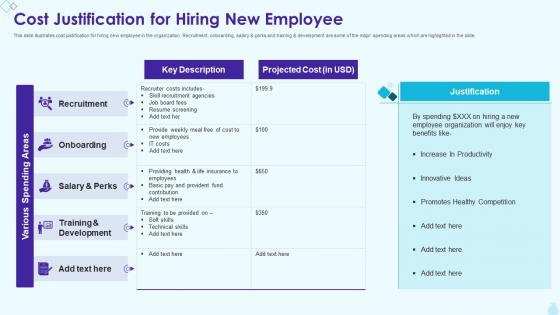
This slide illustrates cost justification for hiring new employee in the organization. Recruitment, onboarding, salary and perks and training and development are some of the major spending areas which are highlighted in the slide.
People who downloaded this PowerPoint presentation also viewed the following :
Cost Justification For Hiring New Employee with all 6 slides:
Use our Cost Justification For Hiring New Employee to effectively help you save your valuable time. They are readymade to fit into any presentation structure.





FAQs for Cost Justification For
Honestly, just focus on three things: what you'll save/make, what it'll cost upfront, and what could go wrong. Put real numbers on everything - cost savings, new revenue, time saved, whatever. Don't forget the hidden costs though, like training people or ongoing maintenance (that stuff adds up fast). The fuzzy benefits matter too - happier employees, better customer experience - even if they're hard to measure. Oh, and always pad your budget because these things never go as planned. Trust me on that one. Throw it all in a simple spreadsheet showing 2-3 years out so everyone can actually see if it's worth doing.
Look at your expected benefits vs total costs over like 3-5 years. Figure out both the obvious savings (labor costs, etc.) and the harder-to-measure stuff like better efficiency. Here's where people mess up though - they're way too optimistic about costs and timelines. Projects always go sideways somehow. Calculate payback period if you want to be thorough about it. Write down all your assumptions so you can check them later when reality hits. Oh, and definitely pad your budget for unexpected crap that'll come up. Trust me on this one.
You need both, but honestly? Lead with the tangible stuff first. Finance people love hard numbers - labor cost savings, revenue bumps, time reductions you can actually measure. The fluffy benefits like better morale or happier customers are real, but they'll roll their eyes if that's all you've got. I'd grab at least 2-3 solid measurable benefits before writing anything. Then sprinkle in the intangibles to make your case stronger. It's annoying how much they focus on dollars and cents, but that's just how these proposals work.
So basically, cost justification helps you rank projects by actual financial impact instead of just gut feelings. You calculate ROI and payback periods for each one, then compare them head-to-head. Super helpful when you've got limited budget and everyone's pushing their "urgent" project. The math cuts through most of the BS, though office politics still creep in sometimes - ugh. Start with expected returns vs implementation costs. Some projects look flashy but won't actually move the needle. Others might seem boring but deliver real results. Just rank everything by the numbers and you'll have solid backing for your decisions.
So you've got a few solid options here. NPV and ROI are the big ones - NPV's better for long-term stuff since it factors in how money loses value over time. ROI is nice because executives eat up those percentages. Payback period just tells you when you'll break even, which is pretty self-explanatory. Oh, and there's IRR too if things get complicated. Honestly? I'd run two methods minimum. ROI's easier to explain, then throw in NPV if your project runs multiple years. Makes your case way stronger when you're not relying on just one calculation.
Market conditions totally change the game for cost justifications. Hot market with lots of competitor spending? You can push through higher costs because nobody wants to fall behind. Downturn hits and suddenly they want 18-month payback instead of 36 months - honestly it's kinda brutal how fast priorities shift. Economic stuff like interest rates and industry trends mess with how leadership thinks about ROI thresholds. Your best bet is building your business case around what's actually happening in the market right now, not just your internal numbers. Competitive analysis becomes way more important than people realize.
Don't be too rosy with your projections - that's the big one. Hidden costs will absolutely wreck you if you're not careful. Skip the cherry-picking where you only show the good stuff because reviewers aren't idiots. Training time, implementation headaches, ongoing maintenance... all that adds up fast. Honestly, I've watched so many people crash and burn on the "soft costs" alone - employee hours, getting everyone on board with changes, that whole mess. Compare things fairly when you show alternatives. Build in padding for when stuff inevitably goes sideways, and give them a few different scenarios to chew on.
Dude, getting stakeholders involved early is a game-changer for cost justification. They're way less likely to shoot down a budget they helped shape, you know? Map out who controls the purse strings first, then loop them into your planning conversations. They'll catch costs you totally missed - I swear, finance people have this weird sixth sense about hidden expenses. Plus they know exactly how to pitch things to the higher-ups in a way that actually lands. Short version: make them partners, not just people you're asking money from.
Honestly? Just start with Excel or Google Sheets - they handle ROI calcs and those comparison charts finance always wants. Monday.com or Prophix are solid if you need something fancier, but I've watched so many people blow money on expensive tools when a good spreadsheet template does like 90% of what you need. The real trick is finding something your team won't abandon after two weeks. Build a simple template first. You can always upgrade later if you're doing this stuff constantly. Sometimes the boring solution is actually the smart one, you know?
Oh man, compliance totally changes the game! Instead of proving ROI, you're basically saying "we'll get crushed by fines if we don't do this." Healthcare and finance companies especially can't mess around with regulations. The cool thing is budget approval becomes way easier - just point to the specific rules you need to follow. I mean, nobody wants their company shut down, right? Frame it like insurance against massive penalties or losing your operating license. Just document exactly which requirements you're hitting in your business case and you're golden.
Look, historical data is what makes you look legit when you're asking for money. Real ROI numbers and usage patterns beat wishful thinking every time. I learned this the hard way - walked into a meeting once with just projections and got absolutely roasted. Nobody wants to gamble their budget on your hunches, you know? Past performance shows actual cost savings and proves your track record. Oh, and start hoarding that data now even if you don't need it yet. Trust me, future you will be grateful when it's crunch time.
Look, decision-makers are swamped with stuff all day. Clear cost justification? It's like handing them the answer key. They can spot the financial impact immediately and actually understand what they're trading off. Nobody wants to dig through messy spreadsheets - good visuals save everyone's sanity. Plus your presentation becomes their go-to reference when they're explaining things upward to their own bosses. Honestly, I've seen bad presentations kill good ideas just because people couldn't follow the logic. Tell the story behind your numbers instead of data-dumping. You'll get faster approvals and way stronger support.
Show them the money trail - connect every expense to actual results like revenue or cost cuts. Paint the disaster scenario too (honestly, that's usually what gets them). Grab data from past wins and industry benchmarks to back yourself up. Rally other departments who'd benefit - way easier when you're not the only voice in the room. Start small with your slam-dunk requests first. Once you've got some wins under your belt, those bigger budget asks become much harder to say no to. Trust me on this one.
Honestly, it's the same basic idea whether you're spending $500 or $5M - just figure out if the benefits outweigh the costs. Small stuff? Keep it simple, maybe just look at how fast you'll break even. Big projects get way more complicated though - you'll need fancy spreadsheets, risk analysis, the whole nine yards. But here's the thing: you always start by defining what "success" looks like in actual dollar amounts. Then work backwards from there. What problem are you solving? What's it gonna cost to implement? Can you prove it's worth it? That's your business case right there.
Ugh, definitely learned this one the hard way! My boss grilled me about some decision from months back and I had zero documentation. So now I write everything down - the problem you're solving, what options you looked at (even the crappy ones), plus all your cost/benefit math. Don't forget the assumptions you made or what people told you during meetings. I usually dump it all in a shared folder so anyone can find it later. Oh and name your files consistently or you'll hate yourself trying to find stuff. Trust me, write it like you're gonna forget everything tomorrow because... you probably will.
-
Best Representation of topics, really appreciable.
-
Appreciate the research and its presentable format.