

Digital Marketing Key Performance Indicator Framework




Try Before you Buy Download Free Sample Product
 Impress Your
 Audience
 100%
100% Editable
 Save Hours
 of Time


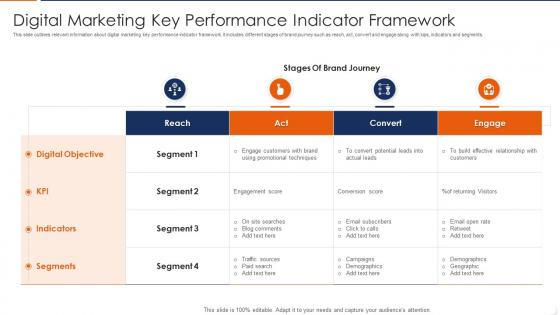
This slide outlines relevant information about digital marketing key performance indicator framework. It includes different stages of brand journey such as reach, act, convert and engage along with kips, indicators and segments.
People who downloaded this PowerPoint presentation also viewed the following :
Digital Marketing Key Performance Indicator Framework with all 6 slides:
Use our Digital Marketing Key Performance Indicator Framework to effectively help you save your valuable time. They are readymade to fit into any presentation structure.





FAQs for Digital Marketing Key
Critical digital marketing KPIs include conversion rate, customer acquisition cost (CAC), return on ad spend (ROAS), click-through rates, and lifetime customer value (LTV). These metrics enable organizations to optimize campaign performance, allocate resources strategically, and measure ROI effectively, with many companies finding that tracking these KPIs simultaneously delivers enhanced targeting precision and significantly improved marketing efficiency.
Businesses can effectively measure conversion rates by implementing unified tracking systems, setting up channel-specific attribution models, and utilizing analytics platforms like Google Analytics, Facebook Pixel, and marketing automation tools. Through cross-channel tracking and consistent goal definitions, organizations streamline performance analysis across email, social media, and paid advertising, ultimately delivering comprehensive insights that enable strategic budget allocation and campaign optimization.
Customer lifetime value serves as a comprehensive metric for measuring long-term digital marketing effectiveness, revealing the total revenue potential from acquired customers rather than just immediate conversions. This strategic approach enables marketers to optimize acquisition costs, justify higher upfront investments in quality leads, and shift focus toward retention campaigns, with many e-commerce and SaaS companies finding that CLV-driven strategies deliver significantly better ROI than short-term conversion metrics alone.
Social media engagement metrics translate into actionable insights by analyzing engagement rates, sentiment patterns, content performance, and audience behavior to identify successful strategies. Through tracking which posts generate conversations, shares, and conversions, marketing teams can optimize content timing, messaging, and platform allocation, ultimately enhancing campaign effectiveness and delivering measurable ROI improvements.
ROAS measures revenue generated per dollar spent on advertising, serving as a critical profitability metric that enables marketers to evaluate campaign effectiveness, allocate budgets strategically, and identify high-performing channels. By tracking ROAS across platforms like Google Ads and Facebook, companies can optimize their advertising investments, eliminate underperforming campaigns, and scale successful initiatives, ultimately delivering improved ROI and sustainable growth.
Brands can track SEO effectiveness through organic traffic growth, keyword ranking improvements, click-through rates, conversion rates from organic search, and domain authority scores. These metrics enable marketing teams to measure search visibility, user engagement, and revenue impact, with many e-commerce and service companies finding that tracking bounce rates and page load speeds ultimately delivers competitive advantage in search results.
Vanity metrics focus on surface-level engagement like followers, likes, and page views, while meaningful KPIs measure business impact through conversion rates, customer acquisition costs, lifetime value, and revenue attribution. While vanity metrics boost morale and brand awareness, meaningful KPIs drive strategic decisions, with successful companies finding that focusing on actionable metrics delivers measurable ROI and sustainable growth.
Website traffic sources enable businesses to track visitor origins through analytics platforms like Google Analytics, social media insights, email campaign metrics, and referral tracking systems. By analyzing conversion rates, engagement levels, and customer acquisition costs across channels like search engines, social media, and paid advertising, companies can strategically reallocate marketing budgets toward high-performing channels, ultimately maximizing ROI and driving sustainable growth.
Email marketing KPIs include open rates, click-through rates, conversion rates, bounce rates, and unsubscribe rates, along with revenue per email and list growth metrics. These indicators enable marketers to optimize subject lines, content personalization, and send timing, with many retail and e-commerce businesses finding that tracking these metrics delivers improved customer engagement and significantly higher ROI.
Businesses can analyze customer acquisition costs by tracking spending across marketing channels, calculating cost-per-lead ratios, comparing lifetime value to acquisition expenses, and identifying high-performing campaigns through attribution modeling. Through detailed segmentation analysis, companies streamline budget allocation toward cost-effective channels like social media or email marketing, ultimately reducing CAC while enhancing conversion rates and maximizing marketing ROI.
Content marketing metrics include website traffic, engagement rates, lead generation, conversion rates, social shares, time on page, and brand awareness indicators. These KPIs enable organizations to optimize their content strategies by measuring audience reach, content effectiveness, and revenue impact, with many businesses finding that tracking multiple touchpoints delivers comprehensive insights into campaign performance and ROI.
Brands can leverage A/B testing results to refine their digital marketing KPIs by identifying high-performing variables, optimizing conversion metrics, and realigning measurement priorities based on actual user behavior data. Through systematic testing of email subject lines, ad creatives, and landing pages, companies streamline their KPI frameworks, enhance campaign performance, and ultimately deliver more accurate ROI measurements and strategic insights.
Customer retention rates reveal digital marketing's long-term effectiveness by measuring repeat purchases, subscription renewals, engagement consistency, and brand loyalty development across campaigns. This KPI demonstrates how well marketing strategies build lasting relationships rather than just initial conversions, with many organizations finding that improving retention by even small percentages significantly increases lifetime customer value and reduces acquisition costs.
Marketers can assess UX design impact on KPIs by tracking conversion rates, bounce rates, session duration, page load times, and customer satisfaction scores across user journeys. Through A/B testing and heat mapping analysis, companies in e-commerce, SaaS, and financial services streamline user interactions, ultimately delivering higher engagement rates and improved revenue performance.
**INPUT**: What innovative tools and technologies can help businesses track and analyze digital marketing KPIs effectively? **OUTPUT**: Innovative tools include AI-powered analytics platforms, real-time dashboard technologies, predictive modeling software, cross-channel attribution systems, and automated reporting solutions. These technologies streamline performance tracking by consolidating multi-platform data, identifying trend patterns, and delivering actionable insights, with many marketing teams finding that integrated analytics ultimately enhance campaign optimization and ROI measurement across diverse digital channels.
-
Great combination of visuals and information. Glad I purchased your subscription.
-
Top Quality presentations that are easily editable.