


Financial Report Of An Information Technology Company Complete Deck




Try Before you Buy Download Free Sample Product
 Impress Your
 Audience
 100%
100% Editable
 Save Hours
 of Time


A company profile is a professional introduction of a company to provide operational and financial information. Check out our professionally designed template for the Financial Report of an Information Technology Company that wants to give its business details to its stakeholders employees, investors, clients, partners, shareholders, etc. It covers the operation information such as a brief overview of the company and its products and services, history, geographic presence, mission and vision statement, latest technologies, research and development activities, distribution network, etc. In addition to this, it covers the competitor details such as the name of top competitors by their operations, competitive landscape, financial comparison with competitors, etc. The template has also covered the financial overview of the company that includes the company's financials from its income statement revenue, EBIT, and Net income, balance sheet total assets, total liabilities, goodwill, and cash flow statement cash flows from operating, investing, and financing activities. In the end, it covers strategic details long-term growth goals and strategies, acquisition details, SWOT analysis, and risk management strategies of the company. The module also covers the primary corporate social responsibilities of the company. Take advantage of our 100 percentage editable company profile, allowing you to tailor the content to your specific requirements. Benefit from our extensive research and skillfully designed product by downloading it now.
People who downloaded this PowerPoint presentation also viewed the following :
Content of this Powerpoint Presentation
Slide 1: This slide introduces Financial Report of an Information Technology Company. State Your Company Name and begin.
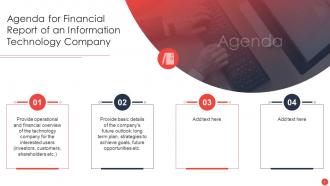
Slide 2: This slide states Agenda of the presentation.
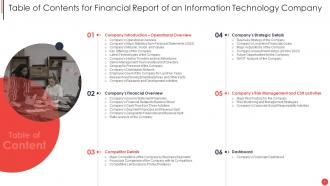
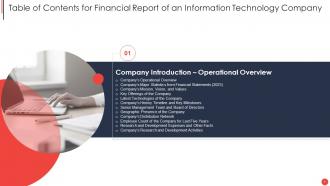
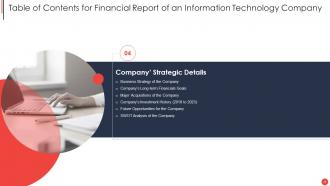
Slide 3: This slide presents Table of Content for the presentation.
Slide 4: This slide highlights title for topics that are to be covered next in the template.
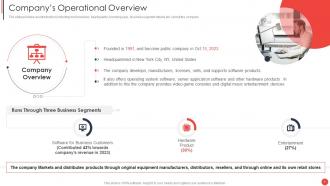
Slide 5: The slide displays an introduction including brief overview, headquarter, founding year, business segment details etc.
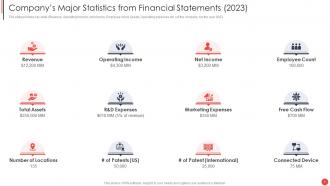
Slide 6: This slide represents Company’s Major Statistics from Financial Statements.
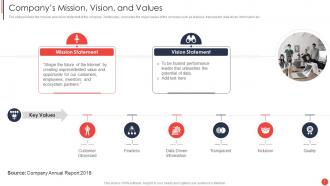
Slide 7: The slide provides the mission and vision statement of the company.
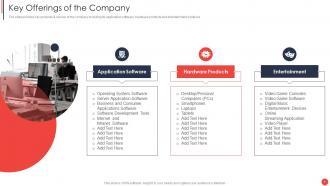
Slide 8: The slide presents key products & service of the company including its application software, hardware products and entertainment solutions.
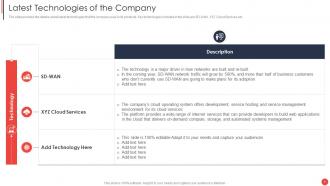
Slide 9: The slide displays the details about latest technologies that the company uses in its products.
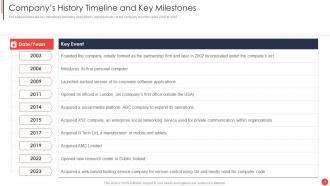
Slide 10: The slide represents the key milestones (founding, acquisitions, expansion etc.) of the company, from the years 2000 to 2020.
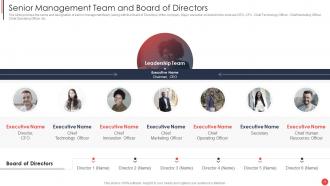
Slide 11: The slide provides the name and designation of senior management team (along with the Board of Directors) of the company.
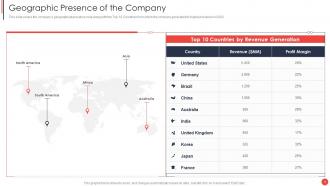
Slide 12: This slide covers the company’s geographical presence map along with the Top 10 Countries from which the company generated its highest revenue.
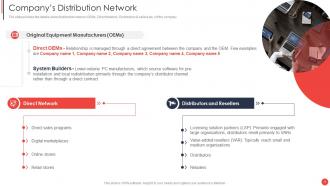
Slide 13: The slide represents the details about distribution network (OEMs, Direct Network, Distributors & sellers etc.) of the company
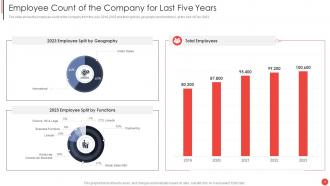
Slide 14: The slide shows the employee count of the company from the year 2017-2021 and their split (by geography and functions).
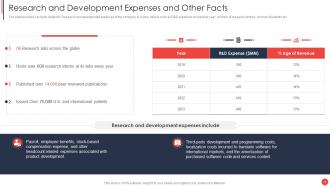
Slide 15: This slide presents Research and Development Expenses and Other Facts.
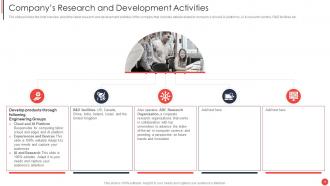
Slide 16: The slide provides the brief overview about the latest research and development activities.
Slide 17: This slide highlights title for topics that are to be covered next in the template.
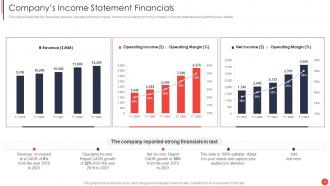
Slide 18: The slide represents the key financials (revenue, operating income & margin, net income & margin) from the company’s income statement.
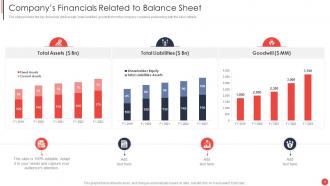
Slide 19: The slide provides the key financials (total assets, total liabilities, goodwill) from the company’s balance sheet along with the basic details
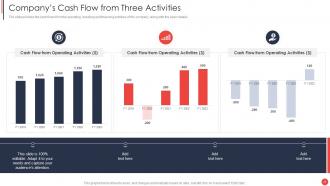
Slide 20: The slide presents the cash flows from the operating, investing and financing activities of the company.
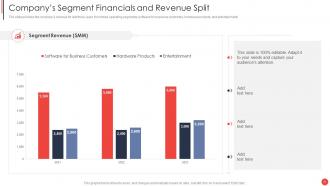
Slide 21: The slide provides the company’s revenue for last three years from three operating segments.
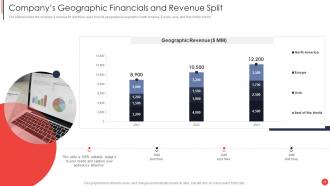
Slide 22: The slide displays the company’s revenue for last three years from its geographical segments.
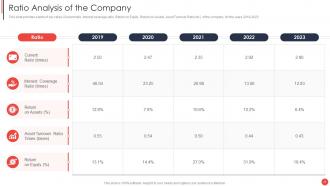
Slide 23: This slide represents a table of key ratios (Current ratio, interest coverage ratio, Return on Equity, Return on Assets, Asset Turnover Ratio etc.) of the company.
Slide 24: This slide highlights title for topics that are to be covered next in the template.
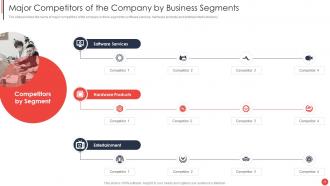
Slide 25: The slide presents the name of major competitors of the company in three segments (software services, hardware products and entertainment solutions).
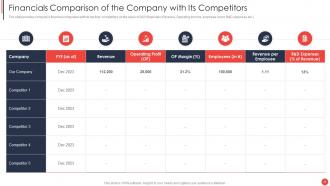
Slide 26: This slide shows Financials Comparison of the Company with Its Competitors.
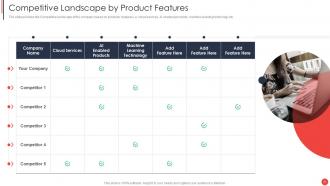
Slide 27: The slide displays the Competitive landscape of the company based on products’ features i.e. cloud services, AI enabled products, machine learning technology etc.
Slide 28: This slide highlights title for topics that are to be covered next in the template.
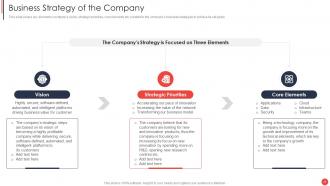
Slide 29: This slide covers key elements (company’s vision, strategic priorities, core elements etc.) related to the company’s business strategies to achieve its set goals.
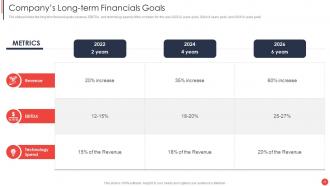
Slide 30: The slide presents the long term financial goals (revenue, EBITDA, and technology spend) of the company.
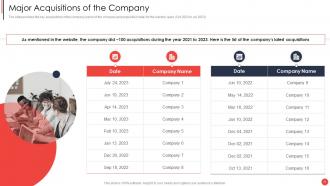
Slide 31: The slide provides the key acquisitions of the company (name of the company and acquisition date) for the last two years.
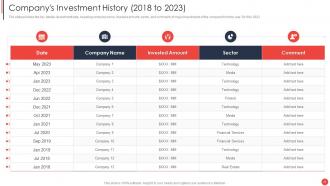
Slide 32: The slide displays the key details (investment date, investing company name, invested amount, sector, and comment) of major investments of the company.
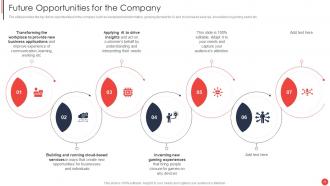
Slide 33: The slide represents the key future opportunities for the company such as workplace transformation, growing demand for AI and cloud based services.
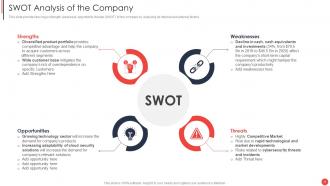
Slide 34: This slide provides the major strength, weakness, opportunity, threats (SWOT) of the company by analyzing its internal and external factors.
Slide 35: This slide highlights title for topics that are to be covered next in the template.
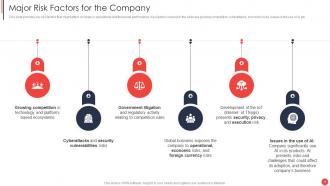
Slide 36: This slide provides key risk factors that might affect company’s operational and financials performance.
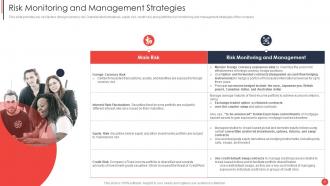
Slide 37: This slide displays key risk factors (foreign currency risk, interest rate fluctuations, equity risk, credit risk) along with the risk management strategies.
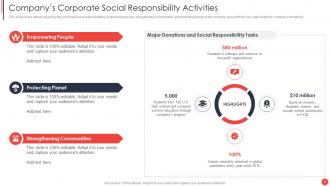
Slide 38: This slide represents Company’s Corporate Social Responsibility Activities.
Slide 39: This slide highlights title for topics that are to be covered next in the template.
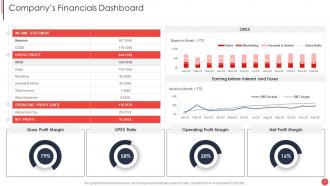
Slide 40: This slide presents Company’s Financials Dashboard with- Gross Profit Margin, Operating Profit Margin, Net Profit Margin, etc.
Slide 41: This slide displays Icons for Financial Report of an Information Technology Company.
Slide 42: This slide is titled as Additional Slides for moving forward.
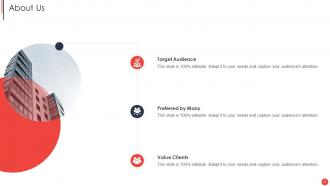
Slide 43: This is About Us slide to show company specifications etc.
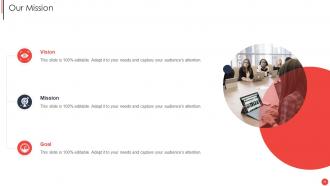
Slide 44: This is Our Mission slide with related imagery and text.
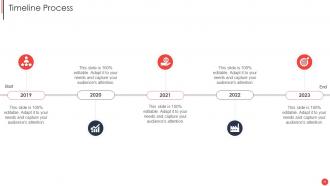
Slide 45: This is a Timeline slide. Show data related to time intervals here.
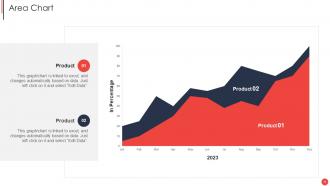
Slide 46: This slide depicts Area chart with two products comparison.
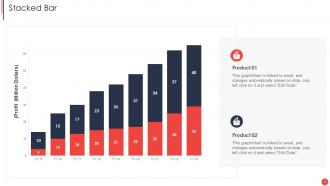
Slide 47: This slide represents Stacked Bar chart with two products comparison.
Slide 48: This slide shows Post It Notes. Post your important notes here.
Slide 49: This slide provides 30 60 90 Days Plan with text boxes.
Slide 50: This slide contains Puzzle with related icons and text.
Slide 51: This slide depicts Venn diagram with text boxes.
Slide 52: This is a Thank You slide with address, contact numbers and email address.
Financial Report Of An Information Technology Company Complete Deck with all 57 slides:
Use our Financial Report Of An Information Technology Company Complete Deck to effectively help you save your valuable time. They are readymade to fit into any presentation structure.






FAQs for Financial Report Of An Information Technology
So for your financial report, definitely track revenue per employee and MRR first - those are your bread and butter. CAC and CLV are crucial too, plus don't sleep on gross margins. Cash burn rate is probably the most important though, honestly I've seen too many tech companies with great products just run out of money. Annual contract value and churn rates will show you where you're headed growth-wise. Oh, and client retention metrics obviously. Set up a monthly dashboard if you can - catching problems early beats scrambling later when everything's already sideways.
So IT revenue is all over the place depending on what type of company you're dealing with. SaaS folks have their predictable monthly subscriptions, but consulting shops? Totally different - they're getting paid per project. Hardware companies do the one-time sale thing, and cloud providers are this weird mix of pay-as-you-go plus subscriptions. Honestly gets confusing fast! You'll want to break these out separately in your reports though. Investors are obsessed with seeing recurring vs non-recurring revenue split out clearly - that's literally what drives valuations. Each stream has different growth patterns and predictability, so don't lump them together or you'll just confuse everyone.
Honestly, R&D spending is tricky. You're basically gambling on future payoffs while watching your current profits tank. Investors hate seeing all that cash disappear with nothing to show for it immediately. But if you don't invest? You'll get crushed when competitors roll out the next big thing. I've seen too many companies try to save money by cutting R&D - terrible mistake. The trick is spending enough to stay ahead without going broke. Short bursts hurt, but long-term it's make or break. Check what others in your industry are spending percentage-wise.
So for your IP stuff, definitely break it out clearly - patents, trademarks, software licenses should all get separate line items with proper valuations. Accounting rules are super conservative though, which is honestly annoying. You might need to add extra details in the notes section to tell the full story. Also throw in some metrics like R&D spend as percentage of revenue. Patent application counts are good too - shows you're not just sitting around. The whole point is helping investors see what actually makes you valuable beyond just having code on servers, you know?
SaaS companies live and die by recurring revenue - it's their whole thing. Instead of one-time sales, they get steady monthly/annual payments that make cash flow super predictable. Investors eat this up because it's like having a guaranteed paycheck vs doing gig work, you know? Look for ARR or MRR when you're reading their reports. Growth rates matter more than the actual numbers though. Also check their churn rates - if customers keep bailing, that's a red flag. Oh and honestly? This model is why SaaS companies can survive market crashes better than traditional software firms.
Break down cyber costs by what they actually are - software subscriptions and salaries are operating expenses, big infrastructure buys get capitalized. Don't just throw everything under "IT costs" because auditors hate that. Incident response deserves its own line item since those hits can be brutal. Honestly, investors are getting pretty obsessed with cyber disclosures lately, so maybe add a dedicated section in your notes. Oh and start tracking this stuff consistently now - I learned the hard way that scrambling during audit season sucks.
So revenue growth rate is what investors actually obsess over - that's your starting point. After that, dig into recurring revenue percentage (SaaS is basically the holy grail), gross margins, and how much you're spending to get customers vs what they're worth long-term. Cash burn matters a ton for growth companies. R&D spending gets me excited because tech changes so damn fast. Oh, and churn rates plus user engagement if it's consumer stuff. Grab three quarters of data though - you want trends, not random good months.
First thing I'd check is revenue growth and gross margins - basically, are they making more money without costs exploding? Cash flow is huge too since tech companies burn through money like crazy when they're scaling. Look at how much they spend to get customers vs what those customers are actually worth long-term. R&D spending should translate to real revenue, not just fancy features nobody uses. Infrastructure investments matter too - smart companies build capacity before they need it. Honestly, if you see steady revenue growth with better margins and they're not hemorrhaging cash, that's usually a solid sign they won't crash and burn during expansion.
Look, forget the standard accounting timelines - they're useless for tech. Your depreciation needs to actually match how fast your products become outdated. Write down inventory way more often and get aggressive with obsolete stock reserves. Tech moves insanely fast compared to other industries. Keep reviewing asset useful lives too, especially R&D equipment and software licenses that go stale quickly. Be conservative with valuations and super transparent about obsolescence risks in your notes. Trust me, you don't want investors getting blindsided when that "cutting-edge" server becomes worthless in 18 months instead of 5 years.
Revenue recognition is gonna be your biggest headache - subscription timing with SaaS gets weird fast. Cash flow's tricky too since you're burning money upfront but revenue comes in chunks. Most startups I know just use janky spreadsheets until they can actually afford real accounting software (which is honestly embarrassing but whatever). R&D capitalization rules are confusing as hell - like what dev costs can you capitalize vs just expense right away? Definitely get proper accounting software early though. And find a CPA who actually gets tech companies, not some random generalist.
Honestly, visual trend analysis is your best bet here. Show revenue fluctuations next to market indicators - think tech stock indices, currency rates, that stuff. Side-by-side quarterly charts make the correlation super clear for stakeholders. Can't believe how many companies totally miss this connection when IT revenues are so tied to market confidence. Add some variance analysis (budget vs actual during crazy market periods) and maybe scenario modeling for different conditions. Oh, and make it visual instead of just dumping spreadsheet numbers on people. Executives actually understand graphs they can read at a glance.
Cash flow's huge for IT companies - you've got those weird revenue spikes from big projects, then nothing for weeks. Super annoying. Your financial docs need a solid cash flow statement broken into operating, investing, and financing sections. Also throw in a 12-month forecast so people can see what's coming. Honestly, most boards just want to see your monthly burn rate and how long your runway is anyway. Sales cycles in tech can drag on forever, so working capital gets tricky. Just be super transparent about where your cash actually sits each month.
So financial reports show partnerships in a few places. Joint ventures pop up on the balance sheet, revenue sharing hits the income statement. But honestly? Skip straight to the footnotes - that's where all the juicy details live. Companies spell out partnership terms, revenue splits, future commitments there. You'll see stuff like "strategic alliances" or "reseller agreements." Also check accounts receivable/payable since that shows money flowing between partners. I always scan those notes first, then work backwards to see what the actual dollar impact is. Way more efficient that way.
Definitely track cloud adoption and cybersecurity spending first - they'll hit your revenue directly. Remote work trends are still reshaping everything (seriously, half these companies are scrambling). AI investments matter too, but honestly the talent costs are what's killing budgets right now. Developer salaries are insane. Don't forget regulatory stuff around data privacy and how everyone's shifting to subscriptions. Currency fluctuations can mess you up if you're international. Maybe set up a quarterly check-in to catch this stuff early? Way better than getting blindsided.
Just throw them right into your financial reports as extra KPIs or make a little dashboard section. Most places I've worked do a "business health" part next to the regular P&L - way less boring tbh. Pick like 2-3 metrics that actually connect to revenue or churn, not just fluff numbers. Customer satisfaction, retention rates, that kind of stuff. Show the trends and how they tie back to your financials. Oh and don't go crazy with too many metrics at first. You'll just overwhelm everyone and they won't look at any of it.
-
The content is very helpful from business point of view.
-
Editable templates with innovative design and color combination.