


Initial public offering process preparation ppt powerpoint presentation slides format





Try Before you Buy Download Free Sample Product
 Impress Your
 Audience
 100%
100% Editable
 Save Hours
 of Time


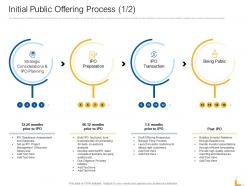
This slide provides information about IPO process that firm can use as an exit option. It is the first sale of companys share to the public and listing of shares on stock exchange. It will allow firm to raise capital by creating newly issued and selling existing shares.
People who downloaded this PowerPoint presentation also viewed the following :
Initial public offering process preparation ppt powerpoint presentation slides format with all 2 slides:
Use our Initial Public Offering Process Preparation Ppt Powerpoint Presentation Slides Format to effectively help you save your valuable time. They are readymade to fit into any presentation structure.

FAQs for Initial public offering process preparation ppt powerpoint
The IPO process includes preparation and due diligence, regulatory filing with the SEC, roadshow presentations, pricing determination, and public trading launch. These stages typically span 12-18 months, with companies working through legal compliance, financial auditing, and investor marketing, ultimately delivering access to public capital markets and enhanced growth opportunities for scaling businesses.
Companies determine IPO timing by evaluating market conditions, financial performance, business maturity, and strategic objectives. Strong revenue growth, stable operations, favorable market sentiment, and competitive positioning create optimal windows, while companies also consider industry trends, investor appetite, and internal readiness factors like governance systems, ultimately timing their public debut when these elements align to maximize valuation and long-term success.
Primary regulatory requirements for IPO companies include SEC registration through Form S-1, comprehensive financial audits, detailed disclosure documents, compliance with exchange listing standards, and adherence to securities laws. These requirements streamline transparency and investor protection by ensuring accurate financial reporting, risk disclosures, and operational details, with many organizations finding that early regulatory preparation ultimately delivers smoother market entry and enhanced investor confidence.
Underwriters facilitate IPO success by conducting due diligence, determining share pricing, purchasing shares from companies, and marketing offerings to institutional investors. Through their extensive networks and market expertise, investment banks like Goldman Sachs or Morgan Stanley help companies navigate regulatory requirements, assess market conditions, and ultimately secure capital while minimizing pricing risks and ensuring successful public market debuts.
IPO pricing depends on company fundamentals, market conditions, investor demand, comparable company valuations, and underwriter recommendations. Investment banks analyze financial performance, growth prospects, and industry trends while gauging institutional investor appetite, with many companies finding that strong financials and favorable market timing ultimately deliver optimal pricing and successful public debuts.
Common IPO pitfalls include inadequate financial preparation, unrealistic valuation expectations, insufficient market timing analysis, weak investor relations strategies, and regulatory compliance gaps. These challenges often result in delayed launches, reduced valuations, or failed offerings, with many companies finding that thorough preparation, realistic pricing, and strong financial controls ultimately deliver smoother transitions and better market reception.
Investor sentiment significantly influences IPO success by determining demand levels, pricing strategies, and post-launch performance through market confidence and risk appetite. Positive sentiment drives higher subscription rates and valuations, while negative sentiment can delay launches or reduce pricing, with many companies in sectors like technology and healthcare timing their IPOs strategically around favorable market conditions to maximize investor reception and long-term trading stability.
IPO documentation includes prospectus, financial statements, registration statement, underwriting agreements, and legal compliance certificates. These comprehensive filings enable regulatory approval by demonstrating financial transparency, operational stability, and growth potential, with many companies finding that thorough documentation preparation ultimately streamlines the launch process and enhances investor confidence in increasingly competitive markets.
The SEC oversees IPO regulation by reviewing registration statements, ensuring financial disclosure compliance, enforcing investor protection standards, and monitoring market fairness throughout the offering process. Through rigorous examination of prospectuses, financial audits, and corporate governance structures, the SEC enables transparent capital markets while protecting public investors, ultimately delivering market integrity and competitive access to growth capital for qualifying companies.
Market conditions significantly influence IPO timing by affecting investor appetite, valuation expectations, and capital accessibility. During favorable conditions with high market confidence and strong sector performance, companies often accelerate their public offerings to capitalize on premium valuations, while volatile or declining markets typically prompt delays, with many organizations finding that strategic timing ultimately delivers better investor reception and long-term market positioning.
Traditional IPOs involve underwriters setting share prices, marketing to institutional investors, and creating new shares for capital raising, while direct listings allow companies to go public without intermediaries or raising new capital. Direct listings enable existing shareholders to sell immediately and provide more price discovery transparency, with companies like Spotify and Slack finding this approach reduces costs and eliminates lock-up periods, ultimately delivering faster market access.
Investor relations proves critical during IPOs by building credibility, managing expectations, and securing strong institutional backing through transparent communication, compelling storytelling, and strategic positioning. Effective IR teams enable companies to achieve optimal valuations, attract long-term investors, and establish sustainable post-IPO relationships, with many successful offerings finding that early investor engagement significantly enhances market reception and trading performance.
IPOs can significantly influence a company's mission and values through increased stakeholder accountability, regulatory compliance requirements, and pressure for quarterly performance metrics. While many organizations successfully maintain their core identity, the transition to public ownership often requires balancing original values with shareholder expectations, ultimately delivering enhanced transparency and governance that can strengthen long-term strategic positioning.
Companies effectively manage post-IPO expectations by establishing clear communication protocols, setting realistic growth projections, and maintaining consistent quarterly reporting practices. Through strategic investor relations programs, newly public companies like tech firms and healthcare organizations deliver transparent performance updates, proactive stakeholder engagement, and comprehensive market guidance, ultimately building sustained investor confidence while avoiding volatile stock price fluctuations.
Post-IPO stock performance strategies include consistent financial transparency, strategic growth investments, effective investor relations, strong corporate governance, and regular market communication. Companies like Zoom and Shopify have maintained momentum by delivering on growth projections, expanding market presence, and building investor confidence through quarterly earnings consistency, ultimately sustaining valuation and competitive positioning in public markets.
-
Topic best represented with attractive design.