


Marketing Analytics Dashboard Snapshot With Conversion Rate




Try Before you Buy Download Free Sample Product
 Impress Your
 Audience
 100%
100% Editable
 Save Hours
 of Time


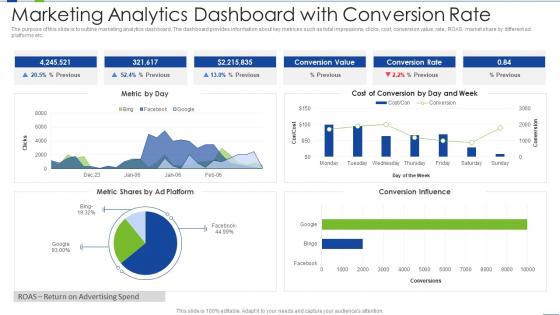
The purpose of this slide is to outline marketing analytics dashboard. The dashboard provides information about key metrices such as total impressions, clicks, cost, conversion value, rate, ROAS, market share by different ad platforms etc.
People who downloaded this PowerPoint presentation also viewed the following :
Marketing Analytics Dashboard Snapshot With Conversion Rate with all 7 slides:
Use our Marketing Analytics Dashboard With Conversion Rate to effectively help you save your valuable time. They are readymade to fit into any presentation structure.





FAQs for Marketing Analytics Dashboard Snapshot
Honestly, just pick 3-4 metrics and stick with them. Customer acquisition cost vs lifetime value is huge - tells you if you're actually making money or just burning cash. Conversion rates at each stage help you find the leaks. ROI seems obvious but I swear half the marketers I know skip this one somehow. Attribution tracking matters too since people don't usually buy on the first click. Oh, and resist the urge to build some massive dashboard with every possible metric. That just paralyzes you. Focus on what actually helps you make decisions.
Honestly, marketing analytics is a game changer for customer segmentation. Instead of those useless "25-34 female" categories, you're looking at actual behavior - like who abandons their cart vs. who only shops during sales. Way more useful, trust me. Pull all your data together (purchase history, website clicks, email opens, social stuff) and hunt for patterns. You'll find segments like "browsers who never buy" or "impulse buyers who love discounts." The insights are pretty wild once you dig in. Oh, and forget basic demographics - they're basically worthless now compared to behavioral data.
Start with Google Analytics 4 - it's free and handles most web tracking stuff. Google Tag Manager is a lifesaver too since you won't need to bother developers every time you want to add tracking code. Facebook Insights and LinkedIn Analytics work fine for social media, though honestly Hootsuite makes everything easier if you don't mind paying. Email platforms like Mailchimp already have decent analytics built in. I'd probably just stick with these basics first. You can always get fancier tools later when things get more complicated, but this covers like 90% of what most businesses actually need.
So predictive analytics is basically using your old data to guess what'll happen next with your marketing. Way better than just throwing money at campaigns and hoping for the best. You can spot which customers are likely to buy, when demand might spike, or if someone's about to bail on you. Honestly, it's pretty wild how accurate it gets. The key is being proactive instead of scrambling to fix things after they go wrong. I'd start small though - pick one thing you want to predict better, like conversion rates. Then expand from there once you get the hang of it.
Honestly, real-time data is a game changer for marketing. You can catch problems before they blow up your budget (learned that one the hard way) and jump on trends while they're actually hot. Why wait weeks to find out your campaign tanked? Set up alerts for the stuff that matters to your specific goals - though don't go overboard or you'll get alert fatigue. The best part is making decisions based on what's happening now instead of old, useless data. It's like having x-ray vision for your campaigns.
Honestly, just focus on revenue vs what you actually spent - forget about clicks and impressions for now, they don't pay the bills. Google Analytics conversion tracking is your friend here, or whatever CRM you're using. The math is simple: (Revenue - Campaign Cost) / Campaign Cost × 100. Attribution modeling gets tricky because customers bounce around different channels before buying, so track both direct sales and the assists too. I'd start small though - pick maybe 2-3 campaigns and nail down measuring those consistently. You can always expand once you've got the hang of it. Way easier than trying to track everything at once and getting overwhelmed.
Honestly, analytics is a game changer because it shows you what's actually working instead of just guessing. Look at your top 10 posts and find the patterns - topics, length, when you posted them. You'll probably discover your audience is different than you thought (mine turned out way younger). Track which content moves people from just browsing to actually buying something. The demographic stuff is clutch for adjusting your tone. Also check where competitors are crushing it but you're not - those are easy wins waiting to happen. Oh, and see when people are most active online.
Honestly, social media analytics are a game changer because you can finally see what your audience actually cares about. Which posts get people talking? When are they scrolling? What format works best - videos, carousels, whatever. Use that data to tweak your content strategy and posting times. You can also track brand mentions to see what people really think (way more honest than survey responses, trust me). Here's the thing though - don't get obsessed with follower counts. Focus on engagement rates and reach trends instead. Those vanity metrics are pretty much useless for measuring real impact.
Dude, the data volume is insane - you're literally drowning in numbers but can't figure out what actually matters. Attribution is a nightmare too. Like, which touchpoint actually made someone buy? Your systems probably don't even talk to each other, which makes everything worse. Oh, and watch out for correlation vs causation - that'll trip you up every time. There's always some exec obsessing over vanity metrics that look pretty but do nothing for revenue (so annoying). Start with proper tracking from day one. Don't try fixing it later. Focus on stuff that actually connects to money coming in.
Dude, A/B testing is a game changer - you're basically comparing two versions of something to see which one actually works better. Split your audience and test different email subject lines or landing pages, then let the data tell you what's up instead of just guessing. I swear it becomes addictive once you see the results! Even tiny improvements like 2-3% better open rates really add up over months. Start with something simple like testing two different headlines. Way better than sitting there wondering "hmm, will this work?" when you could just... test it and know for sure.
Honestly, just don't be a creep with people's data. Get explicit consent before tracking anything personal - and actually tell them what you're doing with it. I've seen some targeting that's genuinely unsettling. Make sure you're not accidentally discriminating against protected groups in your audience segments (happens more than you'd think). Follow GDPR and CCPA rules, keep everything secure. Do a quick audit of your current setup and ask yourself: would I be okay if someone did this with MY information? That gut check usually tells you everything you need to know.
Honestly, marketing analytics is a game changer for email stuff. Instead of throwing campaigns into the void and hoping, you'll actually see what's hitting. Track your opens, clicks, conversions - plus which subject lines don't suck. The segmentation thing is where it gets interesting though. Different customer groups respond to totally different content and timing. A/B test everything - send times, buttons, whatever. I probably sound like a broken record about this, but start with tracking your current campaigns first. Then just test one thing at a time so you don't go crazy.
Honestly, customer journey mapping is a game changer for marketing analytics. You can see exactly where people are dropping off or converting at each touchpoint. Without it? You're basically staring at random numbers that don't connect. I learned this the hard way at my last job - we were optimizing the wrong stuff entirely. Map out like 3-4 key steps in your funnel first. You'll spot patterns immediately. It's the difference between fixing the actual problem versus just polishing metrics that look good but don't matter. Trust me on this one.
Totally! Google Analytics is your best friend here - it's free and honestly gives you more data than you'll know what to do with at first. Same with Facebook Insights. Pick like 3-4 metrics that actually matter for your business (conversion rates, customer acquisition cost, stuff like that) and ignore the rest for now. Mailchimp's got a decent free plan with analytics too, though their interface is kinda clunky. I'd say start there before dropping money on fancy tools. Most small biz owners I know are already overwhelmed by data they're not using anyway!
Honestly, AI's pretty amazing for marketing analytics once you get into it. Machine learning can predict which customers might churn, and it'll automatically segment your audiences way better than doing it manually. Real-time personalization becomes actually doable at scale too. The attribution modeling stuff is clutch - you'll finally know which touchpoints matter instead of guessing. I'd say start with something simple like dynamic pricing or churn prediction first. Prove it works there, then expand. Oh, and the anomaly detection alone will save you hours of staring at spreadsheets trying to spot weird patterns.
-
SlideTeam has helped me take my presentation to the next level. Everyone at the office is impressed! I’ll be using their designs for a long-long time.
-
Like always a great experience with you guys. Always there on the drop of hat to help.