


Micro and macro environmental analysis powerpoint presentation slides




Try Before you Buy Download Free Sample Product
 Impress Your
 Audience
 100%
100% Editable
 Save Hours
 of Time


Environmental analysis, whether micro or macro, has a significant impact on the tracking and success of marketing activities. Where microanalysis is based on the nearby environment under which the company operates, macro analysis affects all the business enterprises PESTEL. Check out our competently designed Micro AND Macro Environmental Analysis template to gather data for strategic decision-making. The PPT presentation aims to identify and assess both present and future business threats AND opportunities. Also, it will determine the impact of environmental forces on the business model. The deck presents details on the financial dashboard, the need to conduct the analysis, key trends, industry forces, etc. The insightful template includes steps involved in environmental analysis, tools to identify factors 5C, PESTAL, techniques to scan the factors SWOT, STEP, and more. The PPT presentation also exhibits the BCG matrix, Porters five forces model, competitive profile matrix, McKinsey portfolio matrix, TWOS matrix, SPACE matrix, quantitative matrix, etc. The deck showcases the forecasted impact of the environmental variables and a financial dashboard for business impact tracking. Get access now.
People who downloaded this PowerPoint presentation also viewed the following :
Content of this Powerpoint Presentation
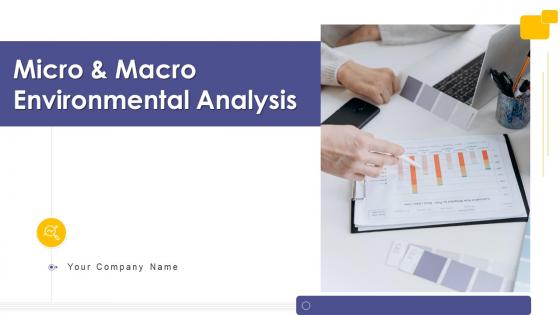
Slide 1: This slide introduces Micro & Macro Environmental Analysis. State Your Company Name and begin.
Slide 2: This slide shows Agenda for Micro & Macro Environmental Analysis.
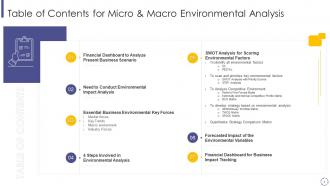
Slide 3: This slide presents Table of Contents for Micro & Macro Environmental Analysis.
Slide 4: This slide displays title for topics that are to be covered next in the template.
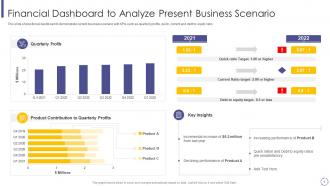
Slide 5: This slide represents financial dashboard to analyze present business scenario.
Slide 6: This slide showcases title for topics that are to be covered next in the template.
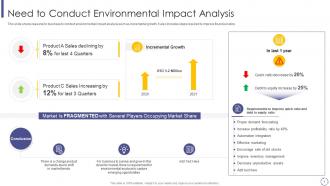
Slide 7: This slide shows reasons for business to conduct environmental impact analysis.
Slide 8: This slide presents title for topics that are to be covered next in the template.
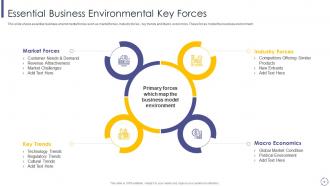
Slide 9: This slide displays essential business environmental forces such as market forces, industry forces , etc.
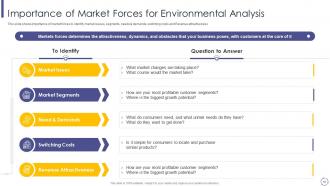
Slide 10: This slide represents importance of market forces to identify market issues, segments, needs & demands, etc.
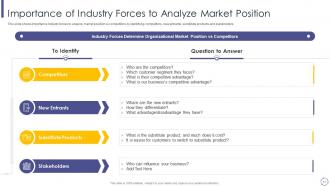
Slide 11: This slide showcases importance Industry forces to analyze market position vs competitors by identifying competitors, new entrants, etc.
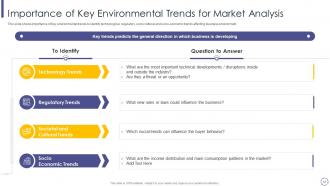
Slide 12: This slide shows importance of Key environmental trends to identify technological, regulatory, etc.
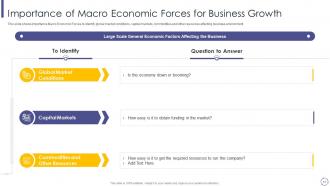
Slide 13: This slide presents Importance of Macro Economic Forces for Business Growth.
Slide 14: This slide displays title for topics that are to be covered next in the template.
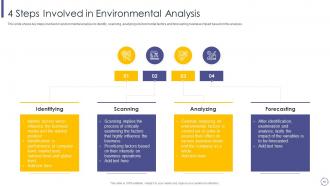
Slide 15: This slide represents key steps involved in environmental analysis to identify, scanning, analyzing environmental factors and forecasting business impact.
Slide 16: This slide showcases title for topics that are to be covered next in the template.
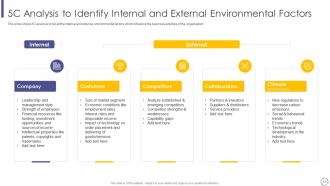
Slide 17: This slide shows 5C Analysis to Identify Internal and External Environmental Factors.
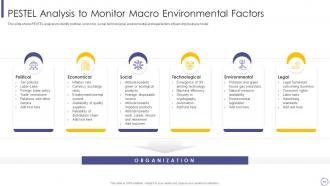
Slide 18: This slide presents PESTEL Analysis to Monitor Macro Environmental Factors.
Slide 19: This slide displays title for topics that are to be covered next in the template.
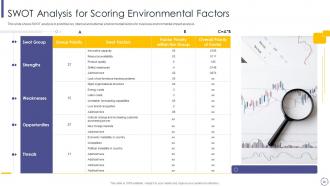
Slide 20: This slide represents SWOT analysis to prioritize key internal and external environmental factors.
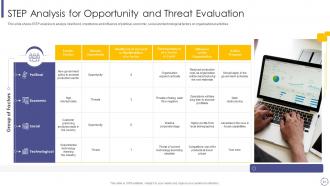
Slide 21: This slide showcases STEP analysis to analyze likelihood, importance and influence of political, economic, social and technological factors.
Slide 22: This slide shows title for topics that are to be covered next in the template.
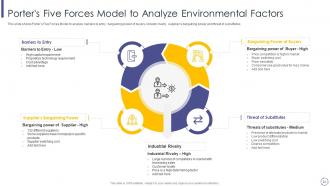
Slide 23: This slide presents Porter's Five Forces Model to Analyze Environmental Factors.
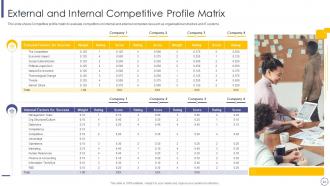
Slide 24: This slide displays External and Internal Competitive Profile Matrix.
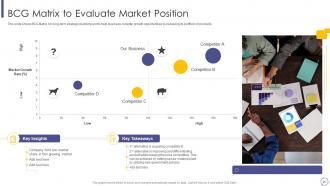
Slide 25: This slide represents BCG Matrix for long-term strategic planning and to help business consider growth opportunities.
Slide 26: This slide showcases title for topics that are to be covered next in the template.
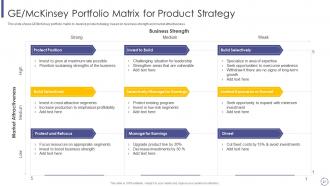
Slide 27: This slide shows GE/McKinsey portfolio matrix to develop product strategy based on business strength and market attractiveness.
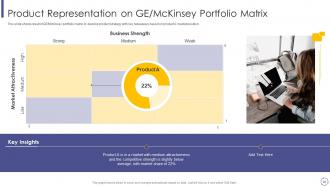
Slide 28: This slide presents result of GE/McKinsey portfolio matrix to develop product strategy.
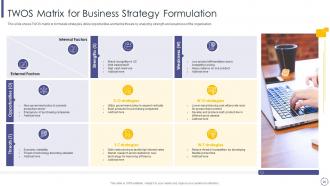
Slide 29: This slide displays TWOS matrix to formulate strategies, utilize opportunities and tackle threats.
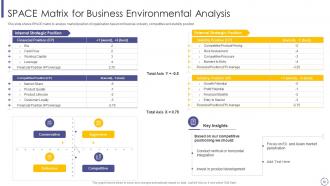
Slide 30: This slide represents SPACE matrix to analyze market position of organization based on financial, industry, etc.
Slide 31: This slide showcases title for topics that are to be covered next in the template.
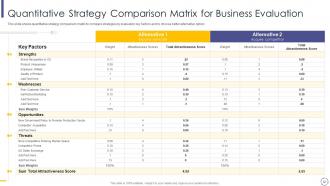
Slide 32: This slide shows Quantitative Strategy Comparison Matrix for Business Evaluation.
Slide 33: This slide presents title for topics that are to be covered next in the template.
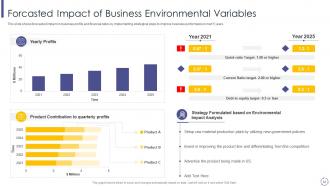
Slide 34: This slide displays forecasted impact on business profits and financial ratios.
Slide 35: This slide represents title for topics that are to be covered next in the template.
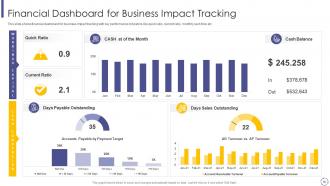
Slide 36: This slide showcases financial dashboard for business impact tracking with key performance indicators.
Slide 37: This slide shows Icons for Micro & Macro Environmental Analysis.
Slide 38: This slide is titled as Additional Slides for moving forward.
Slide 39: This slide shows Post It Notes. Post your important notes here.
Slide 40: This slide shows 30 60 90 Days Plan with text boxes.
Slide 41: This is a Timeline slide. Show data related to time intervals here.
Slide 42: This is a Financial slide. Show your finance related stuff here.
Slide 43: This slide shows Venn diagram with text boxes.
Slide 44: This is a Thank You slide with address, contact numbers and email address.
Micro and macro environmental analysis powerpoint presentation slides with all 52 slides:
Use our Micro And Macro Environmental Analysis Powerpoint Presentation Slides to effectively help you save your valuable time. They are readymade to fit into any presentation structure.










FAQs for Micro and macro environmental analysis
Oh right, PEST analysis! So you've got four main buckets to think about. Political stuff includes regulations and government policies that might mess with your project. Then there's economic factors - market conditions, inflation, interest rates, all that fun financial stuff. Social aspects look at demographic trends and cultural shifts (honestly the most interesting part imo). Technology covers innovation and digital disruption in your field. Some people throw in legal and environmental to make it PESTLE, but whatever. Just figure out which factors actually matter for your specific situation first. Don't waste time on irrelevant stuff - focus on what could really impact things.
So environmental analysis is basically your early warning system - you're watching political, economic, social, and tech trends that could mess with your business. New regulations, economic weirdness, shifts in what people want, emerging tech, all that stuff. Honestly, most people skip this because it sounds super dry. But here's the thing - make it a habit. Do quarterly check-ins where you pick apart these external factors and tweak your plans. Don't overcomplicate it though. Just track 3-4 things that actually matter to your industry consistently.
So SWOT analysis is basically mapping out how environmental stuff hits your company. Look at external threats first - climate risks, new regulations, resource shortages, whatever. Then flip it and find opportunities, like green tech trends or sustainability incentives. Internally, be super honest about your strengths and weaknesses compared to competitors. Where do you actually stand on environmental issues? The boring part is listing everything out, but honestly it's the only way to see patterns you'd miss otherwise. Start with the obvious environmental pressures, then dig into the weird subtle ones that might blindside you later.
PESTLE gives you six categories to sort through all the chaos - Political, Economic, Social, Technological, Legal, and Environmental. Way better than staring at everything and feeling overwhelmed. You can actually divide up the work too, like having Sarah research tech trends while Mike looks at regulations. The best part? You'll catch stuff you'd normally miss. I mean, who really thinks about cultural shifts when they're panicking about quarterly numbers? Short bursts work better than trying to analyze everything at once. Each bucket helps you spot real threats and opportunities instead of just guessing what might mess with your business.
So the regulatory stuff basically controls everything about your analysis. NEPA might want a full ecosystem study, but your local regs could just ask for air quality data - it's kind of a pain figuring out which rules apply where. Each framework sets different thresholds for what counts as "significant impact" too. Your whole methodology has to match whatever regulations you're dealing with, plus they'll dictate your timeline and data requirements. I swear some of these regulatory mazes seem designed to confuse people on purpose.
Map out everyone who's affected first - communities, regulatory folks, NGOs, indigenous groups. Public meetings and surveys are obvious choices, but site visits hit different because people actually see what you're studying. Share your methods upfront and loop back with preliminary findings. Two-way conversation beats just going through the motions every time. Oh, and definitely keep a stakeholder database - sounds boring but you'll thank yourself later when you need to track who said what. Workshops work great too if you can swing the logistics.
Real-time sensors and satellite tech have totally changed how we measure environmental stuff - you can spot pollutants at way lower levels now. Machine learning finds patterns in huge datasets that we'd never catch ourselves. Instead of just taking samples every few weeks, continuous monitoring gives you the full picture. Remote sensing covers massive areas at once, which is honestly a game-changer for tracking changes. Oh, and automated systems cut down on those annoying human errors too. I'd say figure out where your current measurements are weakest and start there.
Start by nailing down your scope first - what environmental stuff are you actually looking at? Grab both hard data (air quality numbers, soil samples) and qualitative observations from different sources. Here's where most people screw up though: they rely on just one dataset. Cross-check everything and hunt for patterns over time instead of random snapshots. Don't forget seasonal changes and what might shift in the future. Honestly, I'd make a checklist so you don't miss obvious things. And write down your methods clearly - future you will thank you when you're trying to recreate this mess later.
So basically, environmental analysis helps you catch problems before they blow up your business. You map out political, economic, social, and tech stuff to see what's coming down the pipeline. It's like weather forecasting but for companies - honestly way more stressful than checking if it'll rain on your barbecue. Once you've got the data, figure out which risks need fixing now vs. the ones you can just keep an eye on. Start with your biggest three threats and actually plan what you'll do if they hit. Don't just collect info and hope for the best.
Track your inputs and outputs first - energy, water, waste, carbon emissions. That's your foundation. Everyone's obsessed with carbon footprint these days (honestly kind of annoying but whatever). Also look at recycling rates and how much renewable energy you're using. Don't go crazy trying to measure everything though. Pick maybe 5-7 things that actually make sense for your industry. Start with whatever data's easiest to grab, then build from there once you've got the basics down. Resource efficiency ratios are useful too if you can swing it.
Don't rely on old data - environmental stuff changes crazy fast. Also, avoid tunnel vision where you only check obvious things like regulations but miss shifts in public opinion or new tech. Regional differences matter too since what's happening in California isn't the same as Texas, obviously. I've watched so many people just go through the motions without actually understanding how all these factors connect. Oh, and don't treat this like a one-and-done thing. Set up quarterly reviews or you'll be working with stale info again.
So environmental analysis is like getting a reality check on your sustainability stuff. First you gather actual data - carbon footprint, waste, how much you're consuming. Trust me, the numbers can be pretty shocking. Once you have that baseline, you can figure out which areas are your biggest problem spots and set targets that aren't total BS. It lets you track if you're actually improving or just spinning your wheels. The whole point is using those insights to focus your money and effort where it'll make a real difference instead of just doing random eco-friendly things that sound nice.
So LCA is basically tracking a product's environmental footprint through its entire life - from making it to trashing it. Super useful because otherwise you're just looking at one tiny piece. Like those electric cars that seem amazing until you dig into how sketchy the battery mining is, or where the electricity actually comes from. Without LCA you'll miss the big picture completely. Even doing a rough version on your projects helps - doesn't have to be some fancy formal thing. I mean, it beats making decisions blind, right?
So environmental analysis is basically detective work - you're hunting for gaps between what exists and what people actually need. Look for unmet needs, new trends, regulatory changes. Like if emissions standards get tighter, boom - there's your opening for cleaner tech. I always think about both current problems AND future ones that don't even exist yet. Pick one environmental trend hitting your industry (honestly, there's probably several). Then brainstorm three ways you could capitalize on it. Map out those pressures first, then figure out what solutions would actually work in that landscape. It's pretty straightforward once you get the hang of it.
Think of environmental analysis as doing your homework before jumping into CSR stuff. You can't just guess what'll actually help - you need real data on your impacts and risks first. Otherwise you're basically just greenwashing, which nobody wants. The analysis shows you where to focus your efforts and gives you measurable goals to track. Honestly, so many companies skip this step and wonder why their CSR programs don't work. Build your whole strategy around what the environmental analysis tells you. Data first, then action.
-
Easy to edit slides with easy to understand instructions.
-
Presentation Design is very nice, good work with the content as well.
-
Unique design & color.
-
Attractive design and informative presentation.
-
Great experience, I would definitely use your services further.