


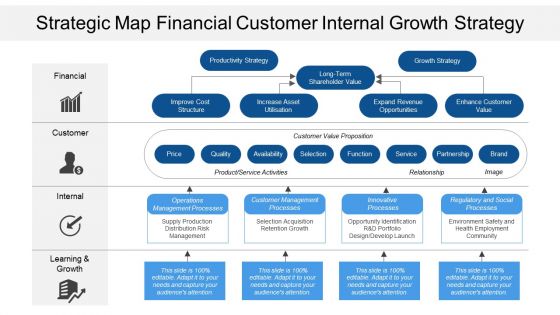
Strategische Karte Interne Wachstumsstrategie für Finanzkunden





Try Before you Buy Download Free Sample Product
 Impress Your
 Audience
 100%
100% Editable
 Save Hours
 of Time


Die Leute möchten mit unserer Strategie für internes Wachstum von Finanzkunden für strategische Kunden aktiv werden. Sie werden mit Spannung auf Ihren Start warten.
People who downloaded this PowerPoint presentation also viewed the following :
Strategic Map Financial Customer Internal Growth Strategy mit allen 5 Folien:
Sorgen Sie mit unserer Strategie für das interne Wachstum von Finanzkunden für ein Gefühl der Zufriedenheit. Beharrliche Anforderungen erfüllen können.



FAQs for Strategic map financial customer
Okay so you need to figure out four main things first. Where do you actually stand in the market vs where you think you do - be brutal about this part. Cash flow is huge, plus do you even have the right people? Your systems matter too - like, will everything crash if you suddenly get way more customers? That happened to my cousin's startup once, total nightmare. Check what competitors are up to and spot the gaps they're missing. Honestly though? Don't go crazy right away. Test stuff small first, see what works, then scale up. Way less risky than betting everything on some massive expansion plan.
Honestly, market analysis is just getting the info you need before making any big moves. Otherwise you're basically guessing and hoping for the best. Look at where competitors are screwing up, find out which customers actually matter, and spot opportunities before everyone else does. I've watched so many businesses tank because they expanded based on wishful thinking instead of real data. Figure out your current position first, then see where the gaps are. Should you go after new cities? Launch different products? Sometimes doubling down on what's already working makes more sense than chasing shiny new markets.
Look, growth doesn't just happen on its own - someone has to drive it. Leaders set the vision and make those hard calls about where to spend money and energy. They also have to sell people on change, which honestly is the worst part because nobody likes switching up what's working. But having a fancy strategy document means nothing if your leadership can't explain it or won't fight through the inevitable chaos. Some leaders just keep things running smoothly instead of actually pushing forward. So really ask yourself: are your leaders creating momentum or just babysitting the business?
Honestly, you gotta watch both the early warning signs AND the final results. Leading stuff like customer acquisition costs and how fast deals move through your pipeline? That's your heads-up. Revenue and ROI are what actually matter in the end though. We got burned once only staring at revenue numbers - by then it was way too late to fix anything lol. Real-time dashboards are clutch here. Pick maybe 4 metrics that directly connect to your goals and check them every week. Don't overthink it with too many numbers or you'll just get overwhelmed.
So organic growth is when you build everything in-house - hiring people, expanding what you already do, creating new products. Inorganic means buying other companies or merging with them. Building organically gives you way more control and keeps your company culture intact. But honestly? It's painfully slow and risky since you're basically gambling on your team's abilities. Buying companies gets you instant results - bigger scale, new markets, stuff that already works. Problem is it costs a fortune and merging two different companies together can be absolutely brutal. Most smart companies do both though. Start with organic as your base, then buy strategically when the right opportunity comes along.
Honestly, tech can be a total game-changer for growth if you use it right. Automate the boring stuff first - that frees up time for actually important work. Data analytics will show you trends and opportunities you'd totally miss otherwise. Cloud solutions are amazing because they just grow with you (seriously, how did businesses even scale before?). You can expand into new markets through digital platforms without dropping crazy money upfront. AI helps personalize everything for customers too. My advice? Figure out what's slowing you down most, then find the tech that fixes it.
Think of customer feedback like your business GPS - it tells you exactly where to put your money for the biggest wins. Look for patterns across multiple customers though, not just one-off complaints (learned that the hard way). You'll discover what features people actually care about vs. what you assume they want. Plus you can catch market shifts early and spot openings your competitors missed. I've watched companies completely change their product direction based on feedback trends, and honestly? It usually works out great. Just make sure you're reviewing this stuff regularly - maybe quarterly - so it actually influences your decisions.
Honestly, the biggest traps are pretty predictable. Companies blow through cash way too fast or jump into markets at terrible times. Most people get excited about growth but forget to check if they can actually pull it off well. Team culture stuff kills deals constantly - like, nobody thinks about whether the new people will even get along with existing staff. Oh, and don't abandon your current customers while chasing shiny new ones. That's business suicide. My take? Test things small first. Run some experiments before you bet everything on one strategy. Way less risky.
Honestly, you've gotta set hard metrics for both and actually stick to them. I'd split your budget something like 70/30 - most going to immediate money-makers, but don't ignore the long-term stuff. Companies get so obsessed with hitting quarterly numbers that they completely miss when competitors start eating their lunch. Make sure your quick wins aren't just random - they should connect to where you're headed overall. Track things like customer retention and your innovation pipeline, not just revenue. Oh, and definitely audit what you're doing right now first. Half the time people don't even realize how scattered their efforts are.
Focus on partnerships that actually fix your weak spots. Joint ventures work great if they've got distribution you're missing. Tech integrations can open up whole new markets too. Honestly? Most companies go after flashy partnerships that look good on paper but do zilch for revenue. The real winners are boring - businesses serving your exact customers without competing directly. Supply chain partnerships can cut costs pretty dramatically. Map out where you're actually stuck growing, then find partners who solve those headaches. Way more effective than chasing the trendy stuff everyone talks about.
Honestly, your company culture is what makes or breaks growth - it's like the difference between a sports car and a rusty pickup truck. Teams that embrace change and let people actually make decisions? They scale fast and pivot when needed. But bureaucratic, risk-averse cultures will kill even the best strategies before they get off the ground. I've watched this happen so many times it's not even funny. People always trump process in the end. Before you launch any big growth plans, take a hard look at whether your culture can actually handle the chaos that comes with scaling.
Focus on metrics that actually matter for your goals. Market expansion? Track customer acquisition cost and revenue per new segment. Scaling up? Watch your margins and efficiency ratios. Honestly, most teams get obsessed with vanity metrics that look cool but don't mean anything. Pick 3-5 KPIs that actually tell you if your strategy's working. Review monthly. Each metric needs an owner and a target - otherwise you're just hoarding spreadsheets for no reason. I learned this the hard way when we were tracking like 20 different things and still had no clue what was broken.
Look, when your main business gets stuck, you gotta find new ways to make money. Amazon's the perfect example - books first, then literally everything under the sun. You can target different people with what you're already selling, or maybe expand into related stuff that makes sense. I'd probably start by figuring out what you're already good at that could work somewhere else. Moving up or down your supply chain works too. The trick is finding markets that aren't totally saturated yet. Map out your current assets and see where they might fit in underserved areas.
Look, engaged employees are your secret weapon for hitting those big goals. They innovate faster and actually give a damn about customer experience. Disengaged people just sleepwalk through their jobs - total momentum killer. Your engaged team members stick around longer too, so you're not hemorrhaging all that knowledge when people quit. Here's what I've noticed though: engaged employees become these unofficial cheerleaders who'll really push when things get tough. My advice? Start asking your team what actually gets them excited about work. Trust me, the answers might surprise you.
So here's what I'd do - dig into your customer data first. Which segments actually make you money? Where's demand picking up? Then connect the dots between your sales numbers and what customers are telling you. Most companies are sitting on tons of useful data but never bother looking at it (which honestly drives me crazy). Market trends matter too, but I'd start internal. Pick your top 3 burning business questions first. Then figure out what info you need to answer them. Way easier than drowning in random spreadsheets.
-
Out of the box and creative design.
-
Unique and attractive product design.