


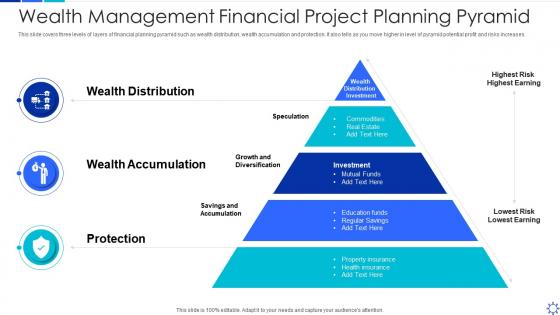
Wealth management financial project planning pyramid




Try Before you Buy Download Free Sample Product
 Impress Your
 Audience
 100%
100% Editable
 Save Hours
 of Time


Our Wealth Management Financial Project Planning Pyramid are topically designed to provide an attractive backdrop to any subject. Use them to look like a presentation pro.
People who downloaded this PowerPoint presentation also viewed the following :
Wealth management financial project planning pyramid with all 6 slides:
Use our Wealth Management Financial Project Planning Pyramid to effectively help you save your valuable time. They are readymade to fit into any presentation structure.





FAQs for Wealth management financial
Okay so there's basically five things you need to nail down for wealth management: investments, taxes, estate stuff, insurance, and retirement planning. They're all connected though - like your investment moves should factor in tax implications, you know? Estate planning has to match up with retirement goals too. I'll be honest, when I first looked into this it felt like way too much. But here's the thing - don't treat them as totally separate categories. Everything works better when it's coordinated. Best approach? Figure out where you stand with each one right now, then tackle whatever gaps could really mess with your long-term security first.
Look, everything comes down to how much risk you can actually stomach and what you're saving for. Someone conservative planning for retirement has completely different needs than an aggressive investor wanting a house in 5 years. Like, high risk tolerance might mean going 80% stocks, while being cautious could put you at 40% bonds - totally opposite approaches. Timeline's huge too since longer goals can ride out market swings better. Honestly, I think most people skip the hard part of really figuring out their tolerance first. But once you nail that down, your whole strategy basically builds itself instead of just following whatever's trending.
So asset allocation is just splitting your money between different investments - stocks, bonds, real estate, whatever. Way more important for returns than trying to pick the "perfect" stock, tbh. Different stuff does well at different times, so you're not putting all your eggs in one basket. There's this old rule where you take 100 minus your age - that's your stock percentage. Like if you're 30, maybe 70% stocks. Though honestly, adjust it based on how much risk makes you sleep well at night and what you're saving for.
So basically tax-efficient investing is just keeping more of your money instead of handing it over to the IRS. Max out your 401k and IRA first - that's the easiest win. Then there's tax-loss harvesting where you sell losers to cancel out your winners. Hold stuff longer than a year too since long-term capital gains rates are way better. Oh, and put your bond funds and REITs in tax-sheltered accounts since they're tax hogs. I swear the tax code was designed by sadists, but honestly these moves can save you serious cash. Just look at what you're currently doing and see where you're getting killed on taxes.
Look, you basically want your investment guy and estate lawyer talking to each other instead of doing their own thing. When they work together, you'll save way more on taxes and avoid those awkward moments where your strategies totally contradict each other. Most people kick themselves for not doing this earlier - I mean, why have conflicting plans, right? Your wealth transfer stuff actually makes sense with your portfolio this way. Get both of them in a room once a year minimum. Trust me, it's worth the coordination headache because everything just flows better across your whole financial picture.
Okay so basically you wanna mix it up - stocks, bonds, real estate, some international stuff. Classic "don't put all your eggs in one basket" thing, which honestly sounds cliché but actually works. Growth and defensive assets balance each other out when markets get weird. I'd say rebalance quarterly to keep your target allocations on track. Figure out your risk tolerance first, then build around that. Oh and definitely review everything once a year or if something big changes in your life - new job, marriage, whatever. The rebalancing part is key though, people forget about it.
Here's the thing - everyone thinks rich clients just want maximum returns and they're all the same. But honestly? They're super different. Some care way more about leaving money to their kids, others want to invest in causes they believe in. And here's what surprised me most - they actually hate overpaying for stuff and will question every fee. Plus they get just as emotional about money decisions as everyone else, especially when family's involved. I learned you can't just assume what someone wants based on their bank account. You've got to actually listen to figure out what matters to them specifically.
Dude, behavioral stuff seriously messes with investing. Loss aversion makes you hang onto garbage stocks way too long - I've done this so many times it's embarrassing. Then there's overconfidence where you start trading like you're some Wall Street genius. People also just follow whatever everyone else is doing without thinking. Oh, and recency bias is huge - you know how everyone piles into whatever fund crushed it last year? Classic mistake. You'll also cherry-pick news that makes your current picks look smart while ignoring red flags. Honestly, the best thing is just admitting you're human and setting up some rules to save yourself from yourself.
Honestly, just pick one tool and start there - don't overwhelm yourself. Robo-advisors handle the boring rebalancing stuff automatically. CRM systems are game changers for tracking client conversations (way better than my old sticky note system lol). Digital onboarding platforms speed things up, plus apps that show all your clients' accounts in one place are clutch. AI can help with risk assessments and spit out investment recommendations too. Your clients will love having real-time portfolio access on their phones. Cuts way down on those random "how's my money doing" calls. Build from there once you get comfortable.
Honestly? Fiduciary duty is huge - you've gotta put their interests first even if it kills your commission. Transparency about fees too, no hiding how you get paid. I learned this the hard way watching other advisors get burned. Don't push products they don't need just to hit some arbitrary target. Keep their financial stuff confidential, obviously. Document why you're recommending something major. Oh, and regularly check if your advice still makes sense for them, not for your wallet. Conflicts of interest will bite you eventually if you're not careful about disclosure.
Dude, the market's constantly changing so you gotta adjust your strategy all the time. High inflation? Jump into real estate, commodities, stuff like that. When things get volatile you'll be rebalancing way more often than you'd like - honestly such a pain but whatever. Interest rates mess with bonds and real estate big time, so your whole mix has to shift. I'd check in on everything quarterly instead of just ignoring it. Oh and don't get too attached to one approach because flexibility's everything right now. It's exhausting but that's just how it is.
Look, here's what I'd do - list out all your debts with their interest rates first. Attack the highest interest ones hard while just paying minimums on everything else. If you can get better rates through consolidation, go for it. Honestly, it drives me crazy when people stress about getting 7% returns while they're paying 18% on credit cards. That's just bad math, you know? If your debt costs more than what your investments are making, use those gains to pay it down. Don't treat debt payoff like it's totally separate from building wealth - they're connected. Focus on the expensive debt first and you'll actually get ahead faster.
Honestly, any big life change means it's time to look at your money stuff again. Marriage, divorce, new baby, different job - all that matters. Getting older changes how much risk you can stomach too. I learned that the hard way during the 2020 market craziness! If your plan isn't hitting your goals anymore, that's obvious. Haven't touched it in two years? Yeah, probably overdue. Tax laws shift around and can screw things up. My advice? Don't overthink it - just call your advisor when something major happens.
Definitely find a fiduciary - they're legally bound to put you first instead of just pushing products. CFP or CFA credentials are your friend here. Commission-based advisors? Hard pass. My first guy was basically just trying to hit his sales quota, ugh. During consultations, pay attention to whether they can actually explain their strategy without using a bunch of jargon. If they're being pushy or vague, that's a red flag. Meet with like 2-3 different firms and have them walk through your specific situation. Also check they've worked with people in your income range before - makes a huge difference in the advice quality.
Look, when geopolitical stuff goes sideways, you gotta spread your clients' money around way more. Wars or trade fights can crash one market while another explodes - seriously crazy how quick it happens. Currency swings become a huge headache too. I'd start moving some assets to safer regions and maybe look at alternative investments. Honestly, the trick is planning for disasters before they hit. Run some worst-case scenarios on your current strategies now, because scrambling during the next crisis sucks. My buddy learned this the hard way in 2020.
-
Really like the color and design of the presentation.
-
It saves your time and decrease your efforts in half.