


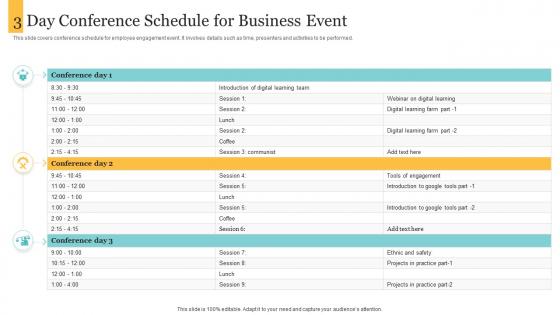
3 Day Conference Schedule For Business Event




Try Before you Buy Download Free Sample Product
 Impress Your
 Audience
 100%
100% Editable
 Save Hours
 of Time


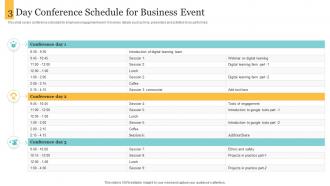
This slide covers conference schedule for employee engagement event. It involves details such as time, presenters and activities to be performed.
People who downloaded this PowerPoint presentation also viewed the following :
3 Day Conference Schedule For Business Event with all 6 slides:
Use our 3 Day Conference Schedule For Business Event to effectively help you save your valuable time. They are readymade to fit into any presentation structure.





FAQs for 3 Day Conference Schedule
Start with your audience - people can focus maybe 45-60 minutes tops before they're mentally checked out. Put keynotes mid-morning when everyone's still alert. Never schedule anything crucial after lunch (trust me, food comas are real). Build in solid networking time between sessions since that's honestly where the magic happens anyway. Oh, and buffer time is your friend - sessions always run long. Have backup plans ready for when the projector inevitably dies. But here's the thing - just ask past attendees what worked. They'll give you the real tea on what was worth their time and what wasn't.
Honestly, I'd go with like 60-70% breakouts and keep keynotes to maybe 30-40%. Kick off each day with a keynote to get everyone pumped, then dive into the smaller sessions where people can actually talk to each other - sitting there listening for 8 hours straight is brutal. Throw another keynote around lunch (people need that midday boost), then back to breakouts. Oh, and group your breakout topics by theme so attendees aren't running around confused trying to find relevant stuff. Always wrap up with a closing keynote that pulls it all together and sends them home feeling motivated.
Mix up your formats - presentations, workshops, networking breaks. People zone out otherwise. Keep sessions under 45 minutes, seriously. I've watched entire rooms just scroll Instagram by lunch when organizers drag things out. Build in participation stuff like Q&As or breakout groups. Strategic coffee breaks are clutch too. Don't just have people sit and listen - let them actually connect with each other. Oh, and get a decent mobile app where attendees can build their own schedule. That's probably your biggest win right there.
Honestly, networking is where the real magic happens at conferences. People forget most presentations within a week, but they'll remember that conversation over coffee for years. I always tell people to block out at least 30% of their schedule just for mingling - coffee breaks, lunch stuff, even those weirdly formal cocktail hours that nobody really wants to attend but somehow work. Short sessions are fine, but if you don't give attendees time to actually talk to each other, you're missing the whole point. Those random conversations turn into partnerships and job leads later.
Honestly, just go with something like Eventbrite or Cvent right off the bat - they handle registration AND schedule updates in one place. Way easier than trying to piece together different tools. I've seen people use Doodle for coordinating speakers but it gets chaotic fast with more than like 10 people. Asana's solid for tracking your million deadlines too. Oh and definitely get a mobile app going - nothing worse than frantically trying to announce room changes to 200 people. Trust me, start with one good platform instead of juggling five mediocre ones. Your sanity will thank you later.
First thing - grab your biggest speakers and stick them in those sweet spots like mid-morning or right after lunch. That's when people actually have energy, you know? Then I'd look at your audience flow and avoid putting two amazing sessions at the same time (learned that the hard way). Don't forget speaker travel stuff - nobody wants to present jetlagged at 8am. Mix up the technical levels across each track so newbies and experts both find their groove. Oh, and survey people beforehand about who they're dying to see. Saves you from playing the guessing game later.
Oh man, feedback is everything for our conference planning! We dig into pre-event surveys, old evaluations, social media rants - basically anywhere people tell us what they actually want to learn. Remember that boring keynote from last year? Yeah, that taught us to listen better. Short sessions work better than marathon talks, we've found. Hot trends are cool but people really want practical stuff they can use Monday morning. We pick speakers based on what attendees keep asking for, not just who's got the biggest LinkedIn following. Pro tip: don't wait until the end to collect feedback - grab it during breaks too.
Dude, just rotate when you schedule the important stuff so it's not always the same people getting screwed with 3am meetings. Map out everyone's time zones first, then switch it up - like Mondays work better for Asia, Tuesdays hit Europe's sweet spot, Wednesdays are good for the Americas. Someone's still gonna be chugging coffee at midnight regardless, but at least you're spreading the pain around! Record everything so people can watch later. Oh and definitely use one of those world clock apps - trust me on this one. Always put the meeting time in multiple zones on your invite because people WILL get confused otherwise.
Try fishbowl discussions - speakers sit in the middle and people can jump in from the audience. Speed networking is solid too (basically business card speed dating but way less weird). Panel discussions with people who disagree create good tension. Honestly, interactive workshops crush boring lectures every time. You could do rotating small groups or walking meetings if your space works for it. Oh, and unconference sessions where people pitch topics on the spot are pretty cool. Just don't go overboard - pick 2-3 formats max or you'll stress out your planning team.
Honestly, start with your speakers - don't just hit up the usual suspects from your network. Hunt down people from different backgrounds, industries, experience levels. The session topics matter too. Make them actually address what different groups deal with, not just generic business stuff. I went to this conference last year and it was literally the same old voices saying nothing new. So boring. Also think about accessibility early - captions, different session formats. Don't wait until the last minute to worry about diversity. That never works. Start reaching out to underrepresented speakers like, yesterday.
Mid-morning's your sweet spot for workshops - people are awake but not hangry yet. Give yourself 90-120 minutes since hands-on stuff always takes longer than you think. Info sessions? Different story. Stack those in the afternoon when everyone's food-coma anyway, but cap them at 45 minutes max because honestly, nobody listens after that. Always build in 15-minute breaks between sessions - workshops run over every single time, plus people need to pee. Oh, and alternate your formats throughout the day or you'll have a room full of zombies by 3pm.
Honestly, I'd go with 15-20% of your total time for Q&A. So like 8-10 minutes if you've got a 45-minute slot. I've been to way too many events where they cram questions into 3 minutes and it's just awkward for everyone. Keynotes are different though - maybe bump it up to 25-30% since people actually want to discuss those. The trick is planning it upfront instead of hoping there's time left over. Oh, and definitely tell your speakers their real presentation time so they don't ramble and kill your Q&A buffer!
Honestly, keeping your schedule loose is a game changer. When something better comes along or a session drags on forever, you're not screwed. Back-to-back meetings are the worst - half of them end up being duds anyway. The random conversations you stumble into? Way more valuable than most of the formal stuff. You actually get time to think about what you learned instead of sprinting between rooms like you're training for a marathon or something. I'd say book about 60-70% of your time and leave the rest open.
Honestly, visual templates are a lifesaver for conference schedules. Color-code your tracks, use clear time blocks, and throw in some icons for different sessions. Nobody wants to squint at a massive PDF trying to figure out what's happening when. Templates help you break everything into chunks people can actually scan through quickly. Speaker photos are nice too if you have space. Pick something that fits your conference style, then slap your branding on it. Oh and start with a basic timeline template - you can always get fancy later. Trust me, your attendees will thank you.
Check your attendance numbers first - how many showed up, who bailed early, that kind of thing. Survey people within like 48 hours while they actually remember stuff. Ask about pacing and break timing especially. Nothing's worse than getting terrible session ratings just because your schedule sucked! Look at which sessions were packed vs totally empty when you check registration data. Also see if your keynotes hit when people had energy or if everyone was already brain-dead. The networking bits matter too - did people actually connect or just awkwardly stand around? Honestly, the qualitative feedback is usually more helpful than raw numbers.
-
I was mind-blown by the services that SlideTeam provided me. Thanks a ton!
-
Awesome use of colors and designs in product templates.