

 0 Comment
 Customer Reviews

"Forecasting is not about predicting the future; it's about minimizing surprise."
Headcount forecasting can be compared to planning a massive party without knowing how many people will come; it is nearly impossible to do it without proper tools. No matter if you are expanding your business, facing the issues of limited budgets, or changing market conditions, you should have a proper headcount forecasting process. To help you with this, we have prepared a list of the best headcount forecasting templates that can be suitable for almost any kind of business. These templates are intended to help you organize your thinking, be clear, and make strategic choices. Every template is designed in detail to assist you in identifying the existing staff patterns, estimating the future needs of your organization, and integrating your HR planning with the overall business objectives. Below are the Top 10 Headcount Forecasting Templates that can be of great help in improving the overall forecasting and strategic planning of your organization, along with examples and samples.
Template 1: Employee Headcount Forecasting Dashboard for HR
The current slide offers a complete dashboard that is focused on forecasting the employee headcount and is made for the HR departments. It contains primary data such as the number of new employees and reasons for resignation of those who resigned, as well as employee distribution by departments. The use of tables and figures in the form of charts and graphs gives a clear picture and makes it easy to comprehend the changes in the workforce. This particular dashboard is accommodating for HR professionals since it provides real-time data on staffing issues that can assist in determining the causes of turnover and the needs of the departments. To this end, it becomes easier for HR to plan for recruitment measures and retention practices and even monitor the spread of the workforce to fulfill organizational objectives, thus contributing to organizational effectiveness and development.

Template 2: Effective Headcount Planning and Forecasting Strategies
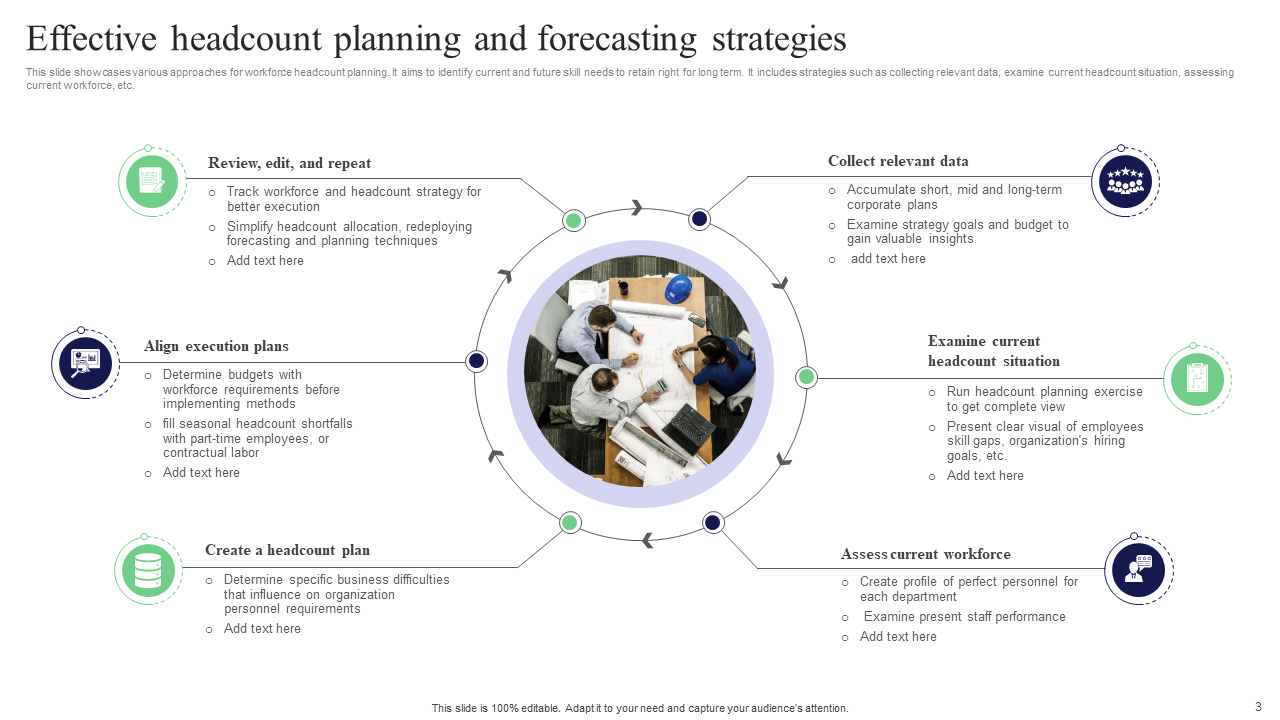
This template provides several strategies for the proper management of the workforce headcount. The slide is based on an image, and the strategies include "Review, Edit, and Repeat," "Collect Relevant Data," "Examine Current Headcount Situation," and "Align Execution Plans." Each strategy is located around the image, thus creating an appealing presentation. Thus, this template is designed to identify the present and future skills required to prevent key employees from leaving the company for good. By using these strategies, organizations can perform a systematic approach to their workforce, support their decisions with data, and build their headcount plans according to the organization's goals.
Template 3: Headcount Forecasting Checklist to Improve Workforce Effectiveness
This template depicts an estimation checklist that aims at guaranteeing a professional workforce. On the left side, there is a detailed list of all the necessary elements that should be taken into consideration for effective headcount forecasting. On the right side of the screen, there are two columns, which are 'Status' and 'Priority', whereby users can easily track the status and the priority of the tasks. This format can be handy in ensuring that organizations go through all the significant aspects of the workforce planning process systematically. Through this model, companies should identify all the aspects they need to take into consideration to be able to have viable forecasts and boost productivity when it comes to managing their workforce.

Template 4: Trends Influencing Employee Headcount Forecasting
This template shows the main drivers that affect employee headcount forecasting. On the left side, it has various hiring trends like remote work, the gig economy, and automation, among others. The slide has two columns, one as status and the other as impact; this helps the users monitor the current state and determine the effects of the trends on their workforce planning. This format assists organizations in being aware of the prevailing market trends and making the necessary changes in the forecasting process. Thus, it will help organizations predict the future more effectively, match their personnel supply with the changes that are taking place in the industry, and adopt a preventive strategy toward talent management and workforce planning.

Template 5: Headcount Demand and Supply Forecasting Model
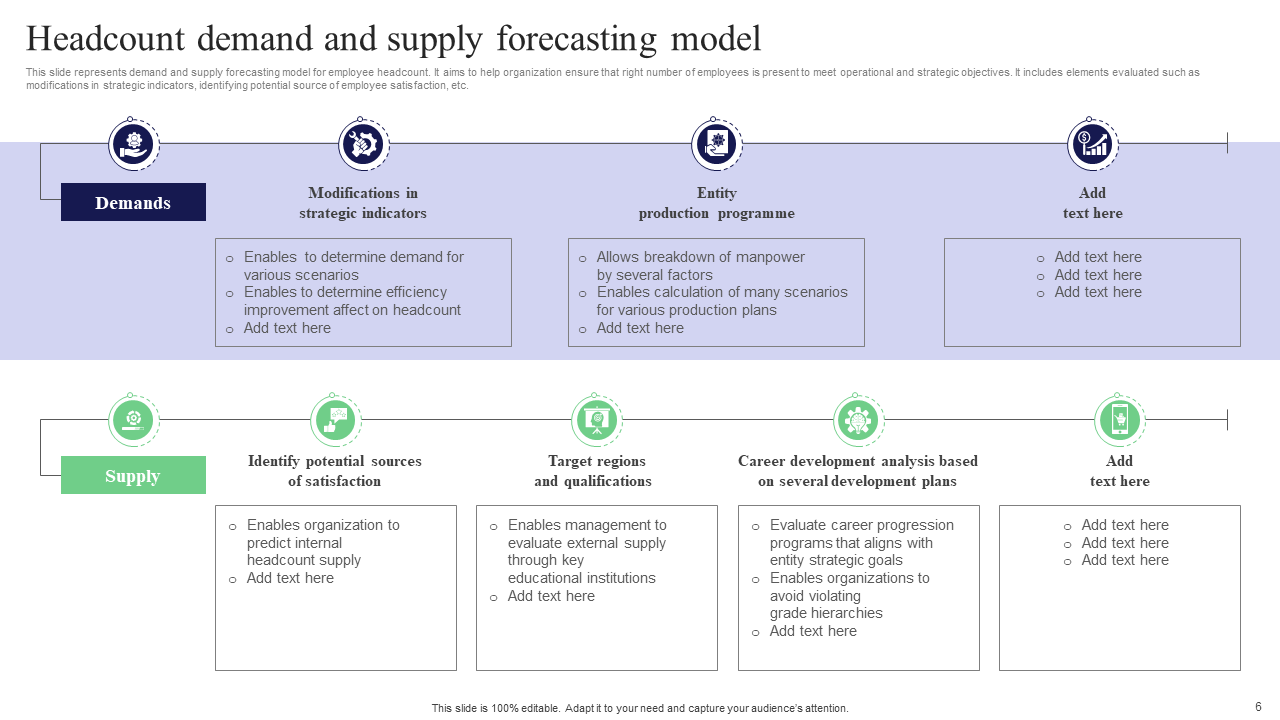
This slide is horizontally split into two sections: The upper part is dedicated to the headcount requirement, whereas the lower part is related to the potential supply. It contains aspects like changes in strategic indicators, entity production programs, and other factors that impact workforce planning. Each section is followed by sufficient blank space for the users to type in their text and modify the model based on their requirements. This template aims to assist the organizations in ensuring that the workforce demand and supply are well managed.
Template 6: Impact of Successful Headcount Forecasting on Quarterly on KPIs
This template has a clear structure for reporting the quarterly KPIs for the employee headcount forecasting. All metrics are listed on the left-hand side, with four columns to the right for each quarter. The main findings are presented for the eight most essential indicators as a means of focusing the reader's attention on important data. This slide can be used by an organization to track their workforce trends and have a way of evaluating them on a quarterly basis so that any changes that may be necessary can be made. Thus, the implementation of these KPIs can contribute significantly to the understanding of the headcount trends and patterns that will help to avoid the negative consequences of incorrect planning, provide efficient utilization of resources, and achieve the desired objectives.

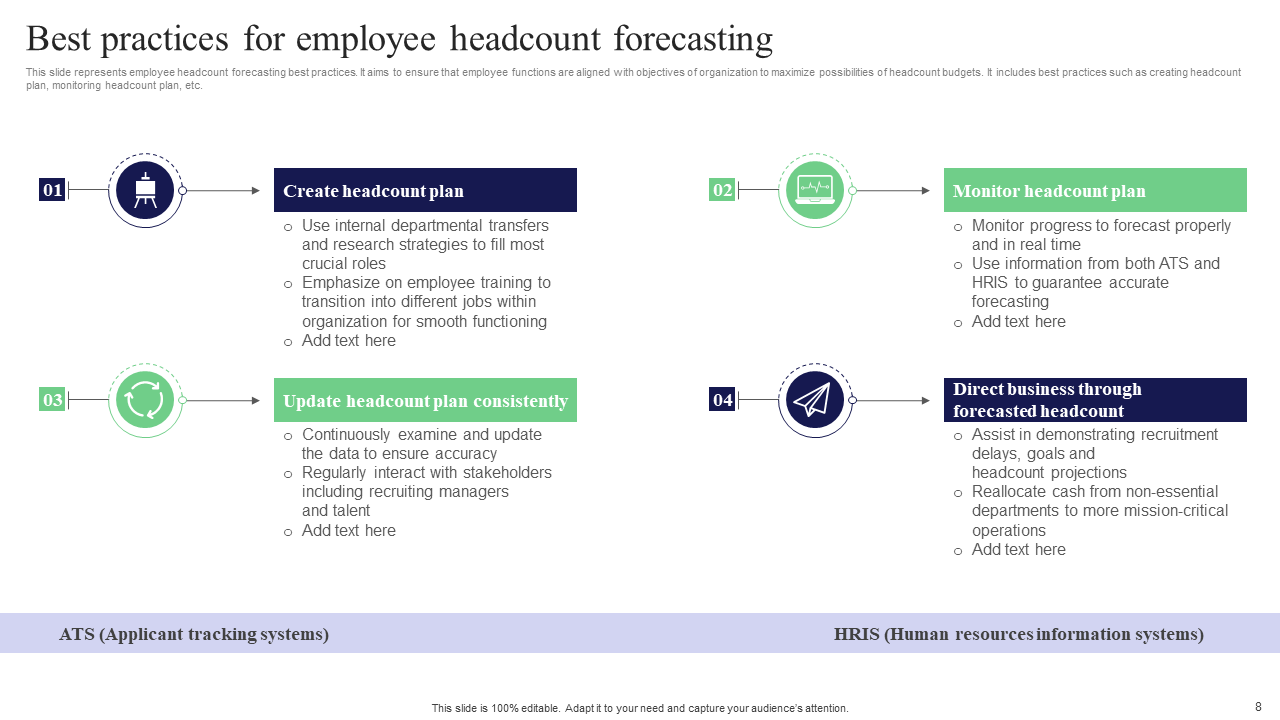
Template 7: Best Practices for Employee Headcount Forecasting
The following is a guide to the most efficient ways of conducting employee headcount forecasting. It includes four key pointers: The four elements of the headcount plan include; "Create Headcount Plan," "Monitor Headcount Plan," "Update Headcount Plan Consistently," and "Direct Business Through Forecasted Headcount." Each of the elements is intended to help organizations to have a proper way of making forecasts. The process of developing a headcount plan includes defining the goals and needed resources. An ongoing review of the plan makes it possible to meet business needs as they stand at the time of reviewing the plan. It helps in the provision of the plan being updated at all times to reflect the current data and changes in the circumstances.
Template 8: Employee Headcount Forecasting Approach Stages
The following is an improved step-by-step guide to an employee headcount forecasting process that organizations can follow. It is organized into five columns: Planning, Data Collection, Design, and Result Evaluation. The first stage is the Preparation stage, which involves specifying objectives and determining the extent of the forecasting activities. Data Gathering deals with identifying and acquiring information that may include the present statistics of the workforce and market trends. The Design stage is the most crucial stage where the forecasting model is created, and it includes many analysis tools and procedures. Result Analysis involves determining the implications of the predicted data in order to make proper conclusions.

Template 9: Headcount Forecasting Budget Allocation Plan
This template contains a suggested structure for the budget forecast related to the number of employees. On the left side, it contains a tabular area of projected headcounts, which is very beneficial in presenting the expected number of individuals to be hired and included in the organization. On the right, there are five vertical columns, each for a month of the year, for easy and detailed planning of the month's expenses. This layout enables organizations to manage resources properly and check on the element of budgetary control and headcount projections.

Template 10: Solutions to Overcome Headcount Forecasting Challenges
This template offers several approaches for addressing the most frequent issues that arise during headcount forecasting. It is organized into three rows: Each column has subdivided the given challenges into three main sections, namely, 'Challenges,' 'Solutions', and 'Impact.' Each sub-section in this column systematically identifies a particular challenge that is likely to be encountered in headcount forecasting and provides a clear and practical solution to the challenge identified while at the same time explaining the possible repercussions of implementing this particular solution.

Final Word
Strategizing for the future of your employees is as tricky as trying to guess the weather – both need the right equipment and information! This being the case, in the ever-evolving world of HR, a proper headcount forecasting strategy must be put in place. The following are the top 10 headcount forecasting templates that we have carefully selected to make this process easier for you. Each template includes dashboards and strategic planning models, KPI metrics for a quarter, and budget allocation plans – all of them are designed to provide clarity and improve decision-making and synchronization of workforce planning with the company's goals. These tools can assist you in mapping the trends related to employees and, at the same time, be ready for the changes that may occur in the future. Do not allow the fog of workforce planning to hinder your organization's effectiveness. Here are our slides. Use them for your headcount forecasting and achieve accuracy.