


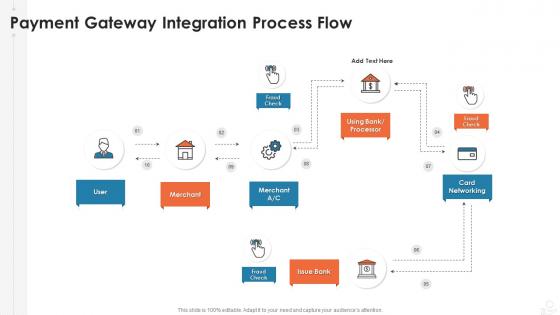
Payment gateway integration process flow




Try Before you Buy Download Free Sample Product
 Impress Your
 Audience
 100%
100% Editable
 Save Hours
 of Time


Our Payment Gateway Integration Process Flow are topically designed to provide an attractive backdrop to any subject. Use them to look like a presentation pro.
Payment gateway integration process flow with all 2 slides:
Use our Payment Gateway Integration Process Flow to effectively help you save your valuable time. They are readymade to fit into any presentation structure.

FAQs for Payment gateway
Security is your top priority - PCI compliance isn't optional. Look for multiple payment options and solid fraud protection too. Pricing transparency matters because hidden fees are the worst. Integration with your current setup should be straightforward, and decent documentation helps tons. Fast transactions keep customers happy, obviously. Mobile optimization is huge since everyone shops on their phone now. Oh, and check their support quality beforehand - you don't want to be stuck when something breaks at 2am. Honestly, I'd write down what you actually need first, then see which gateways tick those boxes.
Dude, integrated payments are a game changer. Your customers stay on your site instead of getting bounced around to weird-looking checkout pages that scream "scam alert." Trust me, cart abandonment drops big time when people don't have to create accounts on random payment sites. Plus you can offer everything - cards, Apple Pay, those buy-now-pay-later things everyone's obsessed with. Honestly the biggest win is just removing friction. People are lazy (myself included) and if paying takes more than like 3 clicks, we're out. Keep it simple and your conversion rates will thank you.
So payment gateways usually hit you with setup fees ($0-500), monthly fees ($10-50), and transaction fees - around 2.9% + $0.30 is pretty normal. Setup fees can sometimes get waived if you're doing decent volume, so definitely push back on those. Transaction fees end up being your biggest expense over time. Stripe and Square are solid options, PayPal too obviously. Oh and factor in dev time if you're doing custom integration vs their hosted thing. Honestly just calculate your monthly volume first - makes it way easier to see which pricing actually works for you.
So PCI compliance is basically the security rules you gotta follow when handling credit card payments. Without it, you're looking at huge fines that'll wreck your business fast. The payment gateway does most of the hard work for you (seriously, thank god for that), but your servers still need to be compliant too. Always use HTTPS and never - like NEVER - store card details on your own systems. That's just asking for trouble. Pick a gateway that's already PCI compliant and get your own certification before you launch. Trust me on this one.
PCI DSS compliance is your starting point - that's the basic security standard you need to meet. Tokenization helps a ton since it replaces actual card numbers with random tokens. SSL/TLS encryption for data transmission is non-negotiable. Multi-factor authentication? Absolute must-have, seriously. Real-time fraud detection tools will catch sketchy transactions before they become problems. Oh, and keep your payment gateway software updated - those security patches matter more than people think. I'd start with a PCI audit of what you've got now. Shows you exactly what needs fixing.
So basically, hosted gateways redirect your customers to PayPal or whatever to enter their card info, then they come back to your site. Integrated ones let people pay right on your page without bouncing around. Hosted is super simple to set up and you don't have to deal with all that security compliance stuff - honestly such a headache. But integrated gives you way more control over how everything looks and feels. My old boss was obsessed with the "seamless experience" thing. Really comes down to how much coding you want to deal with. I'd just go hosted first if you need something working fast.
So if you're running a small business, just go with Stripe, Square, or PayPal. They're dead simple to set up and won't hit you with weird monthly fees. I'm kinda biased toward Stripe tbh - works great for most stuff. Big companies though? Totally different story. They need heavy-duty options like Authorize.Net or Adyen that can handle tons of transactions and all those fancy integrations. Plus enterprises actually want the complex features - multi-currency, detailed reporting, all that jazz. Really comes down to your volume and budget. Small biz = keep it simple. Enterprise = go robust.
Honestly, just grab an SDK from Stripe or PayPal - way easier than coding payments yourself. Their docs are actually decent too. Definitely set up sandbox testing first because you'll break things and nobody wants real transactions going haywire. I learned that one the hard way lol. Error handling and webhook stuff should be priority
-
The content is very helpful from business point of view.
-
Editable templates with innovative design and color combination.
-
Awesomely designed templates, Easy to understand.