


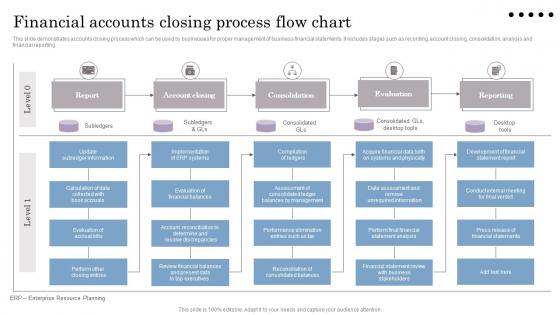
Financial Accounts Closing Process Flow Chart




Try Before you Buy Download Free Sample Product
 Impress Your
 Audience
 100%
100% Editable
 Save Hours
 of Time


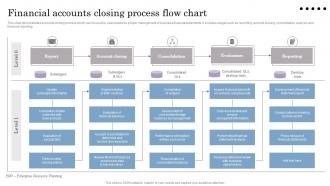
This slide demonstrates accounts closing process which can be used by businesses for proper management of business financial statements. It includes stages such as recording, account closing, consolidation, analysis and financial reporting.
People who downloaded this PowerPoint presentation also viewed the following :
Financial Accounts Closing Process Flow Chart with all 6 slides:
Use our Financial Accounts Closing Process Flow Chart to effectively help you save your valuable time. They are readymade to fit into any presentation structure.





FAQs for Financial Accounts Closing
Honestly, start with reconciling accounts and journal entries first - trust me on this one. Review your accruals and prepayments next, then tackle the trial balance and financial statements (ugh, the boring stuff). You'll need to analyze any budget variances after that. Management review comes next, obviously, then distribute reports to stakeholders and handle regulatory filings. Pro tip though - seriously get those reconciliations done early. I learned this the hard way when I was scrambling last quarter trying to find a $500 discrepancy at like 9pm the night before everything was due. Not fun.
Honestly, detailed checklists are your best friend here - they'll save you when everything's falling apart at month-end. Don't wait until the end to reconcile your balance sheet accounts, do it daily. Have someone else review any big journal entries too. I always run variance reports against last month and budget to spot weird stuff. Here's what really works though: close everything internally like 2 days early. Gives you breathing room for reviews and fixing whatever you missed. Trust me on the early close thing - it's a total lifesaver.
Honestly, the biggest game-changer is how it kills all that manual busywork that used to drag out month-end forever. Automated journal entries, real-time validation, workflow approvals - no more of those ridiculous email threads where you're waiting on Karen from accounting for three days. Dashboards show you exactly what's done and what isn't, so you're not playing detective anymore. Oh, and automated reconciliations catch mistakes way faster than staring at spreadsheets until your eyes bleed. I'd start with whatever's eating up most of your time right now and find tools that fix those specific headaches first.
Oh man, tight deadlines are the worst part honestly. Your team's probably drowning in manual stuff that takes forever, plus all your data is living in like 5 different places that don't sync up. Version control becomes this total mess - someone's using last week's spreadsheet while you've already updated everything. Then you're trying to reconcile accounts from multiple sources and it's chaos. Different departments always submit their numbers late too (why is it always the same ones?). My advice? Figure out what's killing you most and fix that first. Don't try tackling everything.
Monthly is definitely the way to go for most companies. Weekly gets crazy expensive and honestly, who has time for that? Quarterly though... ugh, that's where things get messy fast. I've watched teams scramble trying to find mistakes from three months back - not fun. The monthly approach gives you solid visibility without burning out your accounting team. You'll catch problems before they snowball, plus everyone can actually focus on bigger picture stuff. Oh, and definitely create some kind of checklist system. Aim to wrap everything up within a week after month-end if you can swing it.
Monthly closes are pretty straightforward - just basic P&L stuff and making sure your accounts reconcile. Nothing too crazy. Quarterly is where it gets messy though. You're doing all that monthly work PLUS journal entries, accruals, and prepping reports for management (sometimes investors too). Annual closes? That's a whole different animal. Full audits, comprehensive reviews, tax prep - honestly it can drag on for weeks. Here's the thing - if you nail down your monthly process first, the quarterly and yearly ones won't make you want to pull your hair out as much.
Variance analysis is like having a financial radar system - it catches weird changes between periods before they blow up later. Set your thresholds (maybe 5% or whatever makes sense) and let it flag the accounts that actually need your attention. Way better than staring at every single line item like a zombie. Honestly, I wish I'd started using this sooner because it finds errors and missing accruals super fast. Your biggest balance sheet accounts are the best place to jump in first. Trust me, you'll immediately know exactly where to focus instead of wandering around aimlessly during close.
Grab your P&L, balance sheet, and cash flow statements first. Then get all the supporting schedules, reconciliations, and any adjusting entries with backup docs. Your trial balance and general ledger details are must-haves too. Honestly, auditors are obsessed with that stuff. Any big transactions or estimates from the period? Have documentation ready for those. The trick is staying organized so you're not frantically digging through files when they ask questions. Oh, and definitely make a closing checklist - trust me, it'll save your sanity next time around.
Okay so first thing - write down literally every task your team does during closing. Even the obvious stuff. Give each task a clear owner and deadline, plus note what depends on what so nothing falls through the cracks. Your first draft will probably be way too long and detailed, but honestly that's better than missing something important. Build in review points and approval stages too. Then actually test it for a few cycles and tweak based on reality vs what you thought would happen. Oh and this is key - get everyone's input who'll actually use it, because a checklist people ignore is basically useless.
Don't wait until month-end to reconcile your big accounts - you'll hate yourself later. I do cash, AR, and inventory daily throughout the month. Honestly, high-activity accounts are where stuff goes wrong most often. Document any weird variances right when you spot them, and dig into anything over your threshold immediately. Create templates so your team isn't starting from scratch every time. Oh, and make sure someone actually owns each reconciliation - nobody wants that "I thought you were doing it" drama. Start prepping like 3 days early.
Honestly, daily check-ins are a lifesaver here. Set up dedicated Slack channels for each part of the closing process - email threads become a nightmare otherwise. Document all the dependencies between tasks upfront. If someone hits a roadblock, they need to speak up immediately, not wait until everything's falling apart. Brief 15-minute standups each morning during closing week keep everyone on the same page. Oh, and get shared dashboards that update in real-time so nobody's working off old info. Better to overcommunicate than have surprises pop up at the worst moment.
Honestly, days to close is your biggest metric - everything else flows from there. Track manual journal entries, how many accounts you're reconciling on time, and error rates in your deliverables. Overtime hours matter too because burnout is real. Post-close adjustments are actually a huge red flag since they usually mean something's broken upstream in your process. Don't forget revenue recognition accuracy and hitting compliance deadlines. Here's what I'd do: figure out your current baseline first, then set targets you can actually hit. Most teams I've seen can cut 1-2 days pretty easily within six months just by watching these numbers consistently.
Ugh, regulatory changes are the worst for closing deadlines. New rules pop up with zero warning and suddenly you need different paperwork or extra approval steps that weren't there before. Your team's basically playing catch-up the whole time. I'd say build in some cushion time when you're planning your closing calendar - trust me on this one. Also set up a quick way to figure out how new regs will hit your specific process. Try staying connected with your accounting contacts so at least you're not completely blindsided when changes drop.
Oh man, dealing with global teams during close is honestly such a headache. Some cultures are crazy strict about deadlines while others are way more relaxed and focus on relationships first. Then you've got different accounting rules everywhere, holidays that never line up, and don't even get me started on language mix-ups with financial data. Technology adoption varies wildly too - what works in one office might flop in another. I learned the hard way to always build in extra buffer time. Setting up standardized processes from the start helps, but you'll still need patience for all the cultural quirks.
Think of scenario planning as your safety net for closing chaos. You map out different "what if" situations so you're not panicking when stuff inevitably breaks. System crashes, Bob from accounting calls in sick, delayed vendor payments - whatever. I swear month-end always finds new ways to mess with you! Create backup workflows for your most likely disasters. Three scenarios is a good start. Short version: figure out what could go wrong, then have a plan ready. Sounds obvious but most people skip this step and regret it later.
-
If you have visited their site and failed to find the products, try reaching the customer service because it will be the case that you didn't use the search bar well.
-
Graphics are very appealing to eyes.