


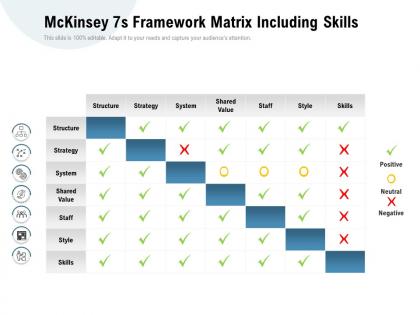
Mckinsey 7s framework matrix including skills




Try Before you Buy Download Free Sample Product
 Impress Your
 Audience
 100%
100% Editable
 Save Hours
 of Time


Identify your biggest assets with our Mckinsey 7s Framework Matrix Including Skills. Elaborate on areas of core competency.
People who downloaded this PowerPoint presentation also viewed the following :
Mckinsey 7s framework matrix including skills with all 2 slides:
Elaborate on areas of core competency with our Mckinsey 7s Framework Matrix Including Skills. It helps identify your biggest assets.

FAQs for Mckinsey 7s framework
So basically there's hard and soft stuff. Hard = strategy, structure, systems - the concrete things you can change pretty easily. Soft = shared values, staff, skills, style - all the messy people/culture parts that take forever to shift. Here's the thing though - they're all connected. Change your team structure? Now you gotta update systems and retrain people. It's like dominoes. That's why most change initiatives fail honestly - companies just focus on strategy or reorganizing and ignore everything else. Before making any big moves, sketch out how it'll affect all seven areas. Saves you from those "oh crap, we didn't think about..." moments later.
Honestly, you've got to dig into all seven S's - strategy, structure, systems, shared values, style, staff, and skills. Interview people, run some surveys, review docs to see where you actually stand right now (not where you think you stand). The real magic happens when you spot the disconnects - like when leadership talks about collaboration but your whole structure rewards individual performance. That stuff drives me crazy because it's so common. Map out how these elements connect, then focus on fixing the biggest gaps first. Don't try to tackle everything at once or you'll burn out your team.
So the 7S thing is pretty smart - you map out strategy, structure, systems, skills, staff, style, and shared values all at once. Makes it super obvious when stuff doesn't line up (honestly, most companies are messier than they think). Write down where you are now across all seven areas, then figure out where you want to be. The gaps? That's your to-do list right there. I've seen people skip the "current state" part and just jump to planning - don't do that. You'll miss half the problems hiding in plain sight.
So shared values are like the DNA of the 7S model - they're what actually drives your company culture and affects everything else. Look at what behaviors get rewarded and what stories people tell around the office. That'll show you way more than whatever's hanging in the conference room. Check your hiring patterns too, plus why people actually quit. The tricky part? Separating the real values from the BS corporate speak. Most companies have this weird gap between what they say matters and what actually influences decisions day-to-day. Focus on the authentic stuff that drives behavior.
So basically, run through each of the 7S elements and see what's blocking your teams from actually working together. Map out your structure first - are departments stuck in silos? Check your processes for bottlenecks too. The soft stuff matters more than people think though. Leadership needs to actually model cross-functional behavior, not just talk about it. Your team values should scream collaboration. Skills-wise, figure out who needs better communication training. Honestly, I'd get reps from each department in a room and just audit the whole thing together. They'll spot the biggest problems faster than any consultant would.
Most teams screw this up by treating it like some one-and-done assessment. Big mistake. They obsess over strategy and structure - the obvious stuff - but totally ignore the messy human parts like company culture and management style. That's actually where most problems hide though. Oh, and here's what nobody tells you: touch one element and watch everything else shift. It's all connected. Don't try forcing your situation into the framework either. Just use it to get your team talking about what's really broken. Way more useful that way.
So basically, map both companies using the 7S Framework - strategy, structure, systems, shared values, style, staff, and skills. Think of it like a compatibility test before moving in together (weird analogy but it works lol). The framework shows you where things might clash, like totally different company cultures or systems that don't talk to each other. Pay extra attention to the "soft" stuff - culture, leadership style, that kind of thing. That's where most mergers actually blow up. Once you spot the mismatches, draft some action plans to fix them before signing anything. Don't skip this step!
Okay so you're gonna have to rethink a bunch of stuff. Decision-making gets tricky when everyone's scattered, so nail down who calls the shots on what. Everything needs to work digitally first - communication, reviews, all of it. Skills-wise, people better know their tech and how to actually collaborate online. Hiring changes too - you can forget about location and focus on self-motivated people who fit your vibe. The talent pool thing is honestly incredible now. Leaders need to show up digitally and be way more transparent than before. Some strategies might need tweaking for remote delivery. Culture becomes harder since you lose that office energy, so your values really matter. Start by figuring out what currently assumes everyone's in the same room.
Honestly, the 7S Framework is clutch for digital transformation. Most companies just throw money at new tech and wonder why everything falls apart. This framework makes you check both the obvious stuff (strategy, structure, systems) AND the human side - skills, staff, leadership style, company culture. That's where things usually go sideways, actually. Your people might not know how to use the new tools, or your culture might resist change completely. Short sentences work. The framework is basically your sanity check to catch those gaps before they torpedo your whole project. Think of it as your transformation playbook.
So track your employee engagement scores first - that's honestly the most telling metric. If people aren't buying in, nothing else matters. Then watch your operational stuff like cycle times and error rates since those show whether your systems actually work together. Customer satisfaction is another big one because when everything clicks, customers feel it. Oh and definitely do culture surveys regularly - I'd say quarterly maybe? That's where you'll catch problems before they blow up. Productivity measures are solid too. The whole point is spotting misalignment early.
Honestly, you've gotta be the example 24/7 - it's exhausting but people notice everything. Your decision-making style becomes their roadmap. I'd set up regular touchpoints like town halls or team check-ins where your approach is super visible. Create little rituals too - recognition stuff, cross-team projects, whatever fits your vibe. How you run meetings matters more than you think. The tricky part? Every single interaction counts because they're basically copying your playbook. Open-door policies help, but real talk - consistency is what actually sticks. People will mirror however you handle conflicts and celebrate wins.
Honestly, the 7S Framework kinda sucks when things are moving fast or you're in crisis mode. Quick decisions beat comprehensive analysis every time in those situations. For startups? Forget about it - mapping "systems" with three people feels ridiculous. Works way better for established companies that actually have real structures and hierarchies. Major disruption happening? Skip the 7S deep dive completely. Go with something more agile instead. Save this framework for when you've got time to sit down and really act on all those detailed insights you'll uncover.
Honestly, you don't need to blow your budget on this. The 7S thing is really just about figuring out what you already have going on. Grab your team and do a whiteboard session - most of this stuff is already floating around in everyone's heads anyway. Look for the obvious disconnects first, like when your company says one thing but everyone actually does something totally different. That's usually where the real problems are hiding. Don't try fixing everything at once though, that's a recipe for burnout. Pick one area and work on it. Maybe make it a monthly check-in so you're not just doing it once and forgetting about it forever.
Look at IBM in the 90s - they completely flipped from hardware to services and had to change everything at once to make it work. Southwest Airlines is another good one, though honestly they're kind of in a league of their own with how tight their operations are. That's why Delta and United can't just copy them, you know? Netflix did something similar when they ditched DVDs for streaming. They didn't just change their tech - they restructured teams, retrained people, the whole nine yards. Pick one of these and try mapping out how they tackled all seven elements. You'll see the connections pretty quickly.
Honestly, these three frameworks work really well together if you don't overthink it. I'd start with PESTLE for the external stuff, then SWOT to figure out where you stand. After that, use 7S to see if your internal pieces actually fit together - spoiler alert, they usually don't. Teams I've worked with get stuck trying to run all three at once, which just creates a mess. The 7S part is gold for figuring out why your brilliant strategy from SWOT isn't actually happening. Nine times out of ten it's because your systems are outdated or people don't have the right skills. Think of 7S as your reality check once you're done with the big picture thinking.
No Reviews