


Metric Dashboard For Loan Fund Portfolio Analysis Ppt Show Example Introduction




Try Before you Buy Download Free Sample Product
 Impress Your
 Audience
 100%
100% Editable
 Save Hours
 of Time


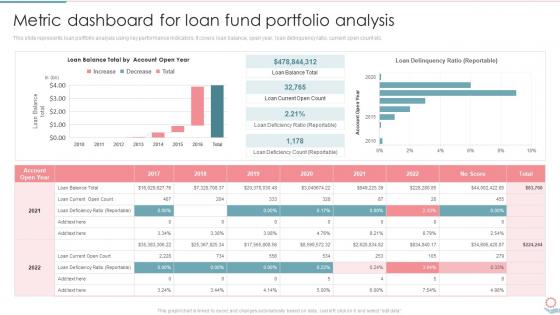
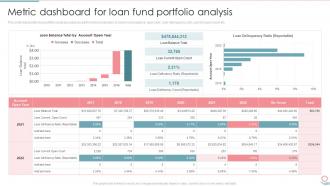
This slide represents loan portfolio analysis using key performance indicators. It covers loan balance, open year, loan delinquency ratio, current open count etc.
People who downloaded this PowerPoint presentation also viewed the following :
Metric Dashboard For Loan Fund Portfolio Analysis Ppt Show Example Introduction with all 7 slides:
Use our Metric Dashboard For Loan Fund Portfolio Analysis Ppt Show Example Introduction to effectively help you save your valuable time. They are readymade to fit into any presentation structure.





FAQs for Metric Dashboard For Loan Fund Portfolio Analysis Ppt
You'll wanna track net annualized return, default rates, and loss severity first - those are your main performance indicators. Vintage analysis is huge too since it shows how different loan groups perform over time. Also keep an eye on weighted average life, yield spread, and recovery rates. Recovery rates are honestly so underrated but they're critical for understanding your downside protection. Oh and compare everything against benchmarks - don't just look at one-time snapshots. Track trends quarterly instead. There's a lot to monitor but these metrics will give you the full picture of how your fund's actually doing.
Look, diversification is honestly your best friend when it comes to loan funds. Spread your money across different borrowers, industries, loan types - you know the drill. If one loan goes bad, it won't wreck everything since your other investments pick up the slack. Mix up loan sizes, different sectors, maybe some geographic variety too. Oh and credit quality - don't just go for the risky high-yield stuff. Rule of thumb? Keep each individual loan under 5-10% of your total portfolio. Trust me on this one.
So credit quality is basically how likely people are to pay back their loans - pretty crucial stuff. Check out the credit ratings and default rates first. Then look at how much investment-grade debt versus junkier high-yield stuff they're holding. Better credit quality means lower returns but you won't lose sleep over defaults. Honestly, I'd rather have boring reliable returns than stress about my money disappearing. It's like picking a Toyota over some sketchy used BMW, you know? Just make sure their risk level actually fits what you're comfortable with before you put money in.
Look, historical performance data is like your best guess at what'll happen next - it shows default patterns, how long recoveries take, all that stuff. You need at least 3-5 years to see how loans act during good times vs when everything goes to hell. Break it down by loan type and borrower profiles because a small business loan isn't gonna behave like a mortgage, obviously. The data helps you stress-test assumptions so you don't get roasted by investors later. Honestly, I'd rather have too much historical data than not enough when I'm building projections.
Don't get caught up in the shiny headline numbers - that's where most people mess up. Past performance means basically nothing when the economy shifts, which honestly should be obvious but somehow isn't. Geographic concentration is huge too, and industry concentration will bite you. I've watched so many people ignore this stuff. Stress-test everything and dig into loan-to-value ratios, who's actually borrowing, payment histories. Oh, and definitely check out how thorough the fund manager's due diligence process actually is before you commit to anything.
So macro stuff hits your loan fund in a bunch of ways. Interest rates are huge - they mess with your funding costs AND how many borrowers default. GDP growth, unemployment, inflation - track these religiously. Currency moves matter if you've got international exposure (though obviously not for domestic-only funds). Here's the weird part: these factors fight each other sometimes. Rising rates hurt borrowers but can actually boost your margins. Honestly, you need solid scenario modeling built into your risk setup. Stress-test against different economic situations regularly - it's not fun but you'll thank yourself later.
Honestly, just start with Excel or Google Sheets - you can do way more than people think with basic formulas and scenario modeling. Most of the work happens there anyway. If your team knows coding, R or Python are solid for deeper risk stuff. Tableau's great for dashboards that don't look like garbage (stakeholders actually get them). Yeah, Moody's and Fitch have fancy loan portfolio tools but they cost a fortune. SAS too if you're into that. My advice? Work with whatever you've got first and build from there. No point dropping serious cash until you know what gaps you're actually trying to fill.
Start with your base assumptions then mess around with the variables that could screw you over. Bump default rates up 2-3%, shift interest rates by 100-200 basis points - basically whatever scenario makes you nervous. The trick is testing multiple things at once since everything's connected anyway. Build a simple model where you can quickly tweak inputs and see how badly it hits your returns. Honestly, this is way more useful than those fancy stress tests banks do. You'll figure out fast which factors actually matter for your portfolio and where you're most vulnerable. Just don't overthink the setup.
Look, stress testing is like running "what if" scenarios on your loan portfolio. What happens when unemployment jumps? Interest rates spike? Some major industry crashes? I know it sounds boring as hell, but it's your early warning system before things actually blow up. You can spot weak spots and tweak your risk limits or diversification before you're scrambling to fix real losses. Honestly, most people skip this until they get burned - don't be one of them. Think of it as a regular checkup for your portfolio's health. Way better than getting blindsided later.
Dude, regulatory changes will totally mess with your loan fund analysis. New rules can flip your risk weightings and capital requirements overnight - honestly, it's like playing whack-a-mole sometimes. You might have to reclassify loans or dump entire sectors if regulations shift. The trick is watching what's coming down the pipeline, not just what's happening now. I'd build some regulatory stress tests into your regular reviews. That way you won't be caught off guard when some new compliance requirement drops and suddenly your portfolio math doesn't work anymore.
Honestly, start by mixing up your loan terms - don't put everything in long-term stuff. Short-term assets are your friend here. Prime commercial real estate and solid corporate debt move way easier than other junk when you need to sell. Credit facilities are clutch for quick cash access. I'd keep around 10-15% in super liquid stuff as backup (boring but necessary). Map out when everything matures first though. Oh, and stay away from concentrating in distressed assets - trust me on that one. You want positions you can actually exit without getting destroyed on price.
So when rates go up, your existing loans look pretty crappy compared to newer ones paying more - that tanks the fund value. Floating rate loans are different though. They actually love rate hikes since their payments adjust upward. Fixed-rate stuff? Not so much. Credit risk gets messy too because higher rates stress out borrowers and defaults spike. Duration matters a ton here - tells you how jumpy your fund will be. Honestly, just check if it's floating or fixed rate loans. That's like 90% of predicting how it'll handle Fed drama.
Start with your core metrics - default rates, sector concentration, vintage trends. Nothing worse than reports that just vomit numbers everywhere without any context, honestly. Compare everything to benchmarks and historical data so people can actually make sense of what they're looking at. Executives want clean dashboards, but your risk team needs the detailed appendices too. Call out any weird outliers right upfront. Include forward-looking stuff about where the portfolio's headed. Oh, and match your detail level to who's reading - board wants the big picture while portfolio managers need the granular loan data.
Build behavioral scoring models that track payment patterns, how fast people respond to emails, and whether they actually communicate when problems come up. Don't just obsess over payment dates though - that's where most people mess up. Look at the full picture: request frequency, modification history, all that stuff. Then segment borrowers into risk buckets and update your loss models. Honestly, a simple behavioral scorecard works fine to start. Just overlay it with whatever quantitative metrics you're already using and you'll get way better insights.
So basically you want to check what kinds of companies these funds are actually lending to. Most decent ones now screen out stuff like fossil fuels and tobacco - thank god because those options were pretty slim before. Look for funds focusing on renewable energy, affordable housing, or small biz in underserved areas. ESG criteria is huge now, so find funds that prioritize environmental practices and good governance. The trick is really digging into their investment policy to see if their lending standards actually match what you care about. Don't just take their marketing at face value.
-
Great designs, really helpful.
-
Stunning collection! With a wide variety of options available, I was able to find a perfect slide for my presentation. Thank you, SlideTeam!