

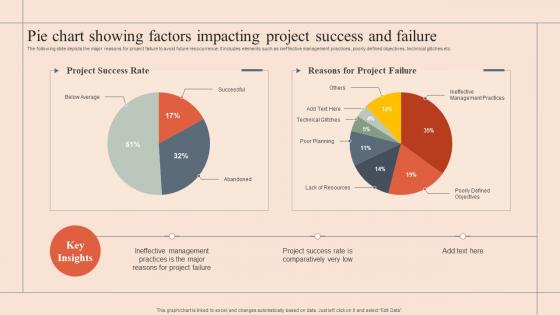
Pie Chart Showing Factors Impacting Project Success And Failure




Try Before you Buy Download Free Sample Product
 Impress Your
Audience
 100%
Editable
 Save Hours
of Time


The following slide depicts the major reasons for project failure to avoid future reoccurrence. It includes elements such as ineffective management practices, poorly defined objectives, technical glitches etc.
People who downloaded this PowerPoint presentation also viewed the following :
Pie Chart Showing Factors Impacting Project Success And Failure with all 7 slides:
Use our Pie Chart Showing Factors Impacting Project Success And Failure to effectively help you save your valuable time. They are readymade to fit into any presentation structure.







FAQs for Pie Chart Showing Factors Impacting Project
Honestly, it all comes down to your industry. Tech teams obsess over deadlines, clean code, and whether people actually use what they built. Construction? Safety first, then budget and making sure you don't get shut down by regulators. Healthcare is different - patient outcomes trump everything else. But here's the thing: every field cares about keeping stakeholders happy and making money, just in their own way. You really need to figure out what "success" means in your world before diving into planning. Map out the deal-breakers early and build your goals around those. Trust me, it'll save you headaches later.
Dude, you HAVE to get your stakeholders involved from day one - seriously, this can make or break everything. Better requirements, less random scope changes, and people actually want to use what you build. They'll also help you deal with office politics (which honestly is half the battle sometimes). Map out who actually matters early on. Keep them updated regularly and ask for feedback. Otherwise you're looking at pushback, budget disasters, and maybe a dead project nobody touches. I've seen it happen way too many times. Regular check-ins are your friend here.
Honestly, communication can make or break your whole project. I've watched teams with great plans completely fall apart because nobody talked to each other properly. People end up working toward totally different goals, deadlines get missed because expectations were fuzzy, and clients get pissed off not knowing what's going on. Set up your communication channels right from the start - regular check-ins are clutch. Make sure everyone feels okay speaking up when something's wrong. Trust me, it's way better to overcommunicate than leave people wondering what the hell is happening.
Honestly, picking the right project management approach can save your butt. Agile works great for flexible stuff, while Waterfall's better for more structured projects. Without any framework, teams usually just stumble around - I've watched it happen way too many times. Better communication, less chaos, actually hitting deadlines... that's what you get with a solid methodology. Oh, and whatever you pick? Stick with it. Don't bail halfway through because that's when everything falls apart. Just match it to what your team can handle and what the project actually needs.
Track the obvious stuff first - budget, deadlines, scope. Those are non-negotiable. But don't stop there because honestly, I've seen "successful" projects that technically hit all targets but still sucked. Stakeholder happiness matters. So does team morale (trust me on this one). Quality metrics like defect rates and user adoption tell you if people actually want what you built. Oh, and whether it delivers real business value - kinda the whole point, right? Pick maybe 4-5 metrics max upfront. You'll thank yourself later instead of drowning in spreadsheets.
Honestly, team dynamics can totally make or break a project. Good collaboration means you'll solve problems faster and share knowledge better - plus way less of those annoying miscommunications that mess up your timeline. But when dynamics suck? People stop talking, work gets duplicated, conflicts waste everyone's time. I've watched decent projects completely fall apart just because the team couldn't get along. Set up clear communication from day one and actually listen to people. Oh, and do regular check-ins - don't just hope issues won't come up.
Dude, scope creep will destroy you every time. Like, you start with one thing and suddenly everyone wants fifteen new features. Poor communication kills projects too - when stakeholders aren't talking to each other, everything falls apart. I've honestly seen more failures from people drama than actual tech problems. Someone quits mid-project or priorities randomly shift and boom, you're screwed. Unrealistic deadlines don't help either. Oh, and teams that don't plan for risks? They're always scrambling when problems hit. Get your requirements nailed down early and keep everyone talking regularly. Trust me on this one.
Honestly, risk management is a lifesaver because it catches problems before they completely wreck your project. You'll spot potential issues early and have backup plans ready - way better than panicking when stuff inevitably goes wrong. Your team stays way more chill when they know there's a Plan B, and you won't blow your budget on surprise disasters. Resources get spread around smarter too. Oh, and stakeholders actually trust your timelines because they're realistic. Try this: write down your 5 biggest project risks this week and figure out what you'd do if each one hits.
Dude, scope definition is seriously make-or-break for projects. I can't tell you how many times I've watched things go sideways because nobody bothered to nail down what they're actually building. You get feature creep, confused team members, clients who think you're building something totally different - it's a mess. But when you define it properly upfront? Everything clicks. Your team knows what they're hitting, stakeholders have realistic expectations, and you can actually tell when you're done (which sounds obvious but trust me, it's not always). Yeah, documenting all the details feels boring as hell, but it's worth every minute.
Honestly, just pick like 2-3 tools max that actually work together. I'd go with a solid project management thing - Asana's pretty decent, or Monday if you're feeling fancy. Then whatever chat app your company's already using (Slack, Teams, whatever). The real game changer though? Getting some automation set up for the boring repetitive stuff. Oh and dashboards are clutch for catching problems before they blow up. Don't get sucked into trying every new tool that pops up. Half of them are just solving problems you don't even have.
Your team basically mirrors your leadership style - how you lead determines their whole vibe with collaboration and problem-solving. Too controlling? You'll crush any creativity (learned that one the hard way). Go too hands-off and people get confused about what actually matters. I'd say find that middle ground where you're clear about expectations but still supportive. Watch how your team reacts to different approaches. Some need more guidance, others want space to figure things out. Honestly, it's kind of like reading the room but for management. Just adjust based on what you're seeing.
Dude, resource allocation will absolutely destroy your project if you mess it up. I've watched so many teams crash and burn because they thought resources would magically appear when needed - spoiler alert, they won't. You've got to plan this stuff out beforehand. Map what people, money, and tools you'll need at each stage. Look for bottlenecks early. Always have a backup plan ready because something will go wrong (it always does). Honestly, half the project management battle is just getting this resource planning right from the start.
Honestly, just build yourself a cheat sheet from all your past projects. Take your wins AND your disasters - figure out what actually made the difference. Was it how the team talked to each other? When you brought stakeholders in? Timing of getting resources? I've seen teams repeat the exact same dumb mistakes like three projects in a row, it's wild. Don't sugarcoat the failures when you're documenting this stuff. The brutal truth about what went sideways is way more valuable than just the success stories. Start that database now - you'll be so glad you did later.
Oh totally, external stuff can torpedo your project even when your team's crushing it. Economic crashes, new regulations, customers suddenly wanting something completely different - I've watched solid projects get wrecked by things nobody saw coming. Super annoying but that's just how it goes sometimes. You gotta bake flexibility into your timeline from day one. During planning, actually spend time thinking about what could go sideways externally and have backup plans ready. Oh and definitely keep your stakeholders in the loop when outside forces start messing with your deliverables - saves everyone headaches later.
Honestly, project scheduling is a game-changer. Break everything down into smaller pieces first - way easier to estimate realistically that way. You'll spot problems before they blow up your timeline, plus you can actually tell people when stuff will be done instead of just guessing. Dependencies are huge too - figuring out what needs to happen before other things can start. I learned this the hard way on a project last year. Don't forget buffer time because something always goes sideways. Trust me, spending time upfront on a solid schedule beats scrambling later when everything's behind.
-
Great combination of visuals and information. Glad I purchased your subscription.
-
“Love it! I was able to grab an exciting proposal because of SlideTeam.”