

Stock Inventory Procurement And Warehouse Management System Powerpoint Presentation Slides




Try Before you Buy Download Free Sample Product
 Impress Your
 Audience
 100%
100% Editable
 Save Hours
 of Time


Stock procurement and management help an organization in real-time inventory tracking and procuring goods from suppliers. Grab our insightfully designed Stock Inventory Procurement and Warehouse Management Systems template. It aids in decreasing operational costs and reducing the wastage of inventory. Our Warehouse Management deck initially showcases processes for maintaining an optimum stock level. It does so by purchasing accurate quantities of merchandise from suppliers. The PPT further covers demand forecasting to help identify the optimum level of required inventory quantity based on historical sales data. It also covers methods like economic order quantity and reorders point to determine the required amount of inventory. Our Stock Inventory Procurement presentation also exhibits various warehouse optimization strategies. These include ABC analysis and warehouse automation that can help reduce inventory waste. Additionally, it showcases an automated tracking system to minimize wastage of stock and determine the ideal time to order inventory. It also highlights various strategies for accurate order fulfillment and preventing stock-outs. The PPT also highlights costs incurred and challenges organizations face in managing inventory. Lastly, it contains dashboards and KPIs to track warehouse operations and inventory. Get access now.
People who downloaded this PowerPoint presentation also viewed the following :
Content of this Powerpoint Presentation
Slide 1: This slide introduces Stock Inventory Procurement and Warehouse Management System. Commence by stating Your Company Name.
Slide 2: This slide depicts the Agenda of the presentation.
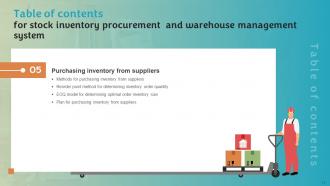
Slide 3: This slide elucidates the Table of contents.
Slide 4: This slide highlights the Title for the Topics to be covered further.
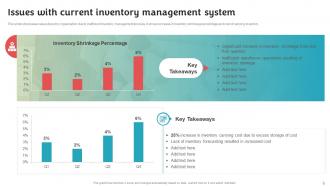
Slide 5: This slide showcases issues faced by organization due to inefficient inventory management process.
Slide 6: This slide presents the problems faced by organization in managing the inventory and warehouse.
Slide 7: This slide elucidates the Heading for the Contents to be covered further.
Slide 8: This slide showcases solutions that can be implemented by organization to tackle inventory management issues.
Slide 9: This slide mentions the Title for the Ideas to be discussed next.
Slide 10: This slide reveals process that can help organization in inventory control and management.
Slide 11: This slide mentions the Heading for the Ideas to be covered in the upcoming template.
Slide 12: This slide highlights the benefits of forecasting demand for inventory.
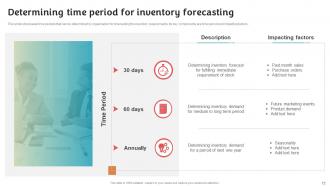
Slide 13: This slide deals with the time periods that can be determined by organization for forecasting the inventory requirements.
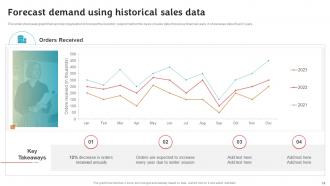
Slide 14: This slide provides information about the Forecast demand using historical sales data.
Slide 15: This slide indicates the Forecasting demand of different types of products.
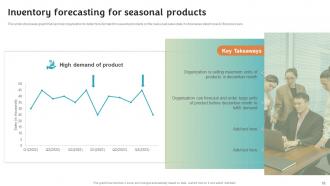
Slide 16: This slide focuses on the Inventory forecasting for seasonal products.
Slide 17: This slide depicts the Title for the Components to be discussed next.
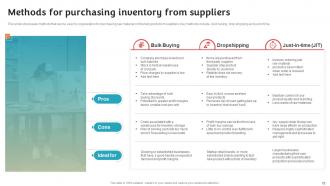
Slide 18: This slide elucidates the Methods for purchasing inventory from suppliers.
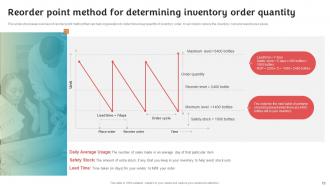
Slide 19: This slide presents the overview of reorder point method that can help organization to determine ideal quantity of inventory order.
Slide 20: This slide exhibits the EOQ method can help organization to determine ideal inventory order size for business.
Slide 21: This slide outlines the plan that can help organization to purchase inventory from suppliers.
Slide 22: This slide presents the Heading for the Topics to be discussed next.
Slide 23: This slide reveals the Strategies to improve warehouse operations.
Slide 24: This slide showcases process flow that can help organization to manage and optimize the warehouse.
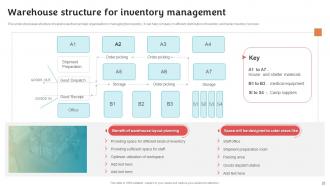
Slide 25: This slide portrays the Warehouse structure for inventory management.
Slide 26: This slide displays the ABC analysis that can help organization in arranging inventory for warehouse.
Slide 27: This slide illustrates Labelling for effective warehouse management.
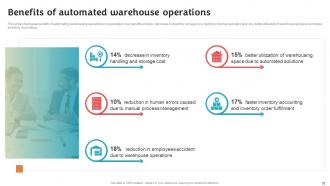
Slide 28: This slide portrays the benefits of automating warehousing operations in organization.
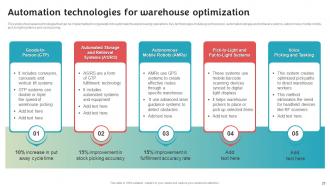
Slide 29: This slide depicts the technologies that can be implemented in organization to automate the warehousing operations.
Slide 30: This slide focuses on the Digital and physical process automation for warehouse.
Slide 31: This slide incorporates the Title for the Topics to be discussed further.
Slide 32: This slide showcases comparison of manual and automated inventory tracking system.
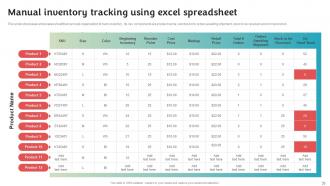
Slide 33: This slide reveals the Manual inventory tracking using excel spreadsheet.
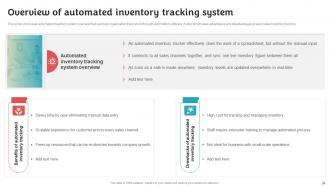
Slide 34: This slide exhibits automated inventory system overview that can help organization track stock through automation software.
Slide 35: This slide contains the tools that can help organization in automated inventory management and reduce wastage of resources.
Slide 36: This slide elucidates the Heading for the Contents to be covered in the forth-coming template.
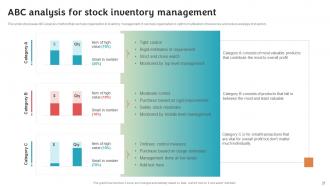
Slide 37: This slide represents the ABC analysis method that can help organization in inventory management.
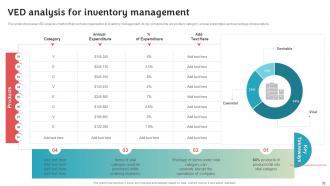
Slide 38: This slide showcases VED analysis method that can help organization in inventory management.
Slide 39: This slide reveals the LIFO and FIFO method for inventory management.
Slide 40: This slide illustrates the HML analysis for inventory management.
Slide 41: This slide depicts the Title for the Topics to be covered further.
Slide 42: This slide focuses on the Inventory management challenges and solutions.
Slide 43: This slide elucidates the Heading for the Components to be discussed next.
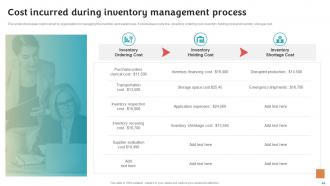
Slide 44: This slide shows the cost incurred by organization in managing the inventory and warehouse.
Slide 45: This slide mentions the Title for the Components to be covered in the following template.
Slide 46: This slide illustrates the KPIs to monitor inventory management performance.
Slide 47: This slide incorporates the Heading for the Topics to be discussed further.
Slide 48: This slide deals with the Impact of inventory management on organization.
Slide 49: This slide reveals the Title for the Topics to be discussed next.
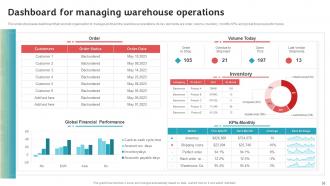
Slide 50: This slide exhibits the Dashboard for managing warehouse operations.
Slide 51: This slide depicts the Dashboard to track inventory management KPIs.
Slide 52: This is the Icons slide containing all the Icons used in the plan.
Slide 53: The purpose of this slide is to present Additional information.
Slide 54: This slide emphasizes on Comparing inventory management metrics with competitors.
Slide 55: This slide outlines the Clustered column.
Slide 56: This is the Idea generation slide for encouraging new ideas.
Slide 57: This slide highlights the mission, vision, and goals of the organization.
Slide 58: This slide is used for the purpose of Comparison.
Slide 59: This slide displays the Company Timeline.
Slide 60: This is Meet our team slide. State the information related to your team members here.
Slide 61: This slide presents the Company's Roadmap.
Slide 62: This is the Thank You slide for acknowledgement.
Stock Inventory Procurement And Warehouse Management System Powerpoint Presentation Slides with all 67 slides:
Use our Stock Inventory Procurement And Warehouse Management System Powerpoint Presentation Slides to effectively help you save your valuable time. They are readymade to fit into any presentation structure.































FAQs for Stock Inventory Procurement And Warehouse Management System
So you'll need demand forecasting first - that's basically predicting what you'll sell. Then figure out safety stock levels and reorder points. Track your supplier lead times too because those change more than you'd think. ABC analysis helps prioritize your expensive stuff vs the random widgets. Honestly, ditch spreadsheets early and get real inventory software or you'll hate your life later. The magic happens when you set up automatic reorders based on your sales history and seasonal trends. I'd start by counting what you actually have, then nail down forecasting since everything flows from there.
Dude, barcode scanners and RFID tags will save your sanity. Manual counting is where everything goes wrong - typos, miscounts, all that nonsense. Real-time updates mean you'll actually know what's on your shelves instead of guessing. Set up alerts for low stock so you're not panicking when you run out of stuff. I swear, once you get the hang of it, you'll wonder how you managed before. Oh, and if you're just starting out, basic barcode scanning is probably your best bet - don't overcomplicate it right away.
Look, demand forecasting is basically what keeps your whole inventory game from falling apart. You're trying to figure out what to order and when, so you don't end up with empty shelves OR a warehouse stuffed with junk nobody buys (trust me, both suck). The goal? Having enough product without tying up all your cash in overstock. Start by digging into your last 12-24 months of sales data - that's where the patterns hide. Seasonal trends, market shifts, all that stuff matters. Without decent forecasting, you're just throwing darts blindfolded and hoping for the best.
So NetSuite, Fishbowl, and QuickBooks Commerce are the heavy hitters everyone talks about. Zoho Inventory is solid for mid-sized stuff - their interface is way cleaner than you'd expect for what you pay. inFlow's decent too. Smaller shops should look at Sortly or ABC Inventory instead. Oh, and definitely pick something that plays nice with whatever software you're already using. Trust me, having everything scattered across different systems is such a headache. I'd grab free trials of maybe 2-3 options in your budget and test drive them. You'll know pretty quick which one feels right.
Ugh, don't just randomly slash prices - that's such a waste. Bundle your slow stuff with popular items instead. Flash sales are honestly your best friend here, people eat that stuff up. Target specific customers who'd actually want those products rather than blasting everyone. Your sales data should tell you what moves and when, so use it to fix your purchasing before you're drowning in stock again. Oh, and start checking turnover rates weekly - monthly is way too slow. You'll catch problems before they get ugly.
Track your inventory turnover ratio first - that one tells you everything about how fast you're moving stock. Also watch days sales outstanding, stockout frequency, and what percentage of inventory value goes to carrying costs. Turnover ratio is honestly where I'd put most of my focus since it shows efficiency better than anything else. Calculate it monthly and compare to industry benchmarks. Days sales outstanding shows how long stuff sits around, stockouts tell you if you're losing sales by running out too much. Oh and carrying costs - those add up quick so you'll want to keep tabs on that percentage.
So basically, just-in-time inventory frees up a ton of cash that would normally just sit there in your warehouse. You're ordering stuff right when you actually need it instead of hoarding everything. Way faster turnover that way. The tricky part is you really can't mess up your supplier relationships or demand forecasting - otherwise you'll be scrambling when you run out of something important. Honestly, it's kind of stressful but the cash flow benefits are pretty huge. You can actually use that money for other things instead of having it tied up in inventory for months.
Ugh, inventory sync is the absolute worst part. You'll be selling on your website, Amazon, maybe a physical store - and nothing talks to each other properly. So you oversell something online when your last unit just walked out the door, or you're telling people stuff's out of stock when you actually have plenty. Each platform has different return times and shipping speeds too, which makes it even trickier. I swear it feels like you're just putting out fires all day instead of actually running your business. Decent inventory software helps a ton though - gives you one place to see everything so you're not guessing where to put your stock.
Honestly, you gotta start way earlier than it feels right - like 6 months out for big seasonal stuff. Look at last year's numbers but definitely pad your orders because forecasting is basically educated guessing (trust me on this one lol). The supplier thing is huge though - having backup vendors saved my butt when my main guy couldn't deliver last Christmas. Oh and don't lock yourself into massive warehouse space year-round. Flexible storage during peak times makes way more sense. I'd start mapping out your next cycle now and set those calendar reminders before you forget!
Yeah stockouts are brutal - you lose sales immediately and customers get pissed off. I'd start with decent demand forecasting using your past data, then keep safety stock for your bestsellers. Automated reorder points are a lifesaver so you're not constantly watching inventory levels. Having backup suppliers matters too, though building those relationships takes time. Oh and focus on your top SKUs first - trying to perfect everything at once is overwhelming. My old manager used to say stockouts keep you awake way more than overstock does.
Honestly, both will save you so much headache with data entry mistakes. Barcoding lets you scan stuff instead of typing everything manually - way faster and fewer screwups. RFID's pretty sweet though, you can read multiple items without even seeing them directly, just walk around with the scanner. Real-time stock tracking with either one. I'd probably go barcode first since it won't break the bank, then maybe upgrade to RFID later if you're dealing with crazy volume. My buddy's warehouse switched last year and he says it was a game changer.
Honestly, start with FIFO if you're not already - moving older stuff first. Sounds basic but places screw this up constantly when they get swamped. Track your sales patterns super closely so you can predict what you'll need, especially with seasonal stuff. Try getting smaller deliveries more often instead of huge batches that might go bad - your suppliers will work with you on this if you build good relationships with them. Oh, and get temperature monitoring set up plus clear date labels. The forecasting thing is probably the trickiest part but makes the biggest difference once you nail it.
So ABC analysis is basically sorting your inventory into three buckets. You rank everything by how much money it brings in annually, then split it up - A items are your cash cows (like 20% of products but 80% of revenue), B is middle tier, C is the small stuff. Honestly, it's just common sense but with a fancy name. Your A items need babysitting - constant monitoring, tight controls, the works. C items? Don't stress too much about those. Oh and it's the Pareto principle thing if you've heard of that. Start by looking at your annual dollar volume per product and you'll see the pattern emerge pretty quickly.
I'd do quarterly audits for most stuff, but if you've got items flying off the shelves, monthly might be better. Compare what your system says versus what's actually sitting there - start with expensive items since those mess up your numbers the worst. Early mornings are clutch, way less people running around creating chaos. Between full counts, throw in some cycle counting to catch problems before they get weird. Oh, and don't let the person who just received or moved inventory do the counting - that's asking for trouble. Write down everything and jump on any big variances right away. Small problems become expensive headaches fast.
Training your team really cuts down on inventory screwups. Proper procedures for receiving and storing stuff means way fewer "wait, where did that go?" moments. Your people catch problems early too - damaged items, low stock, whatever - before things get messy. The upfront time investment? Totally worth it IMO. Staff move faster when they're not constantly asking questions or fixing their own mistakes. Oh, and start with whatever process is causing you the biggest headaches right now. That's where you'll see results fastest.
-
SlideTeam just saved my project! Thank you so much. The variety of templates helped me showcase multiple perspectives easily.
-
The best part about SlideTeam is their meticulously prepared presentations (complete-decks and single-slides both), infused with high-quality graphics and easy to edit. All-in-all worthy products.