


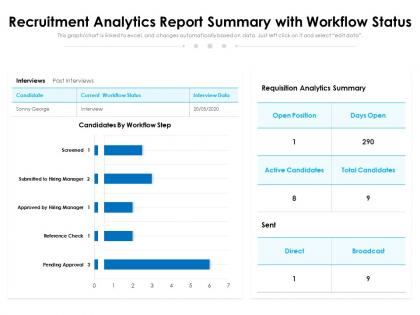
Recruitment analytics report summary with workflow status




Try Before you Buy Download Free Sample Product
 Impress Your
 Audience
 100%
100% Editable
 Save Hours
 of Time


Our Recruitment Analytics Report Summary With Workflow Status are topically designed to provide an attractive backdrop to any subject. Use them to look like a presentation pro.
People who downloaded this PowerPoint presentation also viewed the following :
Recruitment analytics report summary with workflow status with all 2 slides:
Use our Recruitment Analytics Report Summary With Workflow Status to effectively help you save your valuable time. They are readymade to fit into any presentation structure.

FAQs for Recruitment analytics report summary
Honestly, start with the basics - time-to-fill and cost-per-hire are your bread and butter. Quality of hire is trickier but super important, so track 90-day retention and performance ratings. You'll want to know which sources actually deliver too (spoiler: expensive job boards aren't always worth it). Offer acceptance rates matter more than people think. Oh, and candidate satisfaction - bad experiences spread fast on Glassdoor these days. Don't try measuring everything at once though. Pick 4-5 metrics that actually connect to what your company cares about, then add more later.
Basically, predictive analytics looks at your past successful hires and finds patterns - skills, experience, test scores, how they behaved in interviews, all that stuff. Then it scores new candidates based on what actually worked before. Super helpful for weeding out the obvious nos early. You'll spend way less time buried in terrible resumes and can focus on people who might actually work out. Though honestly, I'd be a little skeptical if the data you're feeding it is garbage to begin with. The algorithm is only as good as your historical hiring data, so make sure you've got solid info about which employees actually performed well in specific roles.
Dude, visualization is a game changer for recruitment data. Those messy spreadsheets become actual useful charts that show you stuff like your best candidate sources and where people drop out of your process. Way easier to spot what's working and what isn't. I used to hate digging through hiring data, but now I can see bottlenecks right away. Just start with basic charts for your key metrics - maybe time-to-hire or source effectiveness. Trust me, you'll wonder how you managed without it. Makes everything so much clearer than staring at endless rows of numbers.
So basically you can compare your team's current skills with what you're constantly posting jobs for. The gap? That's what you're missing internally. Pull up your job postings and interview notes - see which skills keep popping up as "must-haves" that nobody on your team actually has. Honestly, it's kind of like a self-updating skills audit. Also check which departments are always hiring externally for the same stuff. That usually means you should probably train people instead of hiring. Start with reports comparing your most common job requirements against employee skill assessments.
Your ATS probably has way better reporting than you realize - Greenhouse, Lever, Workday all do solid dashboards. Google Analytics works great for career page stuff too, which people forget about. Look, I've watched so many teams blow their budget on fancy Tableau setups when they're still figuring out basic metrics. That's backwards. Start simple with your existing tools first. Figure out what numbers actually matter to you. Once you've got that down and you're drowning in data from different places, then think about Power BI or something that pulls everything together. But seriously - master the basics before you get tool-crazy.
Start with data minimization - grab only what you actually need for hiring decisions. Anonymize everything you can. GDPR compliance is crucial, plus whatever local privacy laws apply in your area. Get consent upfront, obviously. The legal maze is honestly a headache, but transparency about tracking is key. Who has access to sensitive data? Audit your analytics tools regularly and dump old records per your retention policies. Oh, and loop in legal early - like, before you even think about launching. They need to review your whole recruitment data setup first.
Honestly, the hardest part is that your data's gonna be a total nightmare - scattered between your ATS, spreadsheets, maybe some random HR system. Takes forever to clean up. Then you've got hiring managers thinking you're just adding extra steps to slow them down. They'll nod along when you present insights but still hire based on "gut feeling" anyway. Oh, and don't get me started on metrics - everyone obsesses over time-to-fill but that doesn't actually tell you if you're finding good people. My advice? Pick one metric that actually matters to everyone and prove value there first.
Look, recruitment analytics basically shows you the real deal - not just wishful thinking about diversity. Track who's applying, where people bail out during interviews, and which job boards actually bring in diverse candidates. Honestly, the data doesn't sugarcoat anything like those cheesy company slogans do. You can spot weird bias patterns happening at different hiring stages and figure out if your job posts are scaring people away. Also check if your outreach is even reaching the right communities. Start by digging through whatever pipeline data you've got and set some actual targets you can measure.
Honestly, time-to-hire data is like a diagnostic tool for your recruiting mess. Track how long each step takes and you'll see where things get stuck - maybe candidates wait forever for manager feedback (classic). Quick hiring usually means less competition swooping in to steal your people. But here's the thing - don't get obsessed with speed if it tanks your hire quality. Some delays matter, others are just red tape garbage. I'd start by timing your current process, then attack whatever's eating up the most pointless time first. Makes way more sense than trying to fix everything at once.
Look, most companies are just burning money on job boards that bring in terrible candidates. Track where your last 20 good hires actually came from - referrals, LinkedIn, whatever. You'll be shocked at the patterns. Some sources probably convert way better from application to actual hire. Double down on those channels and ditch the ones that waste your time. I mean, why keep paying for something that doesn't work? Your cost-per-hire drops and you get better people. It's honestly that simple once you have the data.
So sentiment analysis is basically a game-changer for figuring out where your hiring process sucks. Run candidate feedback through these tools - interviews, applications, even rejection responses. You'll catch frustration points that totally fly under the radar otherwise. Most companies think they're doing fine when they're actually not, tbh. Look for patterns like interviewers who keep getting bad sentiment scores or timing issues with communication. Start small though - survey your recent candidates first and see what comes up. The whole thing only works if you actually fix what you find.
Honestly, recruitment analytics is a game-changer for employer branding. Track which job boards actually bring in decent candidates and figure out where your best hires come from. Look at candidate feedback too - if people are dropping off during applications, there's probably something annoying in your process. Nobody's got time for that. You can measure stuff like how fast you're hiring and whether people accept your offers. Shows the higher-ups that your branding work isn't just fluff, you know? Oh, and definitely start with tracking your career page first - that's where most people bail if it sucks.
Look, without benchmarks you're basically flying blind. That 30-day hiring process you think is fine? Industry average might be 18 days and suddenly you look slow. Benchmarking shows exactly where you're falling behind competitors - and honestly, sometimes where you're crushing it too. You can finally back up those budget requests with real numbers instead of just "trust me, we need this." Plus it helps set goals that aren't completely unrealistic. I mean, there's no point aiming for stuff that's impossible in your industry, right?
Track your application completion rates and see where people bail out - I bet you'll be shocked at the drop-off points. Most companies don't realize their "quick" application actually takes forever to finish. Check your time-to-hire numbers too, plus any feedback scores if you collect them. Communication gaps are huge - candidates hate feeling ignored, so look at how often you're actually updating people. Map out your whole process first, then measure each step. Could be as simple as cutting that ridiculously long form in half or setting up some basic status updates. The data will show you exactly what's broken.
Honestly, AI is gonna transform how we do recruitment analytics. Most teams are stuck doing basic reporting right now, but predictive models will show you which candidates actually want the job before you even make an offer. Pretty game-changing if you ask me. It'll also catch bias in your hiring data and give you real-time pipeline insights - all the tedious stuff that normally takes hours. The system gets better as you feed it more data too. I'd start small though. Find one analysis you do every month and see if there's an AI tool that can handle it automatically.
No Reviews