


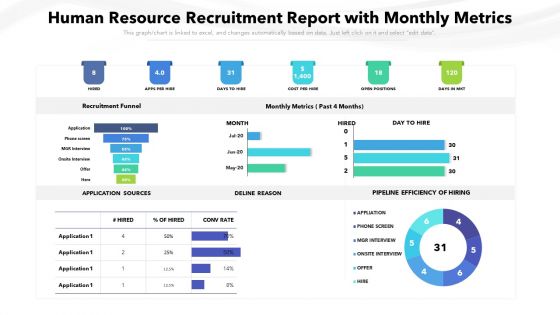
Human resource recruitment report with monthly metrics





Try Before you Buy Download Free Sample Product
 Impress Your
 Audience
 100%
100% Editable
 Save Hours
 of Time


Our Human Resource Recruitment Report With Monthly Metrics are explicit and effective. They combine clarity and concise expression.
People who downloaded this PowerPoint presentation also viewed the following :
Human resource recruitment report with monthly metrics with all 2 slides:
Give your audience a fulfilling experience. They will find our Human Resource Recruitment Report With Monthly Metrics elevating.

FAQs for Human resource recruitment report
Start with time-to-fill, cost-per-hire, and quality of hire - those three will tell you the most. Time-to-fill shows if your process is dragging. Cost-per-hire keeps your budget in check. Quality's harder to nail down, but track 90-day retention and performance scores. Offer acceptance rates matter too - low rates usually mean you're pricing wrong or something's off in interviews. Oh, and candidate satisfaction surveys are clutch for spotting problems early. Don't go crazy with like 15 different metrics though. Pick maybe 4 max so you can actually do something with the data instead of just staring at spreadsheets all day.
Honestly, time-to-fill basically dictates how you run your whole hiring game. Long times? You gotta streamline stuff - better pre-screening, maybe work on your employer brand so people actually respond faster. But if you're filling roles super quick, you're probably rushing and missing good candidates (learned that one the hard way). Different roles need different timelines too - like obviously a software engineer takes way longer than hiring someone for admin work. I'd track it by role type and adjust your sourcing based on what you're seeing. It's also helpful for figuring out where to put your resources and which hiring managers might need support.
So basically, candidate source tracking shows you which recruiting channels actually work vs. the ones wasting your money. Like maybe LinkedIn brings solid hires but job boards just spam you with junk applications. Employee referrals might have way better retention too. Honestly, most recruiters just guess at this stuff. Once you tag every candidate with their source (do this from day one), you'll see patterns pretty quick. Then you can stop throwing budget at useless platforms and focus on what's actually bringing results. Takes maybe 2-3 months to spot the trends.
Look, those satisfaction scores are basically your reality check on whether your recruiting actually works or if you're just spinning wheels. High scores? Great - figure out what's clicking and do more of it. Low scores mean something's broken, probably the usual suspects like sending crappy candidates or setting impossible timelines. I swear half the job is just managing expectations anyway. Use the feedback to tweak your sourcing, tighten up job descriptions, whatever needs fixing. Watch the trends too - you'll start seeing patterns that help you predict what each manager actually wants before they even ask.
Your offer acceptance rate is like a reality check on how appealing your company actually is. Low rates? You're probably underpaying, dragging out the hiring process, or the role just isn't clicking with people. Yeah, rejections suck but they're goldmines for feedback. Most companies should hit 80-90% acceptance, though tech roles can be trickier since everyone's competing for the same talent. I'd track this stuff monthly and definitely reach out to people who said no - ask what went wrong. Sometimes it's something totally fixable like your interview process being a nightmare.
Honestly, tracking diversity metrics is like having x-ray vision for your hiring process. You'll catch bottlenecks you never noticed - like why diverse candidates bail after phone screens or bomb out at final rounds. Start with applicant-to-hire ratios broken down by stage and demographic. The data keeps your managers honest too (nobody wants to look bad on the diversity scorecard). Compare yourself to industry benchmarks so you know if you actually suck or not. Then tackle your worst gaps first - that's where you'll see real movement.
Honestly, just start with basic math - add up everything you spend on recruiting (job posts, recruiter time, interviews, the works) and divide by how many decent hires you actually got. That's your cost-per-hire baseline. From there you can get more detailed. Track how long it takes new people to actually be productive, or look at who's still around after six months (because rehiring sucks). Some folks even calculate what empty positions cost the business. But don't overthink it at first - nail down that simple cost number, then you can layer on the fancier stuff later.
Honestly, tracking quality of hire metrics is huge for long-term success. Good hires perform better and stick around way longer - that's just basic math. When you measure stuff like 90-day performance ratings and retention rates, you get real data on whether your hiring process actually works. Bad hires? They're expensive disasters that create this whole chain reaction of turnover and team drama. I've seen companies totally drain their budgets replacing the wrong people over and over. Time-to-productivity is another big one to watch. Start tracking this stuff now so you can figure out what's working and fix what isn't.
Every person who applies to your company becomes either a fan or a critic afterward. Response times, interview satisfaction, feedback quality - these metrics show what candidates will actually say about you to others. Bad experiences blow up on Glassdoor SO fast. I've watched companies get absolutely roasted over one terrible interview that went viral. The smart move? Survey people you rejected - they'll be way more honest than the ones you hired. Those metrics help catch reputation disasters before they happen. It's basically damage control but proactive.
Ugh, data silos are the worst - your ATS, job boards, and scheduling tools never sync up properly. Getting a full picture feels impossible sometimes. Most teams get caught up tracking easy stuff like application volume instead of what actually matters, like how long new hires take to be productive. That's way harder to measure but so much more valuable. Also, if everyone's logging data differently, your reports are basically garbage. Honestly, I'd just pick maybe 3-4 key metrics first. Master those before you go crazy adding more.
So here's the thing - tech basically fixes all those annoying manual data entry mistakes that mess up your recruitment numbers. Your ATS will automatically track stuff like time-to-hire and which job boards actually work (instead of you updating spreadsheets constantly). AI scoring is pretty solid for keeping candidate evaluations consistent too. When everything's connected - job boards, ATS, analytics - you're not entering the same data twice, which is where most errors happen anyway. I'd honestly just look at what you're doing manually right now and pick the most tedious thing to automate first.
Honestly, retention rate tells you way more than just "did we fill the position." High turnover means you're basically lighting money on fire hiring for the same roles repeatedly. It shows whether you're actually finding people who fit - not just someone with the right resume. Your screening process might look good on paper, but if people bail after six months, something's off. Maybe you're overselling the role or missing red flags. Track it by department because patterns will jump out at you. Sales might have different issues than engineering, you know? Then tweak your approach based on what's actually happening.
So basically, check your likes, shares, comments - all that stuff - to see which platforms actually work for your candidates. LinkedIn's obviously great for senior people, but we found TikTok was surprisingly amazing for younger hires. Our random office videos totally crushed regular job posts, which was weird but cool. You'll want to track when people are most active too - timing matters way more than I thought. Then just use that info to figure out where to spend your recruitment money. It's pretty straightforward once you start paying attention to the numbers.
Look, onboarding is basically what makes or breaks your recruitment numbers. Good onboarding gets people productive way faster - I'm talking weeks, not months. It also stops that brutal 90-day turnover that tanks your hiring ROI. One team I know dropped early quits by 40% just by not screwing up the first week (honestly, it's usually pretty basic stuff). Here's the thing: solid onboarding proves you hired the right person AND helps them actually stick around. Track your retention at 30/60/90 days against how well people complete onboarding. You'll see the connection pretty fast.
Look, you gotta audit your hiring data regularly to catch bias - like if certain groups are getting filtered out unfairly. Watch for sneaky stuff too. Zip codes and college names seem harmless but can hide discrimination (we totally missed this at my old job). Break down your current numbers by demographics first to spot problems. Be upfront about what data you're collecting and why. Honestly, the whole point should be fixing inequities, not just hitting diversity quotas. Use the metrics to actually improve things, not just make yourself look good on paper.
No Reviews