


Record To Report Dashboard Snapshot With Income Statement




Try Before you Buy Download Free Sample Product
 Impress Your
 Audience
 100%
100% Editable
 Save Hours
 of Time


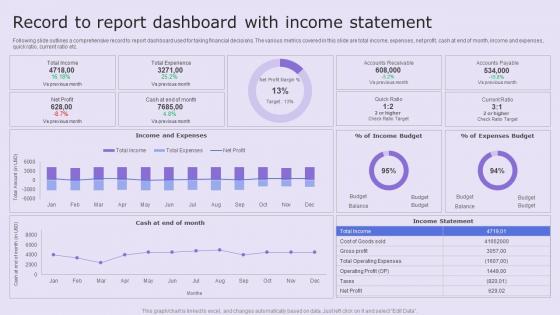
Following slide outlines a comprehensive record to report dashboard used for taking financial decisions. The various metrics covered in this slide are total income, expenses, net profit, cash at end of month, income and expenses, quick ratio, current ratio etc.
People who downloaded this PowerPoint presentation also viewed the following :
Record To Report Dashboard Snapshot With Income Statement with all 7 slides:
Use our Record To Report Dashboard Snapshot With Income Statement to effectively help you save your valuable time. They are readymade to fit into any presentation structure.





FAQs for Record To Report Dashboard Snapshot
So the R2R process has five main stages: data collection (grabbing all those transactions from source systems), journal entry processing, account reconciliations, financial reporting, and management reporting/analysis. Basically goes from recording stuff to creating those monthly reports execs constantly want. Each step builds on the last one - screw up reconciliations and your financial statements will be wrong. Oh, and you'll hear about it from your manager, trust me. The trick is getting data to flow smoothly between stages and having controls that catch errors before they become bigger problems.
Honestly, automation is a total game-changer for speeding up your R2R process. All those manual journal entries and reconciliations that used to eat up days? Now they're done in hours. The best part is cutting out human error - no more fat-fingering data entry everywhere. Your team finally gets to do actual analysis instead of drowning in busy work. I'd say start with something simple like bank recs first. Once you see how much time you're saving, you'll want to automate everything else. Trust me on this one.
So the whole R2R process? It's basically building up to those financial statements. All your journal entries and reconciliations feed into creating the income statement, balance sheet, and cash flow statement. That's what stakeholders actually look at to make decisions - not your perfectly balanced accounts (which is honestly kind of annoying). Auditors and regulators need these statements for compliance too. I know month-end is stressful, but this is literally the point of everything you're doing. Those statements are why the entire cycle exists in the first place.
Honestly, start with automated reconciliations between your source systems and GL - that's your foundation. Exception reporting will catch weird stuff right away. Account analysis is where you'll find most problems hiding, trust me. Month-end checklists with sign-offs are clutch too. I always tell people to focus on high-risk accounts first rather than trying to fix everything at once. Variance analysis against budgets and prior periods catches trends early. The whole point is avoiding that last-minute panic scramble. Oh, and don't skip the regular reviews - they're boring but they work.
Ugh, data quality is the worst - you'll spend forever chasing down why numbers don't match across systems. Manual processes kill your time, especially when month-end hits and everyone's breathing down your neck. Every system speaks a different language, so reconciliation becomes this massive headache. Compliance rules change constantly too, which is just great. Your team's probably stretched thin with outdated tech that barely works together. Honestly, I'd start by figuring out where you're bleeding the most time, then see what you can automate. Gets your people doing actual analysis instead of data entry grunt work.
Honestly, tech integration is a game changer for R2R - it handles all the boring stuff like journal entries and reconciliations automatically. No more manual data entry hell. Your error rates drop big time, plus your team can actually focus on analysis instead of mindless tasks. Cloud platforms are great because everyone can work together in real-time, and AI catches weird anomalies before they blow up. Reports basically build themselves and flow straight into your financials. My advice? Figure out where you're most stuck first, then find tools that tackle those specific headaches. Way more effective than trying to fix everything at once.
Cycle time is huge - track how long it takes from recording transactions to getting final reports out. Accuracy rates matter too, like journal entry errors and reconciliation variances. Honestly, I'd stress about the accuracy stuff more than anything because fixing mistakes later is such a headache. Automation rates tell you what's still being done manually (spoiler: probably too much). Also watch compliance deadlines and cost per transaction. Those five will give you a pretty clear picture of where things stand. Oh, and don't try tracking everything at once - you'll just overwhelm yourself.
So R2R basically gives you full visibility into where your money's going - tracks everything from when you first record a transaction all the way to your final reports. Makes catching errors way simpler since you can see exactly how numbers move through your system. The automated reconciliations are honestly a lifesaver during month-end (no more staying late to hunt down missing pennies). You'll have proper audit trails that actually make sense to stakeholders too. I'd start by figuring out where your current process has the biggest gaps, then focus on whatever R2R pieces would fix those first.
Start with automation - seriously, manual data entry is such a time suck. Get your chart of accounts standardized and set up those recurring journal entries to run automatically. Monthly closes instead of quarterly ones will save you so much stress later (trust me on this). Build detailed checklists so your team doesn't miss anything during closing. Cross-train people on different tasks too - you don't want to be stuck if someone's out sick. Good reconciliation software is worth the investment. Focus on automating whatever eats up the most time first. Oh, and document your processes while you're at it.
Oh man, regulatory changes are such a headache. They basically force you to rebuild chunks of your R2R setup - sometimes everything. New rules come out and suddenly you're updating data processes, tweaking report templates, adding new controls. Your timelines get stretched because compliance reviews eat up time. I learned the hard way to build flexibility in from day one so you're not panicking when things shift. Also, set up some kind of regular check on what's coming down the pipeline. Gives you actual time to prep instead of scrambling at the last minute.
Okay so reconciliation is basically your safety net in R2R. You're comparing different data sources - GL accounts vs bank statements, sub-ledgers, whatever - to catch weird discrepancies before closing the books. It's like quality control but for your financials. Without it? You're flying blind and might publish garbage numbers to stakeholders, which nobody wants. Plus auditors get cranky when stuff doesn't match up. The boring part is documenting everything as you go, but honestly it'll save your butt later when month-end chaos hits and you can't remember what happened three weeks ago.
Dude, it's honestly a game changer. Instead of waiting weeks for those painful month-end reports, you're catching problems right when they happen. Revenue leaks? Gone. Bottlenecks slowing everything down? Fixed before they become disasters. Your stakeholders actually get current info when they need to make decisions - not some stale data from three months ago. I've watched teams shave entire days off their close process just with live dashboards. Don't try to automate everything though, that's where people mess up. Pick your most important KPIs first and go from there.
So basically small businesses keep it simple - you're probably doing journal entries AND financial reports yourself (which honestly isn't always bad). Big companies? They've got whole teams, multiple subsidiaries, and everything needs three approvals before you can breathe. The complexity difference is wild. Small biz can fix problems fast, but enterprises have these massive ERP systems and tons more regulations to deal with. Plus large companies usually have dedicated people for each piece instead of everyone juggling five different tasks. Just figure out which world you're in and don't expect miracles from either setup.
So cloud accounting basically turns R2R from this crazy month-end sprint into something that happens in real-time. Your data's always live, journal entries happen automatically, and everyone can jump in from wherever instead of emailing Excel files back and forth (seriously, such a relief). The whole game changes because you're doing continuous accounting rather than scrambling to catch up every month. Integration is way smoother too - less manual data entry, fewer reconciliation headaches. I'd start by figuring out which parts of your current process are the biggest pain points and automate those first. Makes the transition less overwhelming.
You'll definitely want to get trained on whatever ERP system they use, plus brush up on basic accounting stuff - journal entries, reconciliations, all that fun stuff. The month-end close process is huge, so try to shadow someone through a full cycle if you can. Don't sleep on the soft skills though. You're gonna be bugging people in different departments for info constantly, so being able to communicate without annoying everyone is key. Project management helps too since closes are basically just organized chaos. Cross-training is clutch - seriously, learn as many pieces as possible so you're not screwed when Sarah from reconciliations takes vacation. Oh, and figure out if they follow GAAP or IFRS for reporting standards.
-
SlideTeam offers so many variations of designs and topics. It’s unbelievable! Easy to create such stunning presentations now.
-
Illustrative design with editable content. Exceptional value for money. Highly pleased with the product.