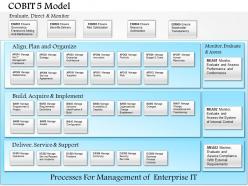
Presentación en Powerpoint del modelo 0514 Cobit 5

Rating:
90%
0514 cobit 5 model powerpoint presentation
Slide 1 of 5
Favourites Favourites

Try Before you Buy Download Free Sample Product

Audience Impress Your
Audience
Editable 100%
Editable
Time Save Hours
of Time
The Biggest Sale is ending soon in
0
0
:
0
0
:
0
0
Rating:
90%

Características de estas diapositivas de presentación de PowerPoint:

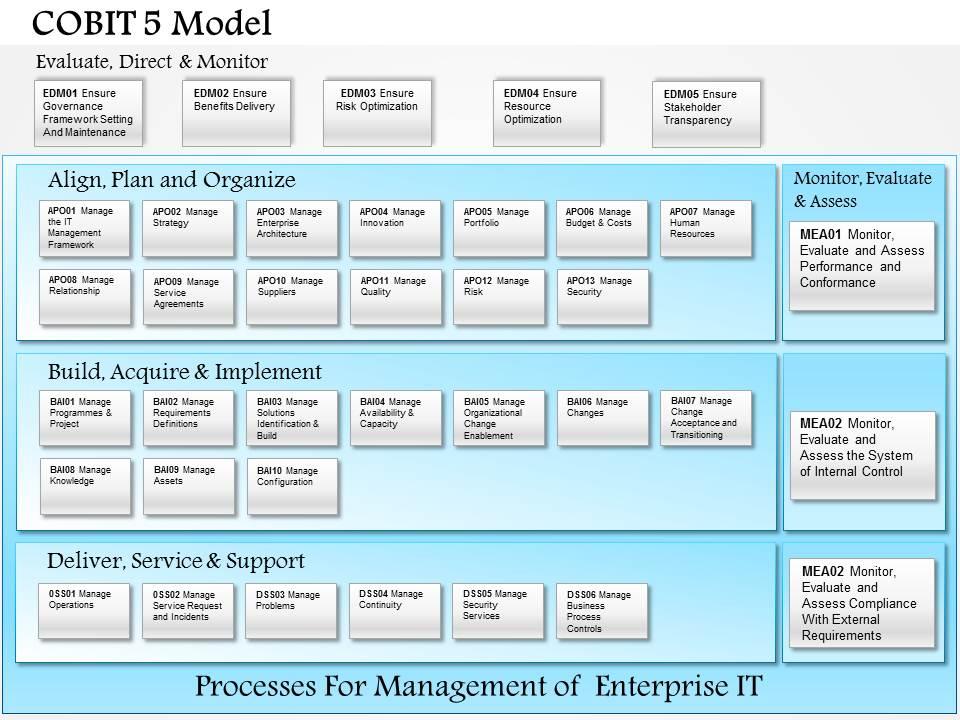
Estamos orgullosos de presentar nuestra presentación de PowerPoint modelo 0514 cobit 5. Esta plantilla de diagrama de power point está diseñada con un modelo 3d único para mostrar el flujo de procesos de negocio de manera lineal.

FAQs for 0514 cobit 5

So COBIT 5 basically helps you get your IT stuff actually working with your business goals instead of just doing its own thing. It's like a roadmap for IT governance - covers processes, org structures, tech, all that. What I really like about it is the specific guidance on who does what and how to measure if things are actually working (not just looking good in meetings, you know?). Plus it helps manage IT risks properly. Honestly, without something like this, IT departments can get pretty disconnected from what the business actually needs. Pretty solid framework overall.

So COBIT 5 basically works like a waterfall - you start with your business goals, then it helps you figure out which IT stuff actually matters for hitting those targets. First step is mapping your business objectives to IT goals, then down to specific enabler goals. Honestly, it feels super structured at first (maybe too structured?). But you get concrete metrics and processes to prove your IT spending isn't just burning money. The goal cascades help you prioritize what to work on and show leadership that IT's contributing real value. Try mapping just your top 3 business goals first - don't overwhelm yourself.

So COBIT 5 breaks down into five main pieces. **Principles** separate governance from management (which honestly makes more sense once you see it in action). Then you've got **Enablers** - seven categories covering processes, structures, culture, all that stuff. The **Process Reference Model** gives you 37 specific governance and management processes to work with. There's also a **Process Capability Model** for checking maturity levels, plus **Product Architecture** that shows how everything connects. I'd start with the principles first - way easier to grasp the rest once you get those down. It all works together to align your IT with business goals and handle risk better.

COBIT 5 has risk management built right in, which is pretty sweet. It gives you structured ways to spot and track IT risks across your processes - way better than cobbling together random tools. The cool part? Risk scenarios map directly to business goals so you can focus on what actually matters. Everyone gets clear ownership too, so no more "not my problem" situations. Oh, and their risk scenarios work as solid templates. Honestly saves you from reinventing the wheel when you're building out your program. Much easier than starting from zero.

So COBIT 5 is pretty solid for compliance stuff - it maps well to SOX, GDPR, PCI-DSS, all that. You'll get the governance processes auditors want to see. The control objectives hit the usual suspects: data protection, financial reporting, risk management. Honestly, the documentation part saves you so much headache during audits. I'd start by mapping your specific regs to COBIT's controls, then just follow that as your roadmap. Way less stressful than winging it, trust me.

Look, stakeholders make or break your COBIT 5 rollout - honestly, I've seen too many projects tank because people ignored this part. Map out everyone first: board members, finance folks, end users, the whole crew. Each group wants different things though. Finance obsesses over ROI while operations just wants stuff to work smoothly. You'll be juggling a lot of competing priorities and doing tons of expectation management. Without their buy-in and active participation, your governance structure becomes pretty useless. Start by figuring out what each stakeholder group actually needs from this implementation.

So for measuring COBIT 5 - honestly, don't try to track everything right away or you'll go crazy. Pick like 3-5 metrics that actually matter to your company. Look at your process maturity levels first - are you moving from that messy "initial" stage toward something more optimized? Then track the obvious stuff: fewer incidents, better compliance scores, happier stakeholders. Each COBIT process has its own metrics built in, which is actually pretty useful once you figure it out. Main thing though? Make sure you're hitting whatever goals you set when you started this whole thing. Keep it simple at first.

So the main thing is COBIT 5 expanded way beyond just IT stuff - it covers your whole business now. Version 4.1 was pretty narrow in comparison. They split governance and management into separate buckets, which actually makes sense when you think about it. Oh and it plays nicer with other frameworks like ITIL. You get these seven "enablers" that help you roll things out in the real world. Honestly, if you're still on 4.1 you should upgrade. The newer version shows how IT actually drives business value instead of just being a cost center.

So COBIT 5 is actually really clever about this - it's built around principles instead of rigid tech-specific rules. That means you can apply it to AI, cloud stuff, or whatever crazy tech shows up next. The whole thing focuses on business outcomes and managing risk, which honestly makes way more sense than trying to predict every new technology. You just use COBIT's enablers (processes, org structures, info flows) to govern whatever emerges. Oh, and definitely map your new tech projects against COBIT's governance objectives first - that'll show you where the gaps are.

COBIT 5 is honestly pretty solid for getting your IT security to actually match what the business needs. It breaks down all that complex security stuff into manageable chunks with clear metrics - way better than just figuring it out as you go. Risk management becomes way more straightforward, and auditors love it because everything's documented properly. The best part? It finally helps IT and business teams talk to each other without getting lost in translation. My suggestion would be to start by comparing what you're doing now against COBIT's five domains. You'll probably find some obvious gaps right away, but that's totally normal.

COBIT 5 basically gives you a solid structure for measuring IT performance that actually connects to business results. Instead of drowning executives in technical jargon they don't care about, you'll get KPIs that show real value from your IT spending. It tracks everything - process maturity, resource optimization, the whole landscape really. What I like most is how it aligns measurements with what governance actually wants to see. Honestly, half the battle is measuring stuff that matters to the business rather than just geek metrics. Map your current approach against COBIT's guidelines first and you'll spot the gaps pretty quickly.

Look, COBIT 5 basically says treat your IT spending like you would any other business investment. Build proper business cases and track your ROI - don't just buy the latest shiny gadgets because they look cool. You want portfolio management that actually lines up with what your company's trying to achieve. Make sure someone's on the hook for results, not just burning through budget. Keep monitoring everything so you can change course when stuff isn't working. Honestly, start by mapping what you're currently spending to your business goals. You'll probably hate what you discover, but at least you'll know where you stand.

So COBIT 5 basically breaks down good IT governance into bite-sized pieces you can actually work with. There's 5 governance objectives for the board-level stuff and strategic direction, then 32 management ones covering daily operations. Honestly, it's way better than vague "best practices" because each objective gives you specific practices, inputs, and outputs - no guessing what you're supposed to do. I'd start by figuring out which objectives match your biggest business risks or compliance headaches first. Makes the whole thing less overwhelming.

Yeah, COBIT 5 is actually really adaptable. You can totally scale it based on your company size - smaller orgs just focus on core processes and skip the heavy governance stuff that big enterprises love. Industry customization is huge too. Healthcare companies go hard on privacy and compliance controls, while others might emphasize different domains. The maturity levels are adjustable, which is smart because nobody wants to bite off more than they can chew initially. I'd definitely start with a capability assessment first - gotta know where you stand before figuring out where to go. Makes the whole thing way less overwhelming.

So ISACA has some pretty good stuff for rolling out COBIT 5. Start with their implementation guide - it's thorough but not terrible to get through. They've got a self-assessment tool that shows you where your governance maturity actually is right now, which is helpful. The process reference guides cover all 37 processes, though honestly that's a lot to digest at once. There's a quick-start guide too if you're feeling lost. I'd probably do the maturity assessment first to see where you stand, then use the implementation guide to figure out your next steps. Way less overwhelming that way.

Ratings and Reviews

90% of 100
Review Form
Write a review
Most Relevant Reviews
  1. 100%

    by Smith Diaz

    Innovative and attractive designs.
  2. 80%

    by Christoper Chavez

    Best way of representation of the topic.

2 Item(s)

per page: