

11 complex process flow steps template powerpoint slide ideas





Try Before you Buy Download Free Sample Product
 Impress Your
Audience
 100%
Editable
 Save Hours
of Time


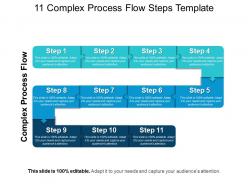
Presenting 11 Complex Process Flow Steps Template PowerPoint Slide to present any complex problem of an organization. Our complex process flow PPT assists in finding the key elements of a process, while drawing clear lines between where one process ends and the next one starts. The diagram helps to clarify how things are currently working and how they could be improved, hence making the audience realize better. With the help of a flowchart slide, the problem can be analyzed in a more effective way. It specifically shows the viewers what type of action each step in a process requires. 11 complex process flow steps flowchart is a powerful but easy-to-use steps template for the PPT which makes it easy to create professional-looking flowcharts based on the pre-formatted flowchart. Flowcharts break a problem up into easily definable parts. The defined process displayed by the flowchart demonstrates the method of solving a complex problem. Use 11 complex flowcharts to reduce the chance that a necessary step for solving a problem is left out. In this way, it reduces the cost and wastage of time of the organization.
People who downloaded this PowerPoint presentation also viewed the following :
11 complex process flow steps template powerpoint slide ideas with all 5 slides:
Your business is important. Make every presentation look flawless with our 11 Complex Process Flow Steps Template Powerpoint Slide Ideas collection.
FAQs for 11 complex process flow steps template
So you'll need the basics first - start/end points, those diamond shapes for decisions, rectangles for actual steps. Connect everything with arrows that make sense. If different people are handling parts of it, definitely add swimlanes (learned this the hard way when my team got super confused about who does what). Each step should have a clear action verb - none of that vague corporate speak. Keep it simple enough that anyone walking by could understand it. Oh, and map out what goes in and comes out at each stage, plus how people should make decisions. Honestly? Just grab a template online and tweak it. Way easier than starting from zero.
Oh man, these templates are game-changers for getting your team on the same page. Everyone looks at the same visual layout, so there's way less confusion about who does what. I swear it's so much easier to catch problems when you can actually see the workflow instead of digging through a million emails. New people pick things up faster too since the process is right there mapped out. Your discussions will get way more focused - like, people actually know what they're talking about. Just grab one process you guys do all the time and turn it into a template first.
Dude, manufacturing and healthcare are huge for these templates - basically anywhere you can't afford to mess up. Financial services too, like loan processing stuff. Assembly lines, patient care, that whole deal. Oh and software teams are obsessed with them for code reviews and deployments. Even retail chains use them for inventory and customer service workflows, which honestly surprised me at first. The sweet spot is when you've got repeatable processes with multiple people involved. If you're in something heavily regulated or dealing with complex operations, I'd definitely start there. Makes the biggest difference.
Dude, visuals are seriously a lifesaver for this stuff. Your brain processes images like 60,000 times faster than text - which sounds made up but it's actually real. Flowcharts show you exactly how steps connect instead of making you dig through boring paragraphs. I always use different colors for different actions, like red for decisions or green for approvals. Honestly? I've watched people's eyes glaze over during training until we started using visual templates. Something about the shapes and arrows just clicks better. Oh, and throw some simple icons next to each step if you can - total game changer for actually remembering this stuff later.
Honestly, the two big ones I always see are overcomplicating things and not testing beforehand. People try to shove every possible scenario into one template - total nightmare to follow. Keep it simple first. Also, you've gotta be crystal clear about who does what at each step. Can't tell you how many gorgeous flowcharts I've seen where nobody actually knows their role. Walk through it with a couple teammates before you launch it everywhere. I'd start basic, run it on something real, then tweak based on what breaks or feels weird.
Honestly, just map out what you're doing now first. Look for the stuff that's slowing you down - bottlenecks, duplicate work, anything that doesn't actually help your customers. I swear, most teams I've worked with cut their process time in half just from being brutally honest about this step. Then rebuild your template around smooth flow and quality checkpoints. Pull systems work way better than push if you can swing it. Oh, and definitely pilot it with a small group before you unleash it on everyone - learned that one the hard way!
Honestly, I'd go with Lucidchart or Visio first - they're popular for a reason. Lucidchart's really user-friendly and great if your team needs to collaborate. Visio has more bells and whistles, especially if you're already using Microsoft stuff. Draw.io is actually pretty solid too and it's free, which is nice. I was skeptical at first but it gets the job done. Miro and Figma could work if you're already using them for other projects - why learn another tool, right? Budget-wise, I'd start with Draw.io. Otherwise Lucidchart hits the sweet spot between features and being easy to use.
Okay so basically you map out every single step visually, and boom - the slow spots become super obvious. Like, you'll actually see where stuff gets stuck or where teams fumble the handoff. Way better than staring at boring spreadsheets tbh. The visual thing is key because patterns just pop out at you that you'd totally miss otherwise. Start with mapping what you're doing now, then hunt for where things get jammed up. It's honestly like getting a drone view of your whole operation - suddenly you're like "oh THAT'S why everything backs up there."
Honestly, process flow templates are perfect for training new people. They show the whole workflow visually instead of having someone frantically scribble notes while you explain everything. Map out your most common processes first - that's where you'll get the biggest bang for your buck. New hires can actually see what they're supposed to do rather than guess from scattered info. They're also clutch when procedures change because you just update the template once. Way better than the old "shadow someone for a week and hope you catch everything" approach. Creates consistent training too.
So process flow templates are like having a roadmap that everyone actually follows. Same steps every time = way less chaos when audits roll around. Documentation becomes super consistent, which honestly makes my life so much easier when something breaks and I need to figure out where. They build compliance stuff right into the workflow too - no scrambling during inspections because you've got proof of everything. Oh, and auditors eat this stuff up. I'd start with your most critical processes first since that's where you'll notice the biggest difference in quality control.
So I'd build feedback collection right into your template workflow instead of tacking it on later. Add checkpoint nodes where people can flag problems or suggest changes - honestly works better than you'd think. Include a simple rating system or feedback form at key stages. The whole point is making it part of the actual process flow. Oh, and definitely schedule regular reviews to actually use that feedback and update your templates. Nobody does this part consistently though. Start with just one or two feedback points per template so you don't overwhelm everyone.
So honestly, cycle time is your best friend here - tracks how long each step actually takes. Throughput matters too (items processed per day/hour). I'd also watch error rates and where bottlenecks happen. Wait times between steps? That's where you'll find most of your problems hiding, trust me. Resource utilization tells you if people are slammed or sitting around doing nothing. Templates make it way easier since you're measuring everything the same way across processes. Don't overthink it though - pick like 2-3 metrics that actually matter for your workflow first, then add more later.
Look, it really comes down to what problem you're trying to solve. Swimlane diagrams? Use those when you need to show who does what - they're lifesavers for cross-departmental stuff where everyone's pointing fingers. SIPOC is perfect for the big picture view, especially when you're kicking off improvement work or getting everyone on the same page about scope. Honestly, I probably use flowcharts the most - they're great for detailed step-by-step breakdowns. Just think about who's gonna read it and what they actually need to know. That'll tell you which format to go with.
Dude, templates are a lifesaver because you skip all that "staring at a blank page" nonsense. Just grab one that's close to what you need and start tweaking. They've already figured out the spacing and visual stuff that would take forever to get right. Most of us suck at design anyway, let's be real. Your team's docs will actually look consistent instead of like everyone just winged it. Oh, and they usually have those auto-align features and icon packs built in. Way better than starting from zero every single time.
So these automation tools basically hook right into your process templates and handle all the boring stuff automatically. No more manually checking boxes or sending those "hey, your turn!" emails. You set up simple rules like "once step 2 wraps up, ping the next person and create their task." Works like magic, honestly. The whole thing keeps projects moving without those annoying bottlenecks where work just sits there waiting. Oh, and definitely start with your most repetitive processes first - that's where you'll see the biggest time savings and can actually show your boss it's worth it.
-
Great designs, really helpful.
-
Top Quality presentations that are easily editable.