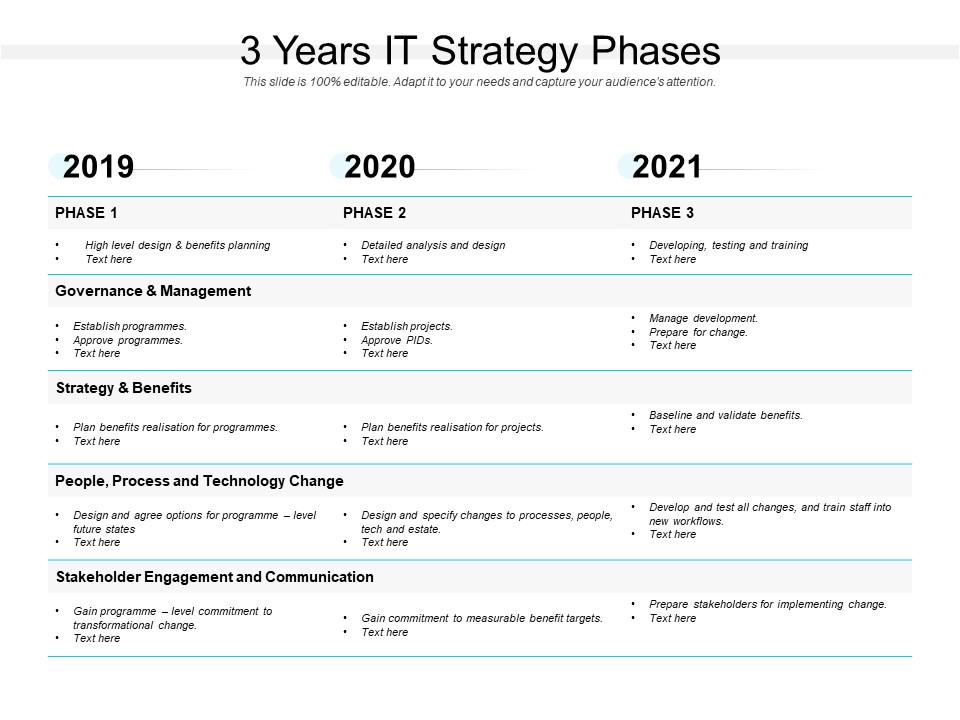
3 Jahre IT-Strategiephasen

Slide 1 of 2
Favourites Favourites

Try Before you Buy Download Free Sample Product

Audience Impress Your
Audience
Editable 100%
Editable
Time Save Hours
of Time
The Biggest Sale is ending soon in
0
0
:
0
0
:
0
0

Merkmale dieser PowerPoint-Präsentationsfolien:

Präsentieren Sie diesen Foliensatz mit dem Namen 3 Jahre IT-Strategiephasen. Dies ist ein dreistufiger Prozess. Die Phasen in diesem Prozess sind Governance und Management, Strategie und Nutzen, Menschen, Prozess- und Technologiewandel, Stakeholder-Engagement und Kommunikation. Dies ist eine vollständig bearbeitbare PowerPoint-Präsentation und steht zum sofortigen Download zur Verfügung. Laden Sie es jetzt herunter und beeindrucken Sie Ihr Publikum.

FAQs for 3 years

An effective IT strategy includes technology infrastructure planning, cybersecurity frameworks, digital transformation roadmaps, resource allocation models, and performance measurement systems. These components work together by aligning technology investments with business objectives, streamlining operational processes, and enhancing competitive positioning, with many organizations finding that strategic integration ultimately delivers improved efficiency and accelerated growth.

Aligning IT strategy with business objectives requires establishing clear governance frameworks, conducting regular stakeholder consultations, mapping technology investments to strategic priorities, and implementing performance metrics that measure business impact. Through collaborative planning sessions, organizations streamline decision-making processes, enhance resource allocation, and accelerate digital transformation initiatives, with many enterprises finding that this strategic alignment ultimately delivers competitive advantage and improved operational efficiency.

Stakeholder engagement ensures IT strategy aligns with business objectives, user needs, and operational requirements through collaborative input from executives, department heads, end-users, and technical teams. This inclusive approach delivers comprehensive strategies that gain organizational buy-in, minimize resistance during implementation, and ultimately create sustainable digital transformation initiatives that enhance productivity across all business functions.

IT strategy should be reviewed quarterly for tactical adjustments and comprehensively updated annually to align with evolving business objectives, technological advancements, and market conditions. Many organizations find that this balanced approach enables them to remain agile while maintaining strategic direction, ultimately delivering competitive advantage through timely technology investments and resource optimization.

Primary challenges in initial IT strategy development include aligning technology goals with business objectives, securing adequate budget and resources, assessing current infrastructure capabilities, managing stakeholder expectations, and establishing clear governance frameworks. Organizations often struggle with defining measurable outcomes and timeline expectations, while navigating competing departmental priorities, ultimately requiring strong leadership commitment and cross-functional collaboration to ensure strategic foundation success.

IT frameworks like ITIL and COBIT enhance strategic planning by standardizing processes, improving governance structures, and aligning IT services with business objectives through systematic risk management and performance measurement. These frameworks enable organizations to streamline operations, reduce costs, and deliver more reliable services, with many enterprises finding that structured approaches ultimately provide greater strategic agility and competitive advantage.

Essential IT strategy metrics include system uptime, user satisfaction scores, project delivery timelines, cost per transaction, security incident frequency, and digital transformation milestones. These measurements enable organizations to track operational efficiency, budget adherence, and strategic goal achievement across departments, with many enterprises finding that balanced scorecards combining financial, operational, and innovation metrics ultimately deliver comprehensive visibility into IT's business impact and competitive advantage.

Emerging technologies impact IT strategy development by reshaping infrastructure requirements, driving digital transformation initiatives, and creating new competitive opportunities across industries. These innovations enable organizations to streamline operations, enhance customer experiences, and automate processes, with many financial services and healthcare institutions finding that strategic technology adoption ultimately delivers significant operational efficiency and market differentiation.

Organizations ensure security and compliance within their IT strategy by implementing robust cybersecurity frameworks, conducting regular risk assessments, establishing clear data governance policies, and maintaining continuous monitoring systems. These approaches enable businesses across sectors like healthcare, finance, and retail to protect sensitive information while meeting regulatory requirements, ultimately delivering enhanced customer trust and competitive advantage in an increasingly digital landscape.

Risk management serves as a critical foundation throughout the IT strategy lifecycle, enabling organizations to identify potential threats, assess vulnerabilities, and implement mitigation strategies before they impact operations. This proactive approach streamlines decision-making processes, enhances resource allocation, and ultimately delivers greater operational resilience, with many enterprises finding that integrated risk frameworks significantly reduce costly disruptions while accelerating strategic initiatives.

IT projects are prioritized through business impact assessment, resource availability analysis, strategic alignment evaluation, and ROI calculations. Organizations typically use scoring matrices that weigh factors like revenue potential, operational efficiency gains, and competitive advantage, with many enterprises finding that projects addressing customer experience and process automation deliver the strongest returns.

Cloud computing serves as a foundational pillar in modern IT strategy, enabling scalable infrastructure, cost optimization, enhanced agility, and improved collaboration across organizations. Through strategic cloud adoption, businesses streamline operations, accelerate digital transformation, and deliver faster services, with many enterprises finding that hybrid and multi-cloud approaches ultimately provide competitive advantage while minimizing capital expenditure.

Data analytics enhances IT decision-making by providing performance insights, predictive maintenance capabilities, resource optimization data, and security threat identification. Through advanced analytics platforms, organizations can forecast system failures, optimize infrastructure investments, and identify bottlenecks before they impact operations, with many enterprises finding that data-driven IT strategies reduce costs while improving service reliability.

Effective IT strategy communication best practices include creating clear visual roadmaps, conducting regular stakeholder briefings, using business-focused language instead of technical jargon, establishing feedback channels, and aligning messaging with organizational goals. These approaches enhance stakeholder buy-in by demonstrating strategic value, fostering transparency across departments, and enabling collaborative implementation, with many organizations finding that consistent, multi-channel communication ultimately delivers stronger adoption and competitive advantage.

IT strategy serves as the foundational blueprint for digital transformation, guiding technology adoption, resource allocation, integration approaches, and change management processes across the organization. Through strategic alignment with business objectives, companies streamline operations, enhance customer experiences, and accelerate innovation capabilities, with many enterprises finding that well-defined IT strategies deliver measurable competitive advantages and sustainable growth.

Ratings and Reviews

0% of 100
Review Form
Write a review
Most Relevant Reviews

No Reviews