360 Degree Appraisal For Employee Performance Improvement

Rating:
90%
360 Degree Appraisal For Employee Performance Improvement
Slide 1 of 6
Favourites Favourites

Try Before you Buy Download Free Sample Product

Audience Impress Your
Audience
Editable 100%
Editable
Time Save Hours
of Time
The Biggest Sale is ending soon in
0
0
:
0
0
:
0
0
Rating:
90%
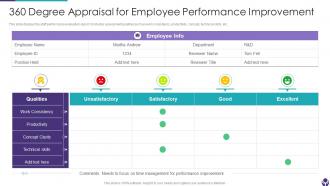
This slide displays the staff performance evaluation report. It includes assessment qualities such as work consistency, productivity, concept, technical skills, etc. Introducing our 360 Degree Appraisal For Employee Performance Improvement set of slides. The topics discussed in these slides are Productivity, Technical Skills, Unsatisfactory, Performance. This is an immediately available PowerPoint presentation that can be conveniently customized. Download it and convince your audience.

FAQs for 360 Degree Appraisal For

So basically you'll get feedback from your boss, coworkers, and anyone who reports to you - plus you do a self-assessment. There are rating scales for different skills and open-ended comments too. Honestly, the hardest part is that people aren't always brutally honest when they know their name's attached to it. You'll sit down with your manager or HR afterward to go through everything and figure out what to work on. Oh, and definitely don't spiral over that one weird comment that makes zero sense - there's always at least one. Focus on the patterns instead.

So with regular reviews, you're only getting your boss's take on things. But 360 reviews? They ask literally everyone - your coworkers, people you manage, other teams, sometimes even customers. Way more complete picture honestly. Regular ones are super formal with all those rating scales and goal-setting stuff. The 360 thing is more about figuring out how you actually come across to people. Here's what's cool though - you'll discover blind spots your manager has no clue about. Like maybe you think you're being helpful but your teammates find you overwhelming or whatever. Pretty eye-opening.

Honestly, the best part is getting feedback from literally everyone - your boss, coworkers, people you manage, sometimes even clients. Way more realistic than those standard top-down reviews (which can be total BS if we're being real). Your team gets actual insight into how they come across to others. That's huge for self-awareness. It catches blind spots that regular performance reviews completely miss. People trust it more because multiple voices are weighing in, not just one manager's opinion. Oh, and definitely pilot it with just one team first - don't go company-wide right away.

Honestly, the biggest pain is getting people to be real with their feedback. Everyone's scared of hurting feelings or getting on someone's bad side, so they just give bland, useless responses. Good luck getting everyone to actually submit on time too - I swear it's like pulling teeth sometimes. Oh, and don't get me started on people who completely lose it over any criticism. They take everything as a personal attack instead of, you know, actually trying to improve. Set clear rules about keeping things confidential from day one. Frame it as helping people grow, not judging them. Then just stay on top of people constantly until they turn stuff in.

Use an anonymous survey platform that keeps individual responses hidden from managers. Require at least 3-5 responses before showing any results - aggregated data only. Raw comments are a no-go since people's writing styles are dead giveaways. Set confidentiality rules upfront and stick to them. The whole thing works when you separate who's collecting feedback from who's getting reviewed. Honestly, if your team trusts the process is actually secure, they'll give you way better feedback. Just make sure the submission method feels bulletproof to them.

Dude, 360 feedback is such a game-changer. You finally see how people *actually* perceive you versus what's in your head - which can be rough honestly. Getting input from your boss, teammates, and the people you manage? That's where the real insights are. I remember being shocked when I learned my "helpful suggestions" came across as micromanaging. The trick is picking just one or two things to work on instead of overwhelming yourself. Don't take it personally either - easier said than done, I know. But seriously, it beats guessing what you need to fix.

So basically, your self-assessment is like your starting point before everyone else weighs in. You rate yourself on the same stuff your boss, coworkers, and team will rate you on. Then you can compare - and honestly, the differences between how you see yourself vs. how others see you? That's where it gets interesting. Sometimes uncomfortable, but interesting. The trick is being real with yourself instead of going too humble or, you know, the opposite. Don't sugarcoat it. Use those insights when you sit down to talk about what you want to work on next.

Meet with them face-to-face - emailing feedback reports is pretty much useless. Lead with what they're doing well, then get into areas for growth. I swear, half the managers I know just throw data at people without explaining what it actually means. Talk about specific behaviors, not vague personality stuff. Work together on maybe 2-3 realistic action steps they can tackle. The whole thing should feel like you're both on the same team figuring out how to help them level up, not like you're judging them. Oh, and definitely set a follow-up meeting before you wrap up.

Start with completion rates - if people bail halfway through, you've got problems. Check response quality too: look at ratings and whether comments are actually thoughtful or just fluff. Honestly, most places see engagement drop initially because it feels like extra work. Track before/after scores there. The bigger question is whether people actually hit the development goals they set during feedback sessions. I'd also measure if managers feel confident using the feedback and if employees think what they're getting is useful. Maybe do quarterly check-ins asking if it's worth keeping - that'll tell you everything.

Honestly, tech platforms make 360 feedback so much easier. No more chasing people down for responses - it handles invitations and reminders automatically. The dashboards are actually useful too, showing completion rates in real time. People tend to be way more honest on anonymous digital surveys than those old paper forms (which nobody liked filling out anyway). Analytics help you spot feedback patterns that'd take hours to catch manually. Just find something that plays nice with your current HR setup and make sure it includes training modules. Trust me, teaching people how to give decent feedback through the tool saves headaches later.

So you'll want to get trained on three main things - feedback delivery, reading the data, and handling conflicts when people get pissy about their scores (which happens more than you'd think). SHRM has decent certification programs, though honestly the mock sessions are where you really learn. Each 360 platform is different too, so mess around with whatever system your company uses first. The defensive reactions are brutal at first - way harder than the actual process part. Start with people who seem chill about feedback, then work your way up to the difficult ones once you've done a few.

Honestly, start by training everyone who's giving feedback on what objective feedback actually looks like. Your forms should ask about specific behaviors - not personality stuff. Way harder to be biased when you're describing what someone did vs. how they made you "feel," you know? Get feedback from different types of people too, not just the same folks who always volunteer for this stuff. Multiple perspectives make the data so much more reliable. Oh, and look for patterns across all the responses instead of getting hung up on weird outliers - that's your best bet for catching obvious bias.

Don't let that 360 feedback just sit there! You've got maybe 2-3 weeks to turn it into actual goals while it's still meaningful. Pick out 2-3 big themes and get specific - like "weekly one-on-ones with each team member" instead of vague stuff like "better communication." Honestly, I've watched so many people file these away and forget about them. Work with HR or grab a coach to help you map this out properly. Build it right into your quarterly goals so there's real structure. Set up a 90-day check-in too. That accountability piece is huge - without it, you'll probably just hope you remember to work on things.

Oh man, 360 reviews get weird depending on where you're doing them. Hierarchical cultures? Forget about it - nobody's gonna tell their boss they suck, even anonymously. Then you've got places where being too direct is basically rude, so everyone gives these super polite non-answers that help nobody. I've seen it where people won't even evaluate their coworkers honestly. The anonymous part helps a little, but cultural programming runs deep, you know? You basically have to redesign the whole thing - different questions, maybe some coaching on how feedback actually works. It's annoying but necessary.

Make your questions super specific - like "gives clear project direction" not just "good leader." Way more useful that way. Don't go crazy with length though, 25-35 questions tops or people get lazy and rush through. I'd mix different skill areas but keep the rating scale consistent throughout. Oh and definitely add some open-ended boxes for extra context - those are honestly the most helpful parts sometimes. Test it with a few people first before rolling it out to everyone. The whole point is focusing on stuff they can actually work on and improve, you know?

Ratings and Reviews

90% of 100
Review Form
Write a review
Most Relevant Reviews
  1. 100%

    by Jones Adams

    “One of the best experiences with SlideTeam for my presentation.Everything on time, communication is efficient and price is reasonable. All good in one place.”
  2. 80%

    by Davis Gutierrez

    “As you have innovative ideas and they are all customizable, this saves a huge chunk of your time to prepare well-read presentations.”

2 Item(s)

per page: