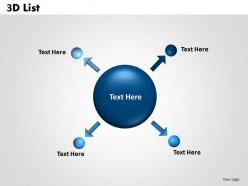
3d circular list 2

Rating:
100%
3d circular list 2
Slide 1 of 4
Favourites Favourites

Try Before you Buy Download Free Sample Product

Audience Impress Your
Audience
Editable 100%
Editable
Time Save Hours
of Time
The Biggest Sale is ending soon in
0
0
:
0
0
:
0
0
Rating:
100%
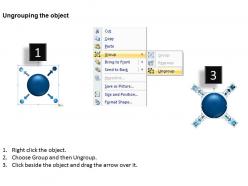
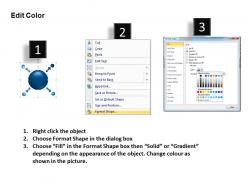
This template is skillfully designed and is completely editable to suit all the needs and requirements of the user. The color of the font, its size, style, and all other elements can be customized according to the user's desire The text in the PPT placeholder can be replaced with the desired information making this template highly flexible and adaptable as well. This template is also compatible with various Microsoft versions and formats like Google Slides, JPG, PDF, etc so the user will face no issue in saving it in the format of his choice.

People who downloaded this PowerPoint presentation also viewed the following :

FAQs for 3d

A 3D circular list is a data structure where elements are arranged in three-dimensional space with circular connectivity, allowing traversal in multiple directions and seamless looping back to starting points. Unlike traditional linear or two-dimensional lists, these structures enable complex spatial relationships and multi-directional navigation, with applications in gaming environments, architectural modeling, and interactive presentations finding enhanced user engagement and intuitive data visualization capabilities.

3D circular lists excel in scenarios requiring spatial data representation, continuous navigation systems, memory-efficient cyclic operations, and multi-dimensional modeling applications like geographic mapping or network topologies. Industries such as gaming, simulation software, and logistics management leverage these structures for seamless data traversal, reduced memory overhead, and enhanced user experiences, ultimately delivering competitive advantages through optimized performance and intuitive interfaces.

A 3D circular list optimizes data retrieval by enabling multi-dimensional indexing, reducing search complexity, and providing intuitive navigation paths through hierarchical relationships, while enhancing visualization through spatial depth and rotational perspectives. This structure streamlines complex dataset analysis in sectors like financial modeling and scientific research, where organizations can manipulate large data volumes more efficiently, ultimately delivering faster query responses and improved analytical insights.

**INPUT**: What are the computational complexities involved in manipulating a 3D circular list? **OUTPUT**: Computational complexities for 3D circular lists include O(n) for traversal and search operations, O(1) for insertion and deletion at known positions, and O(n³) for complete structure reorganization. These complexities enable efficient data management in applications like gaming engines, scientific simulations, and network topology mapping, ultimately delivering streamlined performance for complex spatial data processing.

Real-world applications of 3D circular lists include product catalogs in e-commerce platforms, portfolio showcases for creative agencies, menu systems in restaurant applications, organizational charts for corporate hierarchies, and interactive timelines for educational content. These implementations enhance user engagement by enabling intuitive navigation through complex information structures, while delivering improved visual hierarchy and streamlined content discovery, with many businesses finding that circular presentations increase user interaction rates and ultimately improve conversion outcomes.

Programming languages differ in their support for implementing 3D circular lists through memory management approaches, built-in data structures, pointer handling capabilities, and object-oriented features. Languages like C++ offer direct pointer manipulation and manual memory control, while Python and Java provide automatic garbage collection and dynamic structures, with many developers finding that higher-level languages streamline complex spatial data organization, ultimately delivering faster development cycles and more maintainable code.

Debugging 3D circular lists presents challenges including infinite loop detection across multiple dimensions, complex pointer traversal verification, memory leak identification in interconnected nodes, and visualizing three-dimensional relationships during runtime. These issues require specialized debugging tools, systematic breakpoint strategies, and comprehensive logging mechanisms, with many developers finding that modular testing and dimensional isolation ultimately streamline the troubleshooting process.

Depth-First Search (DFS), Breadth-First Search (BFS), and modified spiral traversal algorithms are best suited for 3D circular lists, offering comprehensive node coverage and efficient memory utilization. These algorithms enable organizations in logistics, manufacturing, and data analytics to streamline complex routing operations, enhance resource allocation across three-dimensional networks, and ultimately deliver faster processing times while maintaining operational efficiency.

A 3D circular list enhances user interface design by providing intuitive navigation through complex datasets, enabling users to visualize hierarchical relationships, and creating immersive experiences that reduce cognitive load when processing multi-dimensional information. This approach streamlines data exploration in applications like financial dashboards, medical imaging software, and engineering platforms, with many developers finding that circular navigation ultimately delivers faster user comprehension and improved decision-making capabilities.

A 3D circular list typically has a higher memory footprint than linear structures due to storing multiple pointers per node for three-dimensional navigation, plus additional overhead for circular references. However, it often uses memory more efficiently than equivalent 3D arrays for sparse data applications, with many graphics rendering and scientific modeling systems finding that the dynamic allocation reduces waste compared to pre-allocated multidimensional structures.

Circularity in 3D lists enhances cyclic operations by eliminating boundary checks, enabling seamless traversal between first and last elements, and maintaining continuous data flow across all three dimensions. Through circular linking, applications like 3D modeling software, simulation systems, and data visualization tools streamline iterative processes, reduce computational overhead, and deliver more efficient rendering cycles, ultimately providing smoother user experiences.

**INPUT**: What tools or libraries are recommended for visualizing 3D circular lists in presentations? **OUTPUT**: Recommended tools include PowerPoint's 3D model features, Prezi's spatial canvas, D3.js for web presentations, Three.js for interactive displays, and specialized design software like Blender or Cinema 4D. These platforms streamline complex data visualization by enabling dynamic rotation, layered information display, and audience engagement, with many organizations finding that 3D circular formats enhance information retention and presentation impact significantly.

3D circular list performance varies significantly with dataset size, experiencing slower traversal times and increased memory overhead as data volume grows, while maintaining consistent insertion and deletion speeds. In applications like manufacturing process tracking and financial portfolio analysis, organizations find that performance remains acceptable for moderate datasets but requires optimization strategies such as segmentation and indexing for larger implementations, ultimately delivering scalable visualization solutions.

User input serves as the primary control mechanism for navigating, selecting, rotating, and modifying elements within a 3D circular list through gestures, clicks, and keyboard commands. These interactive capabilities enable users to seamlessly rotate the circular structure, zoom into specific items, and access detailed information, with many presentation software platforms finding that intuitive input controls significantly enhance audience engagement and information accessibility.

Understanding 3D circular lists can revolutionize data management by enabling more intuitive hierarchical navigation, enhanced spatial relationships between data points, and improved memory efficiency through cyclical structures. These visualization techniques streamline complex dataset interpretation across industries like financial services, healthcare analytics, and manufacturing operations, ultimately delivering faster decision-making capabilities and competitive advantages in data-driven environments.

Ratings and Reviews

100% of 100
Write a review
Most Relevant Reviews
  1. 100%

    by Donny Elliott

    Great product with highly impressive and engaging designs.
  2. 100%

    by Cleveland Foster

    Excellent template with unique design.

2 Item(s)

per page: