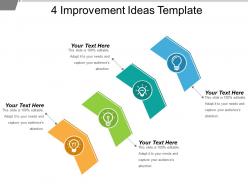
4 improvement ideas template good ppt example

Rating:
90%
4 improvement ideas template good ppt example
Slide 1 of 5
Favourites Favourites

Try Before you Buy Download Free Sample Product

Audience Impress Your
Audience
Editable 100%
Editable
Time Save Hours
of Time
The Biggest Sale is ending soon in
0
0
:
0
0
:
0
0
AI-Ready
Upload this template to AI and ask it to make any changes to content or color
100% editable Powerpoint Template for AI-assisted presentations. Finish your work in less time. Download Prompt Kit ​
Works with
Microsoft PowerPoint
Microsoft 365
Claude for PowerPoint
ChatGPT
Google Slides
Microsoft Copilot
Rating:
90%
SlideTeam feels immensely proud in presenting to all of you this 4 improvement ideas template good PPT example. The slides are 100% editable in nature which lets you make a number of changes to them. The font color, font style and font size of the text are also alterable. The slideshow is totally user-friendly as it is compatible with Google Slides and can be easily saved in the format of JPG or PDF. The PPT template after being downloaded can be viewed in standard size display ratio of 4:3 or widescreen display ratio of 16:9.

FAQs for 4 improvement ideas template

Key elements include problem identification sections, proposed solution descriptions, implementation timelines, resource requirements, and measurable success metrics. These components work together by providing structured frameworks for evaluating feasibility, tracking progress, and demonstrating ROI, with many organizations finding that comprehensive templates streamline innovation processes while ensuring actionable, results-driven improvement initiatives.

Visual aids enhance improvement ideas presentations by simplifying complex data, highlighting key metrics, creating memorable comparisons, and enabling stakeholder alignment through clear storytelling. These tools streamline communication by transforming abstract concepts into actionable insights, with many organizations finding that well-designed charts, infographics, and process diagrams accelerate decision-making and ultimately deliver stronger buy-in for strategic initiatives.

Collaboration can be incorporated through dedicated brainstorming sections, multi-stakeholder input fields, anonymous suggestion boxes, cross-departmental feedback loops, and structured idea-sharing frameworks within the template. These collaborative elements streamline diverse perspectives by enabling real-time input collection, facilitating team-based problem-solving sessions, and creating systematic feedback channels, with many organizations finding that structured collaborative templates ultimately deliver more innovative solutions and enhanced team engagement.

Businesses ensure improvement idea alignment through strategic frameworks that filter suggestions against core objectives, key performance indicators, and long-term vision statements. By implementing structured evaluation processes, organizations in manufacturing, healthcare, and financial services can prioritize initiatives that deliver measurable ROI, enhance operational efficiency, and strengthen competitive positioning, ultimately transforming scattered suggestions into strategic advantage.

**INPUT**: What techniques can be employed in the template to prioritize improvement ideas effectively? **OUTPUT**: Effective prioritization techniques include impact-effort matrices, scoring systems, ROI calculations, stakeholder voting, and feasibility assessments within improvement templates. These methods enable organizations to evaluate ideas systematically by weighing potential benefits against resource requirements, with many companies finding that strategic scoring frameworks streamline decision-making and accelerate implementation timelines. [Word count: 54 words]

User feedback integrates into improvement templates through structured collection mechanisms, regular review cycles, feedback categorization systems, and transparent response protocols. This approach enables organizations to systematically capture insights from employees, customers, and stakeholders, while creating accountability loops that demonstrate how suggestions translate into actionable improvements, ultimately fostering engagement and continuous innovation.

Data visualization transforms improvement ideas into compelling, easily digestible presentations by converting complex metrics, timelines, and outcomes into clear charts, graphs, and infographics within the template. These visual elements enable stakeholders to quickly grasp potential ROI, implementation phases, and comparative benefits, with many organizations finding that well-designed visuals significantly accelerate decision-making processes and secure faster approval for strategic initiatives.

The template can be designed to encourage creativity by incorporating open-ended brainstorming sections, visual thinking spaces, cross-functional collaboration prompts, and "what if" scenario builders. These elements streamline innovative thinking by removing structural barriers, enabling diverse perspectives, and providing frameworks for exploring unconventional solutions, with many organizations finding that structured creativity tools ultimately deliver breakthrough innovations and enhanced team engagement.

Best practices for formatting improvement ideas templates include clear section headers, consistent bullet formatting, prioritization matrices, visual hierarchy through fonts and colors, and standardized input fields for descriptions, timelines, and ownership. These organizational elements streamline idea evaluation by enabling quick scanning, systematic comparison, and efficient tracking, with many organizations finding that structured templates accelerate decision-making and implementation processes.

The template adapts through customized categories, industry-specific metrics, and function-relevant improvement areas, allowing healthcare organizations to focus on patient outcomes while manufacturing companies emphasize operational efficiency. By modifying evaluation criteria, stakeholder roles, and implementation timelines, businesses can align improvement initiatives with sector-specific regulations, customer expectations, and strategic objectives, ultimately delivering targeted solutions that enhance competitive advantage across diverse operational contexts.

Methods include progress tracking dashboards, milestone checkpoints, implementation timelines, status indicators, and performance metrics integration. These tracking mechanisms streamline project oversight by providing real-time visibility, automated progress updates, and comprehensive reporting capabilities, with many organizations finding that systematic monitoring ultimately delivers faster implementation cycles and measurable improvement outcomes.

The template facilitates clear calls to action by incorporating dedicated sections for implementation timelines, assigned responsibilities, required resources, and measurable success metrics for each selected improvement idea. Through structured action plans with specific deadlines and accountability measures, stakeholders receive precise directives on next steps, resource allocation, and expected outcomes, ultimately streamlining execution while ensuring organizational alignment and measurable progress tracking.

Supporting materials for improvement ideas templates include detailed analytics dashboards, cost-benefit analysis spreadsheets, implementation timeline charts, stakeholder mapping documents, and visual progress tracking tools. These resources enhance presentations by providing concrete data validation, financial justifications, and clear roadmaps, with many organizations finding that comprehensive supporting materials significantly increase buy-in and accelerate decision-making processes.

The template enables measuring success through predefined KPIs, baseline metrics, progress tracking milestones, and ROI calculations that quantify tangible outcomes. Organizations can monitor cost reductions, efficiency gains, customer satisfaction scores, and timeline adherence, with many finding that structured measurement frameworks deliver clearer accountability and faster identification of strategic improvements requiring course correction.

Common pitfalls include rushing through brainstorming without proper analysis, focusing solely on problems rather than solutions, dismissing ideas too quickly, and failing to assign clear ownership or timelines. These challenges can derail productive discussions, with many teams finding that structured facilitation, balanced critique with encouragement, and documented action items ultimately deliver more actionable outcomes and sustained engagement.

Ratings and Reviews

90% of 100
Review Form
Write a review
Most Relevant Reviews
  1. 100%

    by Dee Hicks

    Presentation Design is very nice, good work with the content as well.
  2. 80%

    by Dannie Washington

    Helpful product design for delivering presentation.

2 Item(s)

per page: