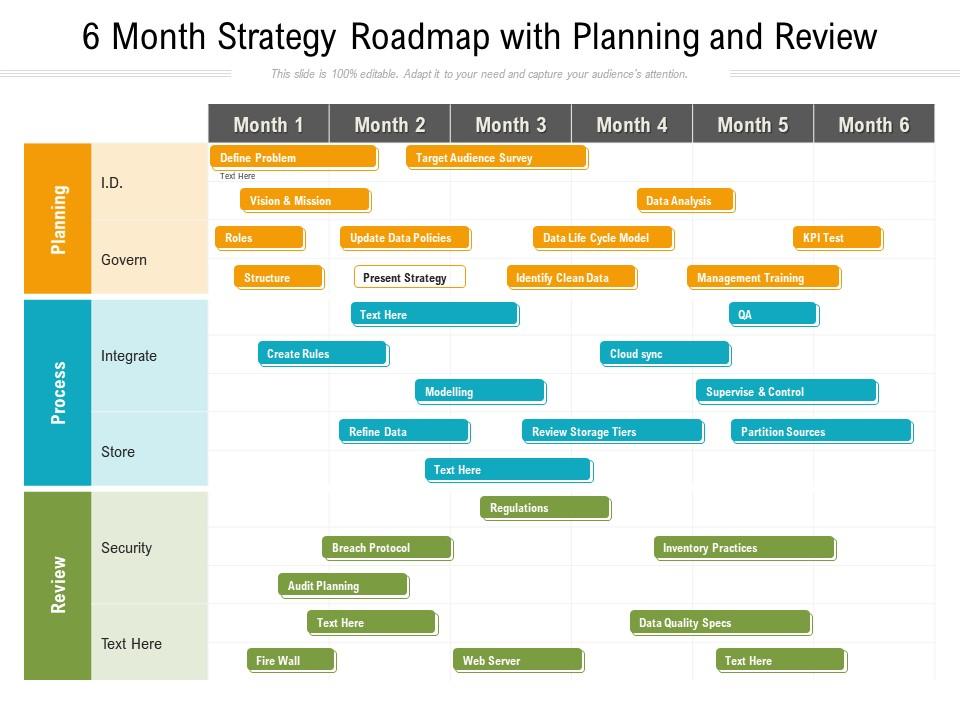
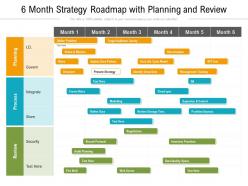
Roteiro estratégico de 6 meses com planejamento e revisão
Try Before you Buy Download Free Sample Product
Audience
Editable
of Time
Um plano de trabalho coeso é essencial para atingir a meta desejada. Comunique sua visão e estabeleça um terreno firme na frente de seu público com nosso layout de PowerPoint. Alinhe os marcos do seu projeto, orçamentos, entregas, prazos e todas as informações necessárias para uma apresentação dinâmica, empregando este roteiro de estratégia de 6 meses com planejamento e revisão. Maximize a eficiência da equipe e simplifique um plano de trabalho com eficiência, apresentando nosso tema de PowerPoint de roteiro pronto. Você pode estabelecer rapidamente a coordenação entre diferentes atividades em toda a organização e apresentar uma visão aos seus colegas utilizando esta útil ferramenta de negócios. Codifique tarefas específicas com cores, priorize e fique de olho nos prazos com a ajuda do nosso atraente modelo de PowerPoint. Baixe nosso roteiro de estratégia de 6 meses com planejamento e revisão para se destacar no gerenciamento produtivo.
Características destes slides de apresentação do PowerPoint:
Apresentando roteiro de estratégia de 6 meses com planejamento e revisão slide do PowerPoint que é 100 por cento editável. Você pode alterar a cor, o tamanho da fonte, o tipo de fonte e as formas deste layout PPT de acordo com suas necessidades. Este modelo PPT é compatível com o Apresentações Google e está disponível nas proporções de 4,3 e 16,9. Esta apresentação PowerPoint pronta para uso pode ser baixada em vários formatos, como PDF, JPG e PNG.
People who downloaded this PowerPoint presentation also viewed the following :
Roteiro de estratégia de 6 meses com planejamento e revisão com todos os 2 slides:
Use nosso roteiro de estratégia de 6 meses com planejamento e revisão para ajudá-lo a economizar seu valioso tempo. Eles são readymade para caber em qualquer estrutura de apresentação.
FAQs for 6 month strategy roadmap with
Start by getting your leadership team on the same page about where you're headed - that's honestly half the battle right there. Then you need environmental scanning (fancy way of saying "figure out where you are now"), vision/mission stuff, and clear goals. Strategy development comes next, followed by implementation planning with regular check-ins. Don't skip stakeholder engagement though - I've watched so many plans crash because nobody bothered getting buy-in from the actual workers. Set up solid metrics to track progress and be realistic about timelines. Oh, and treat this as ongoing work, not some one-time project you finish and forget about.
Your mission and vision should literally be your north star for every decision. Before setting any goal, ask yourself - does this actually push us toward our vision? Too many orgs get distracted by random shiny opportunities that contradict everything they stand for (honestly drives me crazy). Map your strategic goals back to specific parts of your mission statement. Your vision needs to feel reachable through these goals. Here's the real test: if someone reads your goals, they should be able to guess your mission without even seeing it written down.
Look, SWOT analysis is basically taking stock of where you actually are before making big moves. Map out your strengths and weak spots internally, then check what's happening outside - opportunities you could grab and threats that might bite you. It's like cleaning out your closet before packing, if that makes sense. The trick is actually using what you find to set priorities and decide where to spend your time and money. Most people just make the chart and forget about it, which is pointless. Let it guide your decisions - play to your strengths when good opportunities show up, and fix the stuff that could really hurt you down the road.
Try doing a PESTLE analysis - covers Political, Economic, Social, Tech, Legal, and Environmental stuff. Brainstorm what's changing in each area, then check industry reports and government data. I always get sucked into the technology part because it moves so damn fast. Don't skip the boring regulatory stuff though. Your customers are gold for spotting social trends you'd never notice otherwise, so survey them. Google alerts help too. Oh, and do this quarterly - once a year is basically useless since everything shifts so quickly now.
Oh man, where do I start? Most people set super vague goals that mean nothing. Then they skip asking anyone what they actually think - big mistake. I've watched so many plans just sit there doing absolutely nothing because nobody bothered to include the people who'd actually do the work. Teams also go way overboard trying to do everything at once, which just burns everyone out. Don't plan like you're living in a fantasy world either - check what's really happening in your market and what you can actually afford. Build in times to review how it's going because things will change.
Yeah, so most companies do the big strategic review once a year, but honestly? That's not nearly enough. You should be checking your key stuff quarterly at least - markets change way too fast these days. I've watched so many businesses get stuck following some plan they made in January that's totally irrelevant by fall. Super frustrating to see. Do those quarterly check-ins to make sure you're still heading in the right direction, then use your annual review for the bigger pivots. Don't treat it like it's carved in stone or whatever.
Honestly, I'd start with SWOT analysis - it's basic but gives you a good foundation to work with. Balanced Scorecard works well if you need measurable objectives across different areas. OKRs are huge right now, especially in tech (though sometimes I think they're a bit overhyped). You've also got Porter's Five Forces for competitive stuff, scenario planning when things are uncertain, and stakeholder mapping. Oh, and don't forget about those either. SWOT first, then pick whatever fits your industry best. Some frameworks sound fancier than they actually are, but these ones actually deliver.
Honestly, data analytics is just your gut instincts but with actual proof behind them. You'll start seeing patterns you'd never catch otherwise - market trends, how customers really behave, where you're hemorrhaging cash without realizing it. The best part? You can test scenarios before jumping in. Like what if we expand west versus staying local and going deeper. Way better than crossing your fingers and hoping for the best. My advice though - don't go crazy at first. Pick one metric that actually matters to your bottom line and build from there.
Look, you need both types of metrics - the ones that predict stuff (employee engagement, customer acquisition) and the ones that show what already happened (revenue, market share). Most companies just stare at the backward-looking numbers because they're obvious to track. But honestly? The predictive ones are way more useful since you can actually fix things before they're screwed. Don't go crazy with this - pick maybe 3-5 metrics tops and check them monthly. Oh, and make sure your whole team knows what you're tracking. Data overload is real and it sucks.
Honestly, stakeholder input can completely flip your strategy around. Customers see market gaps you're blind to. Suppliers know what's actually possible operationally. Investors? They'll hit you with the hard financial truths. Getting their feedback early helps you catch assumptions that are way off base. Here's the thing though - and I learned this the hard way - people support what they help create. I've watched solid plans crash because nobody bothered asking the right people what they thought until it was too late. You want buy-in? Get them involved in the planning, not just the presentation.
Honestly, it depends so much on what industry you're in. Tech moves crazy fast - most companies there plan maybe 6-12 months out max. But manufacturing? They're thinking 3-5 years ahead because their equipment costs a fortune and takes forever to swap out. Healthcare is wild though - some pharmaceutical projects need like 20-year timelines with all the regulatory stuff. Retail's totally different, they're obsessed with seasons and what customers want next. Then you've got utilities planning decades ahead since their infrastructure lasts forever. Really just comes down to matching your timeline to how your industry actually works.
Basically, scenario planning means you don't put all your eggs in one basket - you map out 3-4 different ways things could go. Best case, worst case, most likely outcome, plus maybe some weird curveball scenario. Then you test your strategy against each one to see where it breaks. Way better than trying to predict the future (spoiler: nobody can). It keeps you flexible when stuff inevitably changes. Super helpful when everything feels uncertain and regular forecasting is pretty much useless. Just figure out what you're most unsure about first, then build your scenarios around those big question marks.
Honestly, the biggest mistake is waiting until the end to show people the plan - that's just asking for pushback. Get folks involved from day one instead. Pull together teams from different departments and actually listen when they speak up in workshops. I've seen too many "feedback sessions" that were just for show. Be upfront about your decision-making process too. Share rough drafts and genuinely use the input you get. Oh, and don't forget the follow-up meetings - people need to see their ideas actually made it into the final strategy. Find the right voices across all levels first, then build everything around making their involvement real, not performative.
Dude, those old 5-year strategic plans? Totally dead now. Digital stuff moves way too fast for that. You gotta review your strategy quarterly instead of annually - I learned this the hard way at my last job. Customer behavior shifts overnight, competitors pop up from nowhere, and honestly the whole thing can feel overwhelming. But here's what works: treat your plan like it's alive. Short planning cycles, quick pivots when needed. Sometimes I think we overthink it though. The companies killing it right now are the ones comfortable with constant change and iteration.
Look, strategic planning just makes you step back from the day-to-day chaos and actually think about where you want to be in a few years. Without it, you're basically just putting out fires constantly (which honestly, some weeks feels inevitable anyway). But it helps you spot problems before they blow up, spend money smarter, and build stuff that'll actually last instead of chasing quick fixes. The biggest thing? Getting everyone on the same page about what you're trying to achieve. Start by figuring out what "growth" even means for your business - could be revenue, market share, whatever matters most to you.
No Reviews