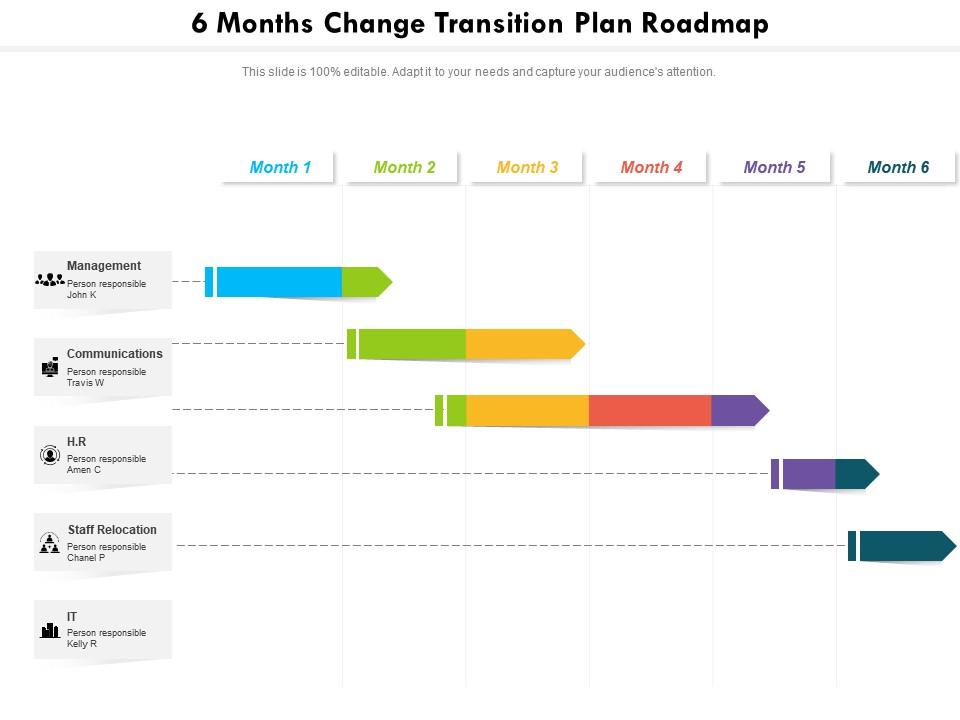
Feuille de route du plan de transition de changement de 6 mois
Try Before you Buy Download Free Sample Product
Audience
Editable
of Time
Utilisez notre feuille de route du plan de transition de changement de 6 mois pré-construit pour présenter votre plan d'action de la manière la plus efficace. Réduisez la paperasserie et montrez comment différentes activités sont liées les unes aux autres en incorporant ce thème PowerPoint qui attire l'attention. Cette mise en page PPT de feuille de route entièrement modifiable est adaptée pour répondre à tous vos besoins et pour avoir un aperçu structuré de l'ensemble du flux de processus à l'aide d'un codage couleur. Fournissez des directives à vos coéquipiers sur le processus de progression en utilisant notre thème PPT. Les membres de l'équipe peuvent facilement être désignés en équipes en accédant aux jalons de travail à accomplir dans les délais. Vous pouvez facilement modifier la diapositive PowerPoint en fonction de situations en temps réel. Téléchargez notre superbe feuille de route du plan de transition de changement de 6 mois, et vous êtes prêt à prouver votre expertise en planification stratégique.
Caractéristiques de ces diapositives de présentation PowerPoint :
Modèle PowerPoint de feuille de route du plan de transition de changement de 6 mois. Cette présentation PPT est compatible avec Google Slides, elle est donc facilement accessible. Vous pouvez télécharger et enregistrer cette mise en page PowerPoint dans différents formats tels que PDF, PNG et JPG. Ce thème PPT est disponible dans les formats d'image 4,3 et 16,9. Ce modèle PowerPoint est personnalisable afin que vous puissiez modifier la taille de la police, le type de police, la couleur et les formes selon vos besoins.
People who downloaded this PowerPoint presentation also viewed the following :
Feuille de route du plan de transition sur 6 mois avec les 2 diapositives :
Utilisez notre feuille de route du plan de transition de changement de 6 mois pour vous aider efficacement à gagner un temps précieux. Ils sont prêts à l'emploi pour s'adapter à n'importe quelle structure de présentation.
FAQs for 6 months change
Key stages of effective change management include preparation and planning, stakeholder engagement, communication strategy development, implementation with pilot testing, and ongoing monitoring and adjustment. These stages work systematically by building organizational readiness, minimizing resistance through transparent communication, and ensuring sustainable adoption, with many organizations finding that structured approaches deliver smoother transitions and higher success rates.
Leaders can best communicate change initiatives through transparent messaging, early stakeholder involvement, clear timeline communication, regular feedback sessions, and demonstrating personal commitment to the process. Through strategic communication approaches, organizations streamline transitions while addressing employee concerns proactively, with many companies finding that consistent, two-way dialogue ultimately delivers higher adoption rates and smoother implementation across departments.
Organizational culture serves as the foundation for change management success, influencing employee acceptance, adaptation speed, communication effectiveness, and leadership credibility throughout transformation initiatives. Cultures that embrace flexibility, continuous learning, and open communication typically experience smoother transitions, while rigid organizational environments often require more intensive culture-shifting strategies before implementing operational changes, ultimately determining whether transformation efforts deliver sustainable competitive advantage.
Kotter's 8-Step model focuses on organizational transformation through structured phases like creating urgency and building coalitions, while ADKAR emphasizes individual change readiness through awareness, desire, knowledge, ability, and reinforcement. Many organizations find that Kotter's approach works best for large-scale strategic initiatives requiring comprehensive stakeholder alignment, whereas ADKAR delivers stronger results for targeted process changes and skill development, with both ultimately enhancing adoption rates and minimizing resistance.
Common change management pitfalls include inadequate communication, insufficient leadership support, poor employee engagement, unrealistic timelines, and lack of training resources. These challenges often result from organizations underestimating resistance factors, failing to create comprehensive change strategies, and neglecting cultural considerations, with many companies finding that addressing these systematically significantly improves transformation success rates and employee adoption.
Employee feedback enhances change management strategies by identifying resistance points, uncovering implementation barriers, and revealing operational gaps that leaders might miss. Through regular surveys, focus groups, and one-on-one sessions, organizations streamline communication processes, adjust timelines based on ground-level insights, and build stronger buy-in, ultimately delivering smoother transitions and higher adoption rates across departments.
Technology facilitates change management through digital communication platforms, project management software, data analytics tools, training management systems, and automated workflow solutions. These technologies streamline stakeholder engagement, track implementation progress, and provide real-time insights, with many organizations finding that automated processes reduce resistance while enhancing transparency and accelerating adoption timelines.
Change management success metrics include employee adoption rates, productivity levels, customer satisfaction scores, financial performance indicators, and timeline adherence measurements. These metrics enable organizations to track progress across multiple dimensions, with many companies finding that combining quantitative data like revenue impact and cost savings with qualitative feedback ultimately delivers comprehensive insights into transformation effectiveness and long-term sustainability.
Change management can be tailored by assessing each department's unique culture, communication preferences, resistance patterns, and operational requirements. Finance teams may need detailed ROI analysis and structured timelines, while creative departments respond better to collaborative workshops and flexible implementation approaches, ultimately ensuring higher adoption rates and smoother transitions across the organization.
Change creates anxiety, resistance, fear of job loss, stress from new responsibilities, and uncertainty about future roles within organizations. Effective addressing involves transparent communication about timelines and expectations, comprehensive training programs, regular check-ins with management, peer support systems, and celebrating small wins, ultimately building employee confidence and reducing turnover while enhancing organizational adaptability.
External factors significantly influence change management strategies by requiring organizations to adapt their approaches, timelines, and resource allocation to align with evolving conditions. Market shifts drive companies to restructure operations, while regulatory changes mandate compliance-focused transformations, with many businesses finding that proactive monitoring and flexible frameworks enable faster responses, reduced risks, and sustainable competitive advantage in increasingly dynamic environments.
Essential skills for change managers include strategic communication, stakeholder engagement, emotional intelligence, project management, and data analysis capabilities. These competencies enable leaders to navigate resistance, build consensus across departments, and measure transformation success, with many organizations finding that managers combining technical expertise with interpersonal skills deliver faster adoption rates and sustainable organizational change.
Organizations build resilience through strategic workforce development, flexible operational frameworks, robust communication systems, cross-functional collaboration, and proactive change leadership training. These approaches enable companies to anticipate market shifts, streamline decision-making processes, and maintain operational continuity, with many finding that resilient cultures ultimately deliver faster adaptation, reduced disruption costs, and sustained competitive advantage in dynamic environments.
Training serves as the foundation for successful change management by building employee competency, reducing resistance, addressing skill gaps, and ensuring smooth transition adoption. Through comprehensive training programs, organizations enable workforce adaptation, enhance confidence levels, and accelerate implementation timelines, with many companies finding that well-trained employees become change champions who drive organizational transformation forward.
Storytelling creates emotional connections during change initiatives by illustrating the vision, addressing concerns, and demonstrating successful transformations through relatable narratives. Through compelling stories about similar organizations overcoming challenges, leaders can reduce resistance, build trust, and inspire action, with many companies finding that personal success stories and case studies significantly accelerate employee adoption and commitment.
-
Great experience, I would definitely use your services further.
-
Awesomely designed templates, Easy to understand.