


A Guide To Front Office Department Functions In Hotel Training Ppt




Try Before you Buy Download Free Sample Product
 Impress Your
 Audience
 100%
100% Editable
 Save Hours
 of Time


These slides provide information regarding the functions of the front office in a hotel. They also cover telephone, message, and luggage handling by the front office and include an operational structure of the front office.
People who downloaded this PowerPoint presentation also viewed the following :
Content of this Powerpoint Presentation
Slide 2
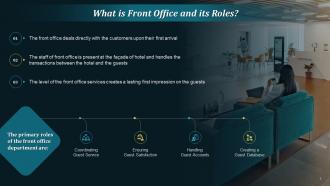
This slide contains information about the definition and roles of front office in hotel which are coordinating guest service, ensuring guest satisfaction, handling guest accounts, and creating a guest database.
Slide 3
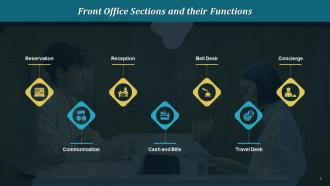
This slide highlights the sections and the functions of front office, which are reservations, reception, bell desk, concierge, communication, cash and bills and travel desk.
Instructor’s Notes:
The functions of front office departments in a hotel are:
- Reservations: The reservation section books rooms for guests in advance. It performs the functions of receiving guests’ requests from sources like email, websites, and telephone and then processing those requests. It also maintains and updates the guests’ records to provide timely and accurate information
- Reception: Reception is located at the façade of hotel and is responsible for receiving and welcoming guests as soon as they arrive. It also completes the registration formality and assigns rooms to the guests
- Bell Desk: This section performs the function of handling guests' luggage during arrival and departure and making general purchases like medicines for them
- Concierge: Concierge section provides personalized services to guests like making reservations in restaurants, arranging special transport, and procurement of tickets to special events
- Communication: Answering incoming calls, charging outgoing calls to guest accounts, and directing calls to guest rooms are the key functions of the communication section of a hotel
- Cash and Bills: The cash and bills section records financial details of the guest. Maintaining guest accounts, preparing bills during checkout, handling payments through debit and credit cards, and organizing foreign currency exchange are the main functions of this section
- Travel Desk: Arranging pick and drop services for guests, organizing sightseeing activities and arranging guides and translators are key roles of the travel desk
Slide 4
This slide showcases how telephone handling has to be done in the hotel. It has to be done in a polite, slow, and clear manner so that the guest can understand everything properly and a notepad could be kept to note down important information.
Slide 5
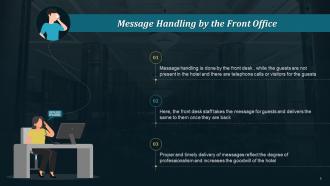
This slide contains information about message handling in hotel. Here, the front desk staff takes the message for guests and delivers it to them once they return.
Slide 6
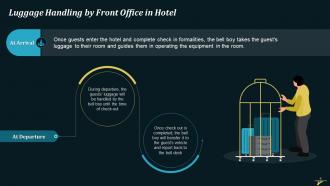
This slide highlights the luggage handling by front office in the hotel at the time of arrival and during departure by bell boy in the hotel.
Slide 7
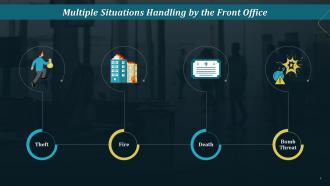
This slide showcases how the front office staff should handle the situation if there is a theft, fire, death or a bomb threat at the hotel.
Instructor’s Notes:
Here are the best-practices/responses for each of these situations:
- Theft: It is important that security features such as automatic closing doors, peepholes, etc. are present. Information about the guest's room number or handing over the keys of guests' rooms to any unauthorized person must be avoided at all costs. Professional hotel security staff could be employed who would be extra vigilant
- Fire: The critical first response is to inform the fire fighting department by giving exact details about the location and size of the hotel. Then, all guests should be quickly and safely evacuated while prioritizing the safety of old and disabled guests
- Death: After receiving information about a guest's death, the front office staff should inform the general manager and call the hotel doctor and the police. The hotel staff should seal the room till all police formalities are over, and the kin of the deceased should be contacted
- Bomb Threat: Raise immediate alarm and call security. Then, announcements should be made and evacuation of the hotel has to be carried out
Slide 8
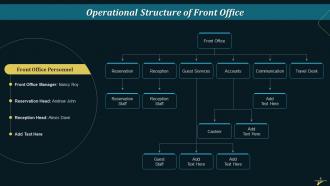
This slide contains information about the sections under front office which could be reservation, reception, guest services, accounts, communication and travel desk.
A Guide To Front Office Department Functions In Hotel Training Ppt with all 27 slides:
Use our A Guide To Front Office Department Functions In Hotel Training Ppt to effectively help you save your valuable time. They are readymade to fit into any presentation structure.












FAQs for A Guide To Front Office Department Functions In
So your front office crew basically runs the whole show - check-ins, reservations, guest complaints, the works. They're constantly juggling room assignments while coordinating with housekeeping about what's clean. Honestly feels like they need three extra arms sometimes! Guests will hit them up for everything too - wake-up calls, restaurant recommendations, WiFi passwords. Oh and they're usually the first ones to hear about it when the AC stops working at 2am. Make sure your team actually knows the hotel well because guests ask about literally everything. They're processing payments and handling concierge stuff on top of all that.
Look, good communication is literally everything in front office work. Your guests can tell immediately if you're actually listening or just going through the motions. Quick responses matter too - nobody wants to wait around wondering if their request got lost somewhere. I've seen so many hotels mess this up by not keeping guests in the loop about basic stuff like check-in times or what's happening nearby. Honestly, the worst thing is dealing with room mix-ups late at night because someone didn't communicate clearly earlier. Train your team to get ahead of problems instead of just reacting. Anticipate what guests need before they even ask.
Most hotels run on property management systems like Opera or Amadeus - they're basically the brain that handles everything from bookings to check-ins to billing. Mobile check-in apps are huge now, plus keyless entry (which guests love, honestly). CRM tools track guest preferences, and tons of places are adding chatbots for simple questions. Oh, and tablets for concierge stuff. It's a lot of systems to juggle! My advice? Look at what your team does manually the most - that's where tech upgrades will actually save you time and headaches.
Your front desk team can seriously make or break your revenue if you think about it. They're the ones upselling room categories, pushing breakfast packages, and handling walk-ins on the spot. Train them to actually think like salespeople instead of just checking people in - it makes a huge difference. Give them authority to adjust rates based on what they're seeing that day. And honestly? They're your best weapon for catching no-shows early and getting those rooms back out there for last-minute bookings. That alone can boost your occupancy big time.
Definitely go with mobile check-in - people hate waiting in lobby lines these days. Send out quick surveys before guests arrive asking about room preferences and when they're getting there. Your staff training matters way more than you'd think (one slow person at the desk can mess up your whole flow). Self-service kiosks work great if your guests are into tech stuff. Always have an express checkout lane too. Honestly, just ask your current guests what bugs them most about the process - they'll give you the real answers. The whole point is offering different options so everyone's happy.
Okay so first thing - just listen and let them vent. Don't jump straight into fix-it mode, you know? Write down what happened in your system because you'll need that trail later. Most complaints need you to do something right away - room swap, free stuff, whatever makes sense. Here's what most people skip though: actually follow up afterward. Guests notice when you check back in. If you can't handle it yourself, get your manager involved immediately. Oh and always say sorry for their crappy experience even if it wasn't your fault. Trust me on that one.
You'll be talking to literally every department daily - front desk is like the hotel's nerve center. Housekeeping for room status, reservations for bookings and special requests, F&B when guests need dining reservations. Security gets involved with any incidents (hopefully not many lol). Accounting wants your daily reports and payment stuff. It's honestly chaos at first! My advice? Introduce yourself to the department managers right away - those relationships are lifesavers. Also get really good with whatever property management system you're using to track everything. The communication never stops, but once you find your rhythm it's actually pretty cool being in the middle of it all.
Oh man, data management is literally everything in hospitality! You're handling guest profiles, reservation history, billing - all that stuff. One screwed up room assignment and you'll have angry guests everywhere (learned that the hard way). Clean records also cover you legally and help with revenue forecasting. The trick? Stay consistent with data entry and audit regularly. I know it sounds boring, but trust me - fixing messy data later is way worse than doing it right the first time. Your future self will thank you!
Oh man, you'll definitely notice this stuff right away. Some guests are super direct about problems, others just look miserable but won't say anything - you have to read between the lines. Personal space is big too, and don't get me started on tipping customs. Eye contact varies wildly depending where people are from. Honestly feels like a lot at first, but you adapt fast. I always ask open questions if something seems off rather than guessing what's wrong. When language gets tricky, smiling goes a long way though.
Start with customer service basics - that's your bread and butter. Communication workshops are massive since these people are literally your storefront. Honestly, conflict resolution should be next because difficult customers are just part of life now. Phone etiquette matters more than people think. Cross-training is smart so nobody's stuck when someone calls out sick. Tech training for whatever systems you're running, obviously. Professional appearance standards too, though that one's kinda obvious. Build it step by step - you can always add more specialized stuff once you see what's actually breaking down day-to-day.
Honestly, the best hotels are always watching what guests actually do, not just what they say they want. Track your social media mentions and survey responses religiously. Booking patterns tell you everything too - way more than you'd think. Most places are already redesigning lobbies and upgrading their tech based on this stuff. Contactless check-in wasn't even a thing before COVID, right? Now it's everywhere. Stay flexible with how you run things and don't be afraid to test new ideas fast when you notice people's habits changing.
Track guest satisfaction scores and your check-in/check-out times first. Revenue per available room (RevPAR) and average daily rate (ADR) are your money metrics. Staff utilization, no-shows, and upselling rates matter too - honestly, people underestimate how much upselling can boost your bottom line. Response time for complaints is critical because bad reviews spread like wildfire. You'll also want first-call resolution rates for guest issues. Set up a weekly dashboard instead of waiting for monthly reports. Way easier to catch problems early that way.
Honestly, the best upselling happens when you actually listen during check-in. Someone mentions it's their anniversary? Boom - suggest the room with a killer view. Family with kids? Maybe pitch the suite with extra space. I always frame it as making their trip better, not just "hey buy more stuff." Timing matters too - if they look stressed or in a rush, just let it go. Oh and read the room! Some people are clearly not interested and that's fine. When you focus on what actually benefits them specifically, guests usually appreciate the suggestions way more.
So basically you're the go-to person for all group bookings - room blocks, guest lists, the whole thing. You'll coordinate with catering and housekeeping, handle special requests, process group check-ins. Peak season gets absolutely wild though, not gonna lie. Group leaders will come to you for everything during their stay, plus you're dealing with billing arrangements. Oh and detailed notes are your best friend - seriously, write everything down because when shifts change, stuff gets forgotten fast. Communication between your team is huge or things just disappear into thin air.
So front office compliance is basically about staying on top of a bunch of safety stuff. You've got to log incidents, keep workstations ergonomic, and sanitize everything constantly - keyboards, counters, all that. Emergency procedures need to be posted where people can actually see them. Fire safety's probably the biggest deal though - clear evacuation routes and making sure everyone knows who to call. Most of this becomes routine after a while, but honestly the sanitization schedules are annoying to stick to. Just don't be that person who posts the cleaning chart but never follows it.
-
I joined SlideTeam last month and there’s no doubt that I tend to find our bond only strengthening over time. Best place to find world-class themes, templates, and icons.
-
I came across many PowerPoint presentations with excellent creatives and I believe they would be beneficial to my work.