


A Guide To Hotel Kitchen Department Sections Training Ppt




Try Before you Buy Download Free Sample Product
 Impress Your
 Audience
 100%
100% Editable
 Save Hours
 of Time


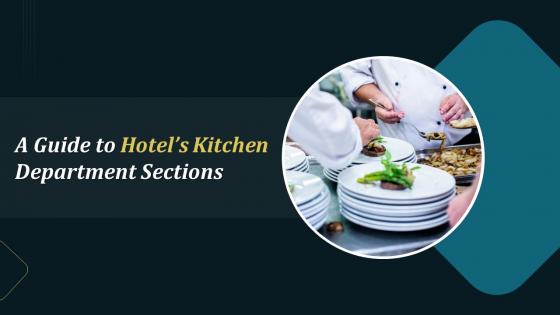
These slides in depth cover the multiple sections of the hotels kitchen department the larder, vegetable, roast, soup, sauce, and pastry sections.
People who downloaded this PowerPoint presentation also viewed the following :
Content of this Powerpoint Presentation
Slide 2
This slide highlights the function of kitchen department in hotel industry which is to prepare ingredients and cook meals to order in a timely and efficient manner as per the guests' needs. It provides meals and beverages that customers order through room service, hotel restaurants, and catering
Slide 3
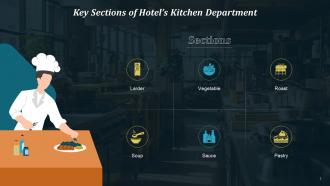
This slide highlights the sections of hotel’s kitchen department which are larder section, vegetable section, roast section, soup section, sauce section, and pastry section.
Slide 4
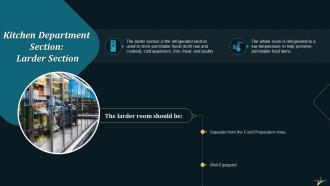
This slide contains information about the larder section in the hotel kitchen department. This is the refrigerated section used to store perishable foods (both raw and cooked), cold appetizers, fish, meat, and poultry.
Instructor’s Notes:
The larder room should be:
- Separate from the Food Preparation Area: The larder room should be separate from the main kitchen where food is prepared. It is important so as to protect food from being spoiled by the heat of kitchen
- Well-Equipped: Mincing and Slicing machines, refrigerators, and other equipment are required in the larder section. This makes it essential for the room to be well-equipped with power and lighting
Slide 5
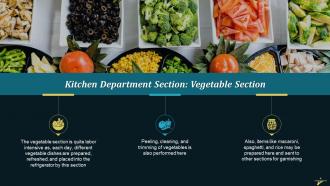
This slide contains information about the role of vegetable section in the kitchen department. This section is quite labor intensive as, each day, various quantities of vegetable dishes are prepared, refreshed, and placed into the refrigerator by this section
Slide 6
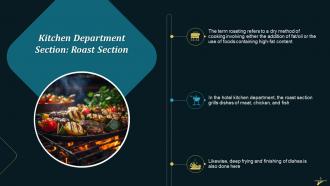
This slide represents the role of roast section in the kitchen department. It is delegated with the role of grilling dishes of meat, chicken, and fish. Likewise, deep frying and finishing of dishes is also done here
Slide 7
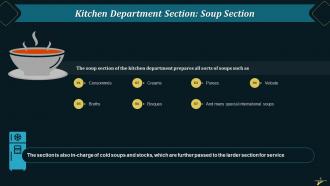
This slide highlights the functions of soup section in the kitchen department which is to prepare all sorts of soups such as creams, purees, broths, and many other international soups.
Slide 8
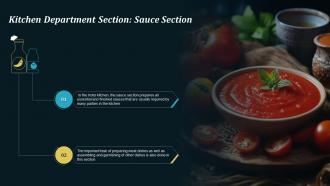
This slide showcases the function of sauce section in the kitchen department. All the meat dishes are cooked and garnished in this section. Also, it provides all essential and finished sauces, that are usually required by the parties in the kitchen.
Slide 9
This slide showcases the role of pastry section in the kitchen department which is to prepare hot & cold sweets, desserts, bread, and cakes for lunches, dinners, and pastries for tea-time and other occasions as well.
Slide 10
This slide highlights the types of kitchen layouts which could be used to design a hotel kitchen which are the single line kitchen. The types are: galley kitchen, U-shaped kitchen, island kitchen, L-shaped kitchen and G-shaped kitchen.
Instructor’s Notes:
The types of kitchen layouts are as follows:
- The Single Line Kitchen: Single line kitchen is a simple space-efficient layout that keeps all the cabinets and appliances against one wall without compromising on functionality and convenience
- Galley Kitchen: Galley kitchen makes use of every millimeter of space without any wastage. It is shaped in a manner where two cabinets face each other, creating an inner pathway or galley between them
- U-Shaped Kitchen: A U-Shaped kitchen is suitable for larger kitchens, with cabinets built along three adjacent walls. It allows for great workflow and multiple users at the same time
- Island Kitchen: A large working area or storage area is provided in the middle of an island kitchen where a cooking surface or a bar or wine fridge could be installed
- L-Shaped Kitchen: A practical layout option for both large and small kitchens, it has cabinets along two perpendicular walls. Another plus point is that it offers great flexibility in the placement of appliances
- G-Shaped Kitchen: G-shaped kitchens resemble the letter 'G.' It is quite similar to U-shaped kitchens except for the fact that it has a fourth dimension that creates additional space for work
Slide 11
This slide contains information about the layout of single line hotel kitchen. It consists of a single counter built along a wall on which all the appliances, cabinets, and countertops are situated. The cooking and clean-up can be performed in a single space, whereas the cabinets for storing kitchen items and utensils are installed under the counter.
Slide 12
This slide highlights the layout of galley hotel kitchen. In galley kitchen, a set of platforms are arranged parallel to each other, leaving a central walkway. It is suitable for commercial kitchens and restaurants with many operations and to accommodate limited staff.
Slide 13
This slide showcases the features of a U-Shaped hotel kitchen layout. It is the most popular type of kitchen format as it consists of cabinets along three sides of the wall forming a U, leaving the fourth one for the door.
Slide 14
This slide contains information about layout of island kitchen. It is a freestanding cabinetry ideal for kitchen activities or dining purposes whose size can be customized according to requirements and space available. It also adds space for installing extra drawers, shelves etc and does not interfere with the main preparation area of the kitchen.
Slide 15
This slide depicts the L-Shaped kitchen layout which permits cabinets and appliances to be installed along right angled walls with an open area in the center. It is best suited for open plan designs where guests can observe the activity in the kitchen. It also facilitates optimum use of the corner space.
Slide 16
This slide highlights about the G-Shaped hotel kitchen layout. It is best suited for those who want to use up every square inch of the kitchen. An extra fourth platform is added, which provides additional space and flexibility for the user. And, it is useful for storing extra kitchen appliances since there is availability of large kitchen space.
Slide 17
This slide showcases the hierarchical chart in the kitchen department of a hotel. An Executive Chef heads this department
Slide 18
This slide represents the organization chart of kitchen department in a hotel. It also contains information about chef’s names.
A Guide To Hotel Kitchen Department Sections Training Ppt with all 27 slides:
Use our A Guide To Hotel Kitchen Department Sections Training Ppt to effectively help you save your valuable time. They are readymade to fit into any presentation structure.

















FAQs for A Guide To Hotel Kitchen Department
Knife skills are absolutely critical - seriously, you'll waste so much time if your crew can't properly dice an onion. Food safety certs come first though, that's non-negotiable. Time management under pressure is make-or-break during dinner rush. Basic techniques like sautéing and seasoning sound simple but trust me, half the people walking in don't actually know them. Communication between your kitchen staff has to be on point or everything falls apart. Oh, and don't sleep on inventory management and sanitation. Start with safety training, then knife work, build out from there.
So you'll want different tracks - beginner, intermediate, advanced stuff. Test people first though, don't just trust their resumes because honestly, half of them exaggerate anyway. Newbies should focus on knife work and basic prep. Intermediate people can handle more complex cooking and menu items. Your advanced folks need leadership training plus specialty techniques. Make the modules flexible so people can jump between levels when they're ready. Oh, and pair up experienced cooks with newer ones - that mentorship thing actually works pretty well from what I've seen.
Dude, cross-training is seriously worth it. Your kitchen becomes way more flexible when everyone knows multiple stations. Like when your prep cook doesn't show up, you're not totally screwed because two other people can jump in. During busy nights especially, it saves your ass. Your team actually stays happier too since they're not stuck doing the exact same thing every single shift - keeps things interesting, you know? I'd start by having your experienced guys teach newer staff different stations. Even just 30 minutes each shift makes a huge difference over time.
Try cooking simulation apps first - they're great for basic skills without wasting ingredients. Digital recipe systems on tablets can track if portions are right, and having trainees film themselves actually works better than you'd think. AR stuff is getting crazy good too, like it literally shows instructions right on your cutting board. Honestly though, start simple with digital checklists and training videos before jumping into the fancy tech. Don't just pick something because it looks cool - make sure it fixes an actual problem you're having. Roll out one thing at a time so your team doesn't get overwhelmed.
Pair your new people with staff who actually follow the rules - not just whoever's been around forever. Explain WHY each food safety rule exists because honestly, people retain the reasoning way better than memorizing random steps. During week one, have them practice handwashing, temp checks, and avoiding cross-contamination religiously. I've watched too many restaurants skip this and totally regret it. Set up check-ins where supervisors confirm they're doing things right before moving on. Oh, and create a basic checklist for each trainee so you don't accidentally miss anything important.
Honestly, just mix the soft skills right into the actual cooking instead of doing separate classes. Try team challenges where someone's calling out prep steps while their partner does the knife work - forces them to actually communicate. Role-playing helps too, like when orders get backed up or servers are being difficult. Daily debriefs work great after service so they can talk through what went well or poorly. Kitchen simulations are probably your best bet though. The trick is making it feel organic while they're cooking, not sitting around discussing "teamwork principles" or whatever. Way more effective than classroom stuff.
Get your ServSafe cert first - hotels literally won't let you touch food without it. HACCP training is solid too for contamination stuff. After that, depends what you're into. Sommelier certs are cool if you like wine, but honestly? Pastry certification opens way more doors than anyone expects. Knife skills courses are always worth it. Oh and grab any allergen training your hotel has - that's becoming huge now. Start with food safety basics though, then see which stations you actually enjoy working before going crazy with specialty certs.
Dude, mentorship programs are a game changer for kitchens. Pair your experienced cooks with the newbies for real hands-on learning instead of just tossing them in during rush hour. Your veterans feel appreciated while the rookies build confidence way faster. Half the battle in a kitchen is honestly just knowing who has your back when things get crazy. The relationships you build matter more than people think. Set up formal pairs for maybe 3-6 months and you'll see better retention. Plus fewer expensive mistakes when it's slammed - nobody wants a green cook accidentally ruining a $200 order on Saturday night.
Track your food waste percentages and prep times first - those numbers tell the real story. Customer complaints should drop too if training's actually working. I'm obsessed with mystery shopper scores because they catch what you miss during busy shifts. Staff retention is massive though, like if people keep quitting your training probably sucks. Watch how fast new people can work solo and whether your team seems confident during dinner rush. Kitchen accidents are another big one to monitor. Honestly, just throw it all in a spreadsheet and check monthly - you'll see what's up pretty quick.
Dude, start prepping your team like 2-3 weeks before you switch menus. Practice runs during slow shifts are clutch - work out the bugs before it gets crazy. Make visual guides for anything that's different from last season's stuff. Cross-training is huge too because someone's always gonna call out at the worst time, I swear. We learned this the hard way when our spring rollout was a disaster. Quick refresher sessions work better than trying to cram everything into one meeting. Focus on new techniques and plating styles first. Oh, and don't wait until the last second - that's how kitchens fall apart during transitions.
Honestly, sustainability training is a total game-changer for kitchens. You'll slash food waste and watch your costs drop big time. Energy-smart practices cut utility bills too. Your staff gets way better at portion control and managing inventory - which is huge. Guests expect eco-friendly stuff now, so you're basically staying competitive. I know hotels saving thousands every month just from tracking waste better. Oh, and teams seem more motivated when they feel like they're actually helping the planet or whatever. Start simple - composting basics, proper storage techniques. You'll see results pretty much immediately.
Your training needs to mimic real kitchen madness - otherwise people just crumble when things get crazy. Run time pressure drills and fake rush scenarios regularly. Honestly, I've watched way too many newbies completely freeze during their first Saturday dinner rush because nobody prepared them for how intense it gets. Teach communication protocols and how to prioritize tasks when everything's on fire. Breathing techniques help too, weirdly enough. Make sure your leads can spot when someone's losing it. The whole point is making practice just as brutal as the real deal, so your team won't panic when it actually matters.
Oh totally, diversity makes such a difference in hotel kitchens! You're cooking for people from everywhere, so having staff who actually know those flavors is clutch. Like, get your Mexican cook to show everyone real mole techniques, or have the Italian chef do pasta demos. The whole team learns way more from each other than any manual. Also the vibe is just better when everyone feels included - less drama, smoother service. I'd definitely set up those cultural cooking sessions where people share their family recipes. Honestly, guests can taste the difference when the food's made by someone who grew up eating it.
Set up feedback at different stages - surveys right after training sessions, then check with supervisors 2-4 weeks later to see how people are actually performing. Monthly one-on-ones are honestly where you get the best stuff because people won't sugarcoat things in private. Track your kitchen numbers too - food waste, prep times, complaints. I learned this the hard way but you've gotta actually use the feedback to fix your training, not just collect it. Otherwise what's the point? Mix short surveys with longer conversations. The timing matters more than you'd think.
Oh man, mystery ingredient boxes are perfect for this! Forces your chefs to get creative on the spot. Also try having them tell stories through their dishes - like connecting to local culture or whatever's in season. Cross-training with front desk staff actually helps too since they'll understand what guests really want. One hotel I know does these "flavor labs" where teams mess around with wild combos like chocolate and chili (sounds gross but it works!). Honestly, just pick one thing to start with this month and rotate through different methods. Keeps everyone from getting bored.
-
Amazing slides! Unique, attractive, and easy to understand.
-
I was never satisfied with my own presentation design but SlideTeam has solved that problem for me. Thank you SlideTeam!