


Achievement motivation goals for employees sample of ppt




Try Before you Buy Download Free Sample Product
 Impress Your
 Audience
 100%
100% Editable
 Save Hours
 of Time


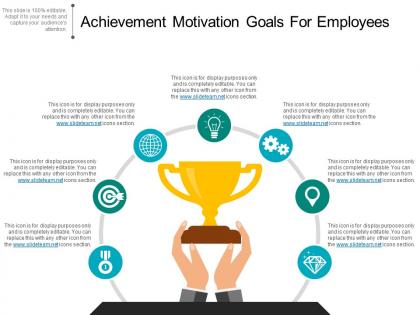
Motivate your human resources with our professional designed achievement motivation goals for employees PPT design. Represent your action plan and the plan for achieving your set targets which will help in taking the effective business decisions. You can also use this employment accomplishment PPT slide design to appraise the efforts of your employees as per their accomplishments in their tenure with the company. You can also define the various benefits of describing or tracking down the list of your all achievements with our key achievements PowerPoint layout template. Such as, it helps in achieving the new heights of business. It results in attracting more investors or creditors to invest into your business and many more. Thus, start working over this goal achievement PowerPoint diagram to create an effective tool for your top level management to take better control over their future business goals. Thus, click on the download link given below to start with. Create common ground for folks to function with our Achievement Motivation Goals For Employees Sample Of Ppt. It enables cohesive action.
People who downloaded this PowerPoint presentation also viewed the following :
Achievement motivation goals for employees sample of ppt with all 5 slides:
Consolidate your influence with our Achievement Motivation Goals For Employees Sample Of Ppt. Increase the impact you have on the group.




FAQs for Achievement motivation goals for employees
Achievement motivation in goal setting includes task orientation, mastery focus, persistence under challenge, self-efficacy beliefs, and outcome expectancy. These components work together by driving individuals to pursue challenging objectives, maintain effort during setbacks, and seek continuous improvement, with many organizations finding that employees with strong achievement motivation consistently deliver higher performance and innovative solutions.
Intrinsic motivations drive goal attainment through personal satisfaction, autonomy, and inherent interest, while extrinsic motivations leverage external rewards, recognition, and competitive pressure. Organizations increasingly find that combining both approaches enhances employee performance, with intrinsic factors delivering sustained engagement and extrinsic elements providing immediate momentum, ultimately creating comprehensive motivation systems that accelerate achievement across diverse teams.
Setting specific, measurable goals significantly enhances achievement motivation by providing clear direction, enabling progress tracking, and creating accountability mechanisms that drive sustained effort. Research consistently shows that individuals and teams with well-defined, quantifiable objectives demonstrate higher engagement, persistence, and performance outcomes, with many organizations finding that SMART goal frameworks ultimately deliver improved productivity and competitive advantage.
Self-efficacy significantly influences achievement motivation by determining confidence levels, goal-setting ambition, persistence through challenges, and resilience after setbacks. Individuals with strong self-efficacy typically pursue more ambitious targets, maintain effort longer during difficulties, and recover faster from failures, ultimately delivering higher performance outcomes and sustained motivation across professional and personal endeavors.
Individuals can overcome obstacles by reframing challenges as learning opportunities, breaking large goals into manageable milestones, and maintaining flexible strategies while keeping core objectives constant. Through resilience-building practices and support networks, professionals across industries find that setbacks become stepping stones, ultimately delivering sustained motivation and competitive advantage in increasingly demanding environments.
Cultivating a growth mindset involves embracing challenges as learning opportunities, reframing setbacks as valuable feedback, and focusing on effort over natural talent. These strategies enhance goal achievement by building resilience, encouraging continuous skill development, and maintaining momentum during obstacles, with many professionals finding that this mindset ultimately delivers sustained performance improvements and competitive advantage.
Cultural background significantly influences achievement motivation through individualistic versus collectivistic values, power distance expectations, uncertainty avoidance preferences, and varying definitions of success. While Western cultures often emphasize individual accomplishments and competitive goals, Eastern cultures frequently prioritize group harmony and collective achievements, with many organizations finding that culturally-adapted goal-setting frameworks enhance employee engagement and performance across diverse teams.
Visualization techniques boost achievement motivation by creating mental blueprints of success, enhancing focus on specific outcomes, strengthening emotional connections to goals, and building confidence through repeated mental rehearsal. These approaches enable individuals and teams to overcome obstacles more effectively, maintain persistence during challenging periods, and ultimately deliver higher performance levels, with many organizations finding that structured visualization programs significantly improve goal attainment rates.
Organizations foster achievement motivation by establishing clear, challenging goals, providing regular feedback and recognition, offering professional development opportunities, and creating accountability systems. Through performance-based rewards, mentorship programs, and career advancement pathways, companies enhance employee engagement, boost productivity, and retain top talent, with many finding that this strategic approach ultimately delivers competitive advantage and organizational growth.
Time management directly enhances achievement motivation by creating structured pathways toward goals, establishing clear priorities, and providing measurable progress milestones that sustain momentum. Through effective scheduling and deadline management, individuals maintain focused energy, reduce procrastination, and experience consistent accomplishments, ultimately delivering heightened confidence and accelerated goal attainment across personal and professional contexts.
Effectively tracking achievement motivation goals involves establishing specific metrics, regular check-ins, milestone celebrations, progress journals, and feedback loops from mentors or peers. Through consistent monitoring systems, individuals can identify patterns in their performance, adjust strategies when needed, and maintain momentum, with many high achievers finding that visible progress tracking significantly enhances their commitment and accelerates goal attainment.
Achievement motivation is grounded in McClelland's Need for Achievement theory, Atkinson's expectancy-value model, goal-setting theory, and self-determination theory, which explore intrinsic drives and goal-oriented behavior. These frameworks help organizations design performance systems, employee development programs, and incentive structures that enhance productivity and engagement, with many companies finding that understanding these psychological drivers ultimately delivers stronger team performance and competitive advantage.
Feedback and recognition significantly enhance achievement motivation by providing clear performance indicators, reinforcing positive behaviors, and creating psychological rewards that sustain effort. Through regular acknowledgment and constructive input, organizations see employees maintain higher engagement levels, pursue more challenging goals, and demonstrate increased persistence, with many companies finding that structured recognition programs ultimately deliver improved performance outcomes and stronger competitive advantage.
Common pitfalls in setting achievement motivation goals include setting overly ambitious targets, lack of specific measurability, inadequate progress tracking, insufficient reward systems, and poor alignment with individual strengths. While these challenges can derail motivation, organizations increasingly find that implementing structured goal-setting frameworks, regular milestone reviews, and personalized incentive approaches ultimately delivers enhanced performance and sustained engagement across teams.
Collaboration and social support enhance achievement motivation by creating accountability systems, fostering knowledge sharing, and providing emotional encouragement during challenging periods. Through peer networks and team-based approaches, organizations streamline goal attainment while building collective expertise, with many businesses finding that collaborative environments ultimately deliver higher performance outcomes and sustained employee engagement.
-
Good research work and creative work done on every template.
-
Enough space for editing and adding your own content.