


Action Plan To Improve Employee Engagement Powerpoint Presentation Slides




Try Before you Buy Download Free Sample Product
 Impress Your
 Audience
 100%
100% Editable
 Save Hours
 of Time


Employee engagement enriches the firms Productivity as the mechanism prioritizes the actions for improving the overall rate. Check out our efficiently designed PPT template that represents the structure that assists in identifying and prioritizing employee engagement drivers. Managers or head of the department can use this customizable designed deck to layout the action plan to improve employee engagement. This PPT optimizes employee engagement tools which aid in creating a well crafted plan which can lead to an increase in employee satisfaction, which leads to an increase in productivity. Moreover, the competent template studies the various strategies that can be used to engage employees in the companys organization. This insightful action plan PowerPoint template helps portray actions via creative diagrams. This helps in highlighting key employee engagement action plans very clearly and concisely. One can depict the action plan to improve employee engagement through our well-researched slides and various diagrams and tables incorporated to make it easy to understand the whole concept of the idea behind this PowerPoint. High definition visual graphics have been used in the deck to provide with the best of quality. Experience this Customized and 100 percent editable template now.
People who downloaded this PowerPoint presentation also viewed the following :
Content of this Powerpoint Presentation
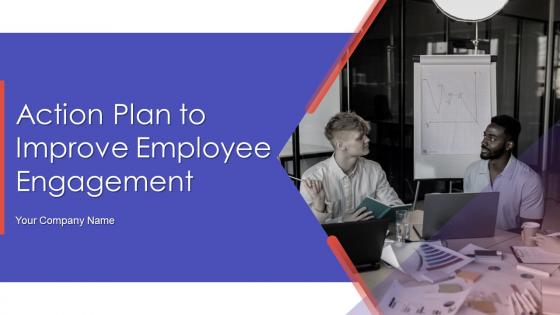
Slide 1: This slide display title "Action Plan to Improve Employee Engagement". State your company name
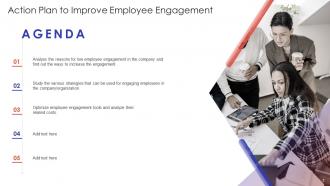
Slide 2: This slide presents the agenda for the "Action Plan to Improve Employee Engagement".
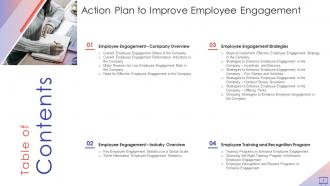
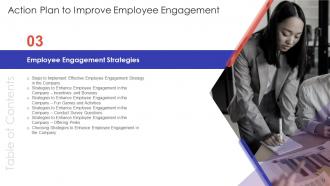
Slide 3: This slide exhibits Table of Contents.
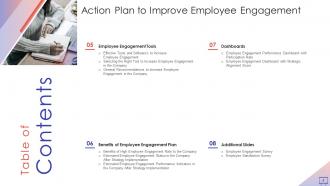
Slide 4: This slide also shows table of contents.
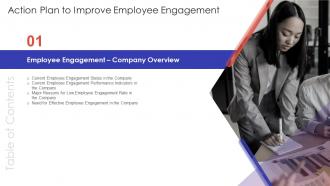
Slide 5: This slide presents a company overview of employee engagement
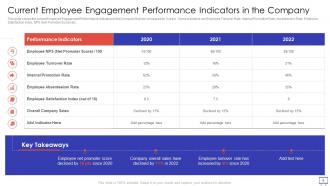
Slide 6: This slide shows the current Employee Engagement Performance Indicators in the Company that is compared for 3 years.
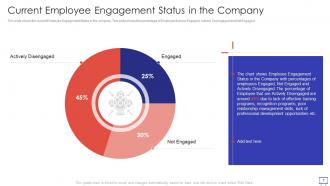
Slide 7: This slide showcase the current Employee Engagement Status in the company in the form of a pie chart.
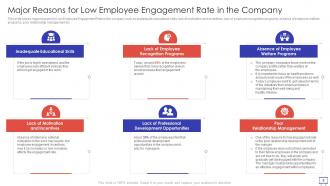
Slide 8: This slide showcase major reasons for Low Employee Engagement Rate in the company.
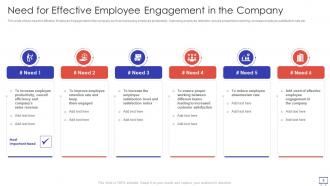
Slide 9: This slide shows the need for effective Employee Engagement in the company such as increasing employee productivity, improving employee retention, satisfaction rate etc.
Slide 10: This slide shows employee Engagement on the basis of an Industry Overview.
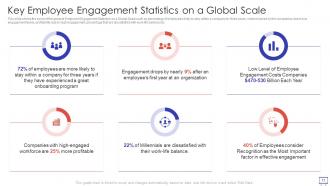
Slide 11: This slide shows some of the general Employee Engagement Statistics on a Global Scale with different icons.
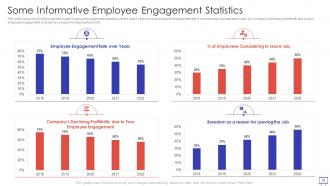
Slide 12: This slide showcase some of the main informative employee engagement statistics over the past 5 years.
Slide 13: This slide shows the Strategies to Enhance Employee Engagement in the Company
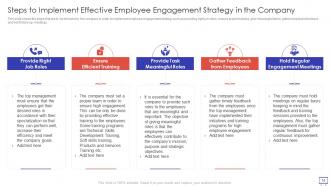
Slide 14: This slide shows the steps that are to be followed by the company in order to implement an employee engagement strategy with different icons.
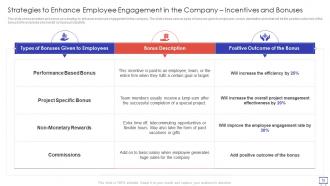
Slide 15: This slide shows various types of incentives and bonuses given to employees as a strategy to enhance employee engagement in the company and the positive outcome of the bonuses.
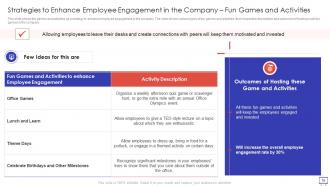
Slide 16: This slide shows fun games and activities as a strategy to enhance employee engagement in the company.
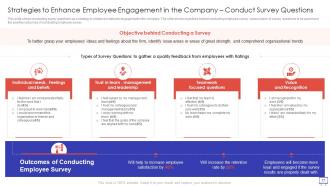
Slide 17: This slide shows conducting survey questions as a strategy to enhance employee engagement in the company.
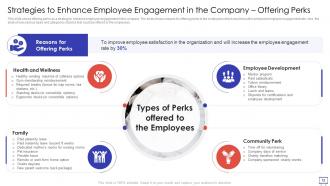
Slide 18: This slide shows offering perks as a strategy to enhance employee engagement in the company.
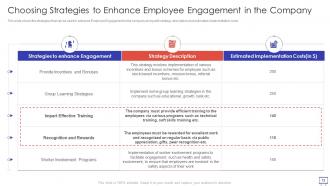
Slide 19: This slide shows the strategies that can be used to enhance Employee Engagement in the company along with strategy description and estimated implementation costs.
Slide 20: This slide shows Employee Training and Recognition Program
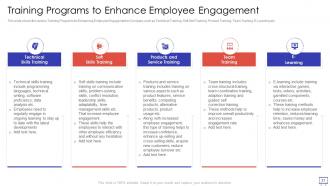
Slide 21: This slide shows the various Training Programs for Enhancing Employee Engagement in Company.
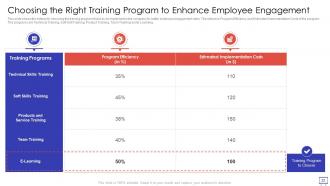
Slide 22: This slide shows the criteria for choosing the training program that is to be implemented in the company for better employee engagement rates
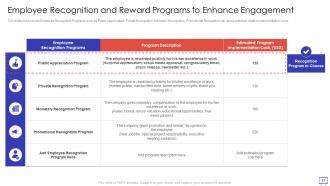
Slide 23: This slide shows some Employee Recognition Programs such as Public Appreciation, Private Recognition, Monetary Recognition, Promotional Recognition etc.
Slide 24: This slide discusses Employee Engagement Tools
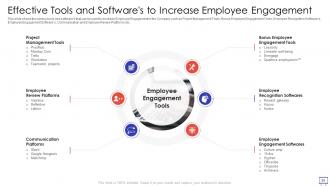
Slide 25: This slide shows the various tools and software that can be used to Increase Employee Engagement in the Company.
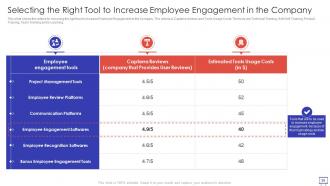
Slide 26: This slide shows the criteria for choosing the right tool to Increase Employee Engagement in the Company. The criteria is Capterra reviews and Tools Usage Costs.
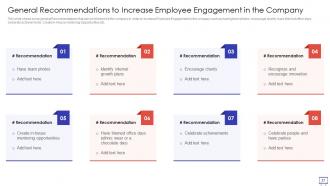
Slide 27: This slide show discusses general Recommendations that can be followed by the company in order to increase Employee Engagement in the company.
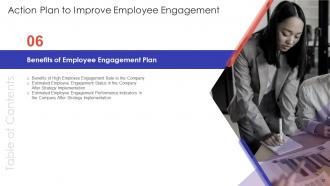
Slide 28: This slide outlines the Benefits of the Employee Engagement Plan
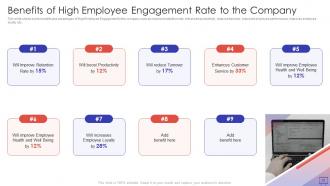
Slide 29: This slide outline some benefits and advantages of High Employee Engagement in the company.
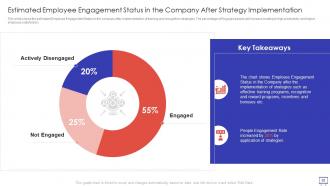
Slide 30: This slide shows the estimated Employee Engagement Status in the company after the implementation of training and recognition strategies.
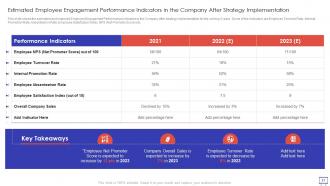
Slide 31: This slide shows the estimated and improved Employee Engagement Performance Indicators in the Company after strategy implementation for the coming 3 years.
Slide 32: This slide shows the Dashboards
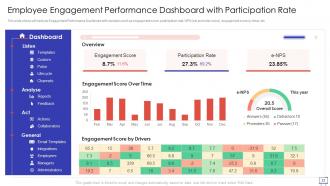
Slide 33: This slide shows an Employee Engagement Performance Dashboard with variables such as engagement score, participation rate, NPS (net promoter score), engagement score by driver etc.
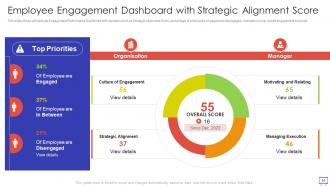
Slide 34: This slide shows an Employee Engagement Performance Dashboard with Strategic Alignment Score.
Slide 35: This is the Additional Slides
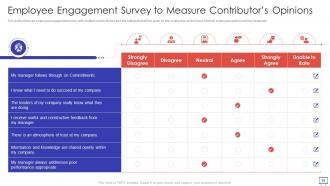
Slide 36: This slide shows an employee engagement survey with multiple survey factors and the ratings given by the employees on the basis opinion is measured.
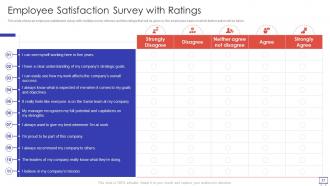
Slide 37: This slide shows an employee satisfaction survey with multiple survey criteria and the ratings that will be given by the employees' basis on which further action will be taken.
Slide 38: This slides display the title "Additional Slides"
Slide 39: This slide is the Icons Slide for Action Plan to Improve Employee Engagement
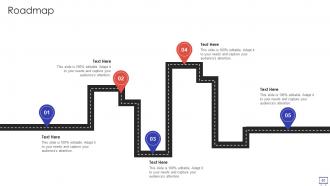
Slide 40: This slide shows the Roadmap.
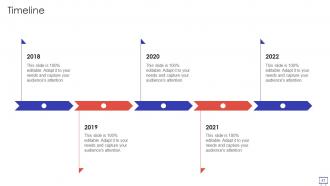
Slide 41: This slide exhibits yearly Timeline.
Slide 42: This slide showcase the 30 60 90 Days Plan
Slide 43: This slide display Post it Notes
Slide 44: this slide display Puzzle.
Slide 45: This slide display Magnifying Glass
Slide 46: This slide showcases Our Target
Slide 47: This slide display Venn
Slide 48: This is thank you slide & contains contact details of the company like office address, phone no., etc.
Action Plan To Improve Employee Engagement Powerpoint Presentation Slides with all 53 slides:
Use our Action Plan To Improve Employee Engagement Powerpoint Presentation Slides to effectively help you save your valuable time. They are readymade to fit into any presentation structure.







FAQs for Action Plan To Improve Employee Engagement
Honestly, just ask your team what they actually want instead of guessing. Communication and recognition are huge - people need to feel heard and appreciated. Don't micromanage either, that kills morale instantly. Give them autonomy over their work and respect their need for work-life balance. Most people quit bad managers, not companies, so those relationships matter more than you'd think. Oh, and connecting daily tasks to bigger meaningful goals keeps everyone motivated long-term. Growth opportunities help too since nobody wants to feel stuck forever.
Dude, communication really is everything at work. When people know what's going on and feel heard, engagement goes through the roof. Think about how annoying it is when you're totally clueless about big decisions - your team feels the same way. Regular feedback and transparency make employees feel like actual people instead of just worker bees. It builds trust too, which honestly might be the most underrated thing in management. Confusion drops way down when everyone's on the same page. Try doing weekly check-ins and sharing more about where the company's headed. You'll probably notice changes pretty fast.
Honestly? Your leadership style makes or breaks everything. People watch how you act every single day and mirror that energy back. Be transparent about decisions, actually listen when they give feedback, and don't forget to recognize good work - that's how you build trust. I've watched amazing teams fall apart because their manager micromanaged everything (such a waste). Give people autonomy instead. Connect their daily tasks to something bigger. Oh, and here's the easiest starting point - just ask your team what they need to do their best work, then follow through.
Mix surveys with actual data - that's your best bet. Do the big annual survey but add quick pulse checks monthly or quarterly since yearly is way too slow. Turnover rates and absenteeism tell you what people won't say out loud. Exit interviews are where you get the real tea, honestly. Focus your questions on whether people feel connected to their work and trust leadership. Oh, and internal mobility data shows if people see a future there. Just don't be one of those companies that surveys everyone then does nothing - people catch on fast.
Honestly, remote management is tricky but doable. Set up regular one-on-ones that aren't just work updates - people really need to feel connected when they're stuck at home all day. Those random hallway chats? Gone. So create virtual coffee breaks or team hangouts to fill that gap. I'd start with weekly check-ins plus one casual virtual thing monthly. Communication needs to be super clear since you can't just walk over and ask quick questions. Oh, and definitely celebrate wins publicly in Slack or team meetings - remote folks need that recognition even more. Small changes, but they actually work.
Engaged employees are honestly a game-changer for your bottom line. They're way more productive and stick around longer - saves you a fortune on hiring costs. Customer service gets better too. I've noticed engaged people barely call in sick and they're always coming up with creative solutions. Short sentences work. Happy employees basically become walking advertisements for your company, which attracts other solid candidates without you doing much. The trick is actually measuring this stuff through regular surveys or check-ins, then - and this is crucial - you've got to act on what people tell you instead of just filing it away.
Honestly, recognition systems can totally change workplace vibes. People just want to feel like their work matters, you know? When someone gets genuine acknowledgment for doing well, they're way more likely to stay engaged and keep pushing. But here's the thing - it has to feel real. Those cookie-cutter "employee of the month" programs? Everyone sees right through that stuff. Mix it up with both formal recognition and casual praise when you catch someone doing great work. Just be consistent about it so people actually believe good work gets noticed. Otherwise what's the point?
Honestly, it's usually communication issues from the top that kill things. Plus people feeling stuck with no room to grow, or just completely undervalued. Micromanagement is brutal too - nothing tanks morale faster. Start with anonymous surveys so people can actually be honest about what sucks. Then you gotta act on it, not just file it away somewhere. Clear career paths help a ton, and recognizing good work consistently makes people feel seen. The biggest thing though? Actually listen when your team tells you what's broken instead of thinking you already know. Even small tweaks to how you communicate can turn things around pretty quickly.
Honestly, D&I stuff works because people actually feel like they belong somewhere. When someone sees their voice matters in meetings and decisions, they'll obviously care more about their work. Diverse teams just crush it performance-wise too - probably because different perspectives spark better ideas. Creates this whole cycle where everyone's pumped to be part of the team. Oh, and check if quieter people are actually getting heard in your meetings. That's usually where the real problems show up. Start there if your engagement scores are trash.
Dude, the numbers are actually crazy - engaged employees are like 87% less likely to bail compared to the disengaged ones. Makes total sense though, right? If you feel valued and connected to your work, why would you leave? Teams with high engagement see way lower turnover across the board. All that recruiting and training money you're hemorrhaging? Gone. I honestly think if companies just tracked their engagement scores more, they'd solve half their retention problems right there. It's such a direct link to your bottom line but somehow gets overlooked constantly.
Honestly, feedback mechanisms work because people just want to feel like their voice matters. When you set up regular check-ins - could be surveys, one-on-ones, whatever - your team knows you actually care about their input. Nobody wants to work in complete silence, never knowing if they're crushing it or totally missing the mark. Here's the thing though: you can't just ask for feedback and then ghost them. Act on what they tell you and let them know what's changing because of it. That's literally when you'll see engagement go through the roof.
Honestly, investing in professional development is a game-changer for keeping people engaged. Shows them you actually care about where they're headed, not just what they can do for you right now. People hate feeling stuck - like, who wants to do the exact same tasks for years? When employees can learn new skills and grow, they'll genuinely give a damn about their work. The trick though is asking what THEY want to learn, not just assuming you know what's best. I've seen managers completely miss the mark on this. Just have real conversations with your team about their goals.
Honestly, team-building stuff actually works when people get to know each other outside work drama. Your crew becomes way more invested once they see coworkers as real humans, not just email signatures. Department silos? Gone. Marketing finally talks to IT without it being weird. Skip those cringe trust falls though - nobody wants that. Go with what your team's actually into. Volunteer days are solid, or even just grabbing lunch together works. I've seen simple stuff make huge differences. The trick is keeping it real, not some forced corporate bonding nightmare. Match your team's energy and you'll see engagement pick up naturally.
Oh totally, there's a huge connection there. Your employees who actually care about their jobs? They'll bend over backwards for customers, get creative with solutions, all that good stuff. Meanwhile the checked-out ones just phone it in - and customers can smell that from a mile away, trust me. Companies with engaged teams consistently score way higher on customer satisfaction than their competition. Honestly, if you want happier customers, figure out why your people aren't excited about work first. It's one of those things that seems backwards but totally makes sense once you think about it.
Honestly, COVID changed everything about keeping employees engaged. Remote work meant you couldn't just walk by someone's desk to see if they're burnt out or whatever. Companies had to get creative fast. Most places ditched the annual survey BS and started doing regular check-ins instead. Mental health support became huge too - way more important than the old pizza party approach (not gonna lie though, I still miss free lunch). Now it's all about flexibility and actually paying attention to what individuals need rather than assuming everyone's the same. Might be worth looking at what you're currently doing and seeing if it actually makes sense for hybrid teams.
-
SlideTeam is very efficient when it comes to saving time. I am happy that I chose them for my presentation.
-
“As you have innovative ideas and they are all customizable, this saves a huge chunk of your time to prepare well-read presentations.”