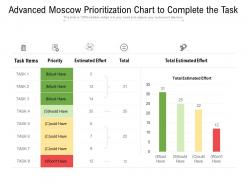
Advanced moscow prioritization chart to complete the task
Try Before you Buy Download Free Sample Product
Audience
Editable
of Time
Handle exaggerated claims with our Advanced Moscow Prioritization Chart To Complete The Task. Cut them down to factual dimensions.
People who downloaded this PowerPoint presentation also viewed the following :
Advanced moscow prioritization chart to complete the task with all 2 slides:
Cut down claims to factual dimensions with our Advanced Moscow Prioritization Chart To Complete The Task. Handle any attempt at exaggeration.
FAQs for Advanced moscow prioritization chart to
Moscow's urban planning prioritization is driven by population density management, transportation infrastructure modernization, environmental sustainability targets, economic development zones, and digital city initiatives. These factors work together by addressing housing demands, streamlining metro expansions, and integrating smart technologies, with many municipal planners finding that strategic combinations ultimately deliver improved citizen services and enhanced urban competitiveness.
The Moscow Prioritization framework addresses public transportation challenges by categorizing improvements into Must-have, Should-have, Could-have, and Won't-have priorities, enabling transit authorities to allocate limited resources strategically. Through this structured approach, cities like London and Berlin streamline infrastructure investments, enhance service reliability, and optimize route planning, while ensuring critical safety upgrades receive immediate attention, ultimately delivering improved passenger experiences and operational efficiency.
Moscow prioritizes cultural preservation through heritage site protection, adaptive reuse of historical buildings, integration of cultural spaces in new developments, and community engagement programs. These approaches enable the city to balance modernization with cultural identity, with many urban renewal projects incorporating traditional architectural elements, preserving neighborhood character, and creating mixed-use spaces that honor Moscow's rich cultural legacy.
Moscow's prioritization model improves residential living standards by categorizing housing initiatives into Must-have (essential infrastructure repairs), Should-have (energy efficiency upgrades), Could-have (community amenities), and Won't-have (luxury features). This systematic approach enables housing authorities and property managers to allocate limited budgets strategically, with many residential organizations finding that prioritizing critical maintenance and safety improvements first ultimately delivers better living conditions and long-term cost savings.
Citizen engagement in Moscow's prioritization involves public consultations, digital feedback platforms, community surveys, and participatory budgeting initiatives that capture resident priorities and concerns. These engagement mechanisms enable city officials to balance technical feasibility with community needs, ensuring infrastructure projects, service improvements, and policy decisions reflect both expert analysis and citizen preferences, ultimately delivering more responsive governance and stronger public support for municipal initiatives.
Moscow balances economic growth with environmental sustainability through strategic urban planning, green technology investments, and circular economy initiatives that reduce waste while promoting innovation. The city prioritizes projects like energy-efficient infrastructure, sustainable transportation systems, and digital governance platforms, with many municipal programs finding that environmental improvements ultimately deliver cost savings, attract international investment, and enhance competitive positioning.
Moscow's prioritization strategies have delivered measurable outcomes including reduced traffic congestion by 15%, increased public transport usage by 25%, enhanced digital service adoption reaching 80% of residents, improved air quality metrics, and streamlined administrative processing times. These strategic investments in infrastructure modernization, smart city technologies, and citizen-focused services have ultimately strengthened Moscow's competitive position among global cities, with residents experiencing faster services and enhanced urban living standards.
COVID-19 significantly accelerated Moscow's prioritization of digital health infrastructure, telemedicine platforms, emergency response systems, and hospital capacity optimization. The pandemic prompted strategic investments in contactless patient services, AI-driven diagnostics, and integrated healthcare data management, with many Russian healthcare institutions finding that these technological enhancements ultimately deliver faster patient care and improved operational efficiency.
Moscow utilizes smart city platforms, IoT sensors, data analytics software, GIS mapping systems, and citizen engagement applications for project prioritization. These technologies streamline decision-making by analyzing traffic patterns, monitoring infrastructure health, and gathering resident feedback, with many municipal departments finding that integrated data platforms ultimately deliver more efficient resource allocation and faster project implementation.
Moscow's prioritization framework emphasizes state-driven digital infrastructure, centralized healthcare systems, and strategic economic diversification, while cities like Singapore focus on smart city integration, London prioritizes financial services innovation, and Tokyo emphasizes technological advancement. This approach enables Moscow to streamline resource allocation across sectors like energy, transportation, and public services, with many organizations finding that centralized frameworks deliver faster implementation and coordinated outcomes.
Moscow has faced challenges including resource constraints limiting comprehensive infrastructure upgrades, coordinating priorities across diverse municipal departments, and balancing citizen expectations with budget realities. While these obstacles initially slowed implementation, the city has increasingly streamlined decision-making processes and enhanced cross-departmental collaboration, ultimately delivering more efficient resource allocation and improved public services.
Moscow's urban development plans integrate green space prioritization through strategic zoning requirements, mandatory ecological corridors, comprehensive park network expansion, and sustainable building standards that require green infrastructure components. Through these frameworks, municipal planners enhance air quality, reduce urban heat islands, and improve resident wellbeing, while developers increasingly find that green-integrated projects deliver higher property values and competitive market advantage.
Socioeconomic disparities significantly influence Moscow's prioritization by creating unequal access to resources, services, and infrastructure across different districts and population segments. Wealthier areas typically receive enhanced urban development, transportation networks, and public amenities, while lower-income neighborhoods face resource constraints, with city planners increasingly recognizing that strategic redistribution enables more equitable growth and sustainable urban development.
Moscow prioritizes safety and security through integrated smart city technologies, enhanced emergency response systems, comprehensive surveillance networks, and data-driven crime prevention strategies. These initiatives streamline public safety operations by deploying IoT sensors, AI-powered monitoring, and predictive analytics, with transportation hubs, residential districts, and commercial centers finding improved incident response times and enhanced citizen protection.
Other cities can learn valuable lessons from Moscow's prioritization experience, including stakeholder engagement strategies, data-driven decision frameworks, resource allocation optimization, and systematic implementation approaches. Through Moscow's methodologies, municipalities can streamline urban planning processes, enhance public service delivery, and improve citizen satisfaction, while balancing competing priorities and budget constraints, ultimately delivering more effective governance and strategic urban development outcomes.
No Reviews