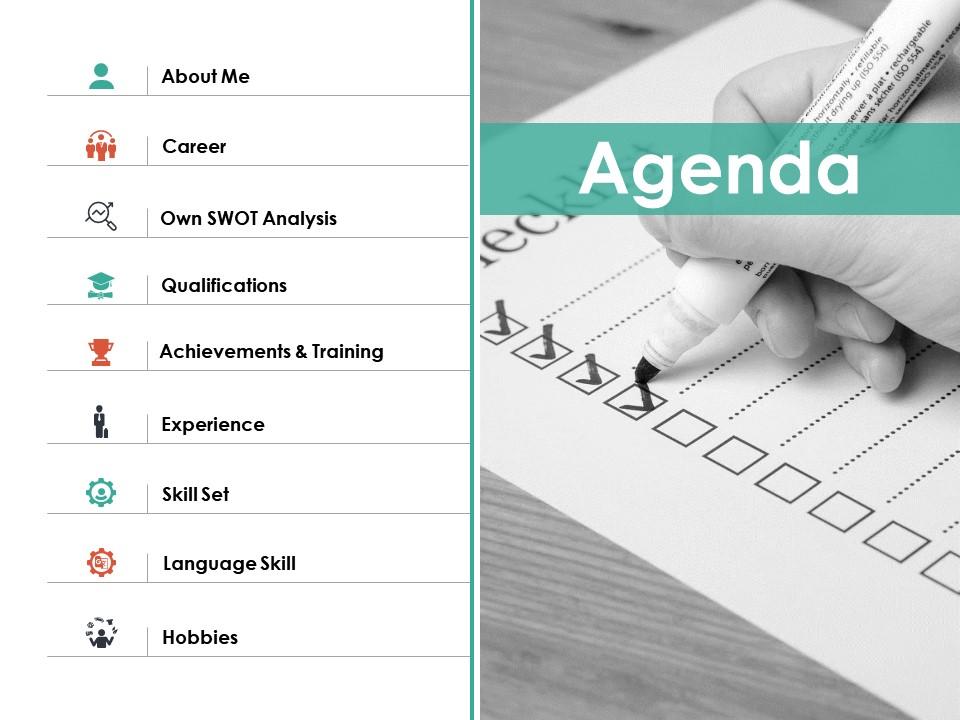
Ordre du jour Ppt Résumé Mises en page
Try Before you Buy Download Free Sample Product
Audience
Editable
of Time
Démontrez votre capacité à gérer les conséquences avec nos mises en page de résumé d'agenda Ppt. Affichez l'appétit pour faire faillite.
Caractéristiques de ces diapositives de présentation PowerPoint :
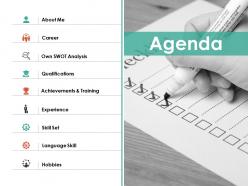
Présentation de cet ensemble de diapositives avec le nom - Mises en page de résumé de l'agenda Ppt. Il s'agit d'un processus en neuf étapes. Les étapes de ce processus sont À propos de moi, Carrière, Propre analyse Swot, Qualifications, Expérience.
People who downloaded this PowerPoint presentation also viewed the following :
Mises en page récapitulatives de l'ordre du jour Ppt avec les 5 diapositives :
Trouvez tous les faits applicables avec nos mises en page de résumé de l'agenda Ppt. Ils ont l'arrière-plan sur tout.
FAQs for Agenda
Effective agenda templates include clear time allocations, logical flow structure, presenter identification, objective statements, and interactive elements like Q&A sessions. These components streamline meeting management by setting expectations, maintaining focus, and ensuring comprehensive coverage, with many organizations finding that well-structured agendas enhance participant engagement and deliver measurably better outcomes.
Different industries customize agenda templates by adapting formats, terminology, regulatory requirements, stakeholder focuses, and time allocations to match their operational contexts. Healthcare organizations emphasize compliance discussions and patient outcomes, financial services prioritize risk assessments and regulatory updates, while manufacturing focuses on production metrics and safety protocols, ultimately enabling more targeted decision-making and enhanced operational efficiency.
PowerPoint, Canva, Google Slides, Adobe InDesign, and Notion offer excellent agenda template creation capabilities, each delivering unique design features and collaborative functionality. These platforms streamline meeting preparation by providing customizable layouts, professional formatting options, and seamless sharing capabilities, with many organizations finding that PowerPoint and Canva particularly enhance visual appeal while maintaining operational efficiency across teams.
Agenda templates improve meeting productivity by providing structured frameworks that define clear objectives, allocate specific time slots, prioritize key topics, and establish actionable outcomes. Through standardized formats, organizations streamline preparation time, enhance participant engagement, and maintain focused discussions, with many companies finding that consistent agenda structures reduce meeting duration by 25-30% while significantly improving decision-making efficiency.
Virtual presentations require shorter segments, built-in interaction breaks, technology checkpoints, and clear visual cues, while in-person agendas can accommodate longer discussion periods and spontaneous networking. These design adaptations enhance engagement by addressing attention spans, technical considerations, and participation methods, with many organizations finding that hybrid-friendly templates ultimately deliver greater flexibility and accessibility across diverse meeting formats.
Agenda templates enhance audience engagement by providing clear structure, setting expectations, and creating interactive touchpoints throughout presentations. When presenters use well-designed agendas, audiences can follow along more easily, anticipate key topics, and participate more actively in discussions, with many organizations finding that structured presentations deliver higher retention rates and more productive meetings.
Common mistakes include using overly generic templates without customization, cramming too many topics into limited timeframes, failing to assign clear time allocations, and neglecting to distribute agendas in advance. Organizations frequently overlook participant preparation requirements, skip defining decision-making authority for each item, and forget to build in buffer time, ultimately delivering unfocused meetings that waste valuable resources and diminish team productivity.
Agenda templates can be easily adapted for different presentation styles by adjusting structure, content focus, timing allocations, and visual emphasis. For informative presentations, agendas emphasize detailed content sections and Q&A periods, while persuasive presentations prioritize problem-solution frameworks and decision points, with many organizations finding that style-specific agendas enhance audience engagement and presentation effectiveness.
Time management elements in agenda templates include designated time slots, buffer periods between topics, priority rankings, and realistic duration estimates for each item. These components streamline meetings by preventing overruns, maintaining focus on critical objectives, and ensuring balanced participation, with many organizations finding that structured timing ultimately delivers more productive discussions and actionable outcomes.
Visual hierarchy in agenda templates guides attention through strategic use of font sizes, colors, spacing, and formatting to prioritize critical information like meeting objectives and key discussion points. This structured approach enables participants to quickly identify priorities, prepare more effectively, and navigate meetings seamlessly, with many organizations finding that well-designed visual hierarchies reduce meeting preparation time and enhance overall productivity.
Cultural differences significantly influence agenda template design through varying communication styles, time orientations, hierarchical structures, and meeting preferences across global audiences. Organizations adapting templates for international teams find that incorporating flexible formatting for high-context versus low-context cultures, adjustable time allocations, and culturally appropriate visual elements ultimately enhances cross-cultural collaboration and meeting effectiveness.
Pre-designed agenda templates offer significant time savings, consistent professional formatting, proven structural frameworks, and reduced planning effort compared to creating from scratch. While custom agendas provide complete control, templates enable faster meeting preparation, ensure comprehensive coverage of essential elements, and deliver standardized experiences across organizations, with many companies finding that template-based approaches streamline operations while maintaining quality.
Feedback from previous presentations can inform agenda improvements by identifying pacing issues, content gaps, engagement challenges, and transition difficulties that audiences experienced. This input enables strategic refinements like adjusting time allocations, enhancing interactive elements, and streamlining flow structures, with many organizations finding that iteratively updated templates deliver significantly better audience engagement and presentation outcomes.
Educational presentations benefit from templates with clear learning objectives, interactive elements, discussion points, and knowledge assessment sections, while corporate pitches require templates emphasizing problem-solution frameworks, ROI projections, and compelling call-to-action slides. Educational formats prioritize engagement and comprehension through structured content flow, whereas corporate templates focus on persuasion and decision-making, with many organizations finding that matching template style to audience expectations significantly enhances presentation effectiveness and outcomes.
Design agenda templates with modular sections, flexible time blocks, and strategic buffer periods built into the structure. Through customizable frameworks that include "Additional Items" sections and adjustable timing allocations, organizations can seamlessly accommodate urgent topics, stakeholder requests, or unexpected priorities, while maintaining meeting flow and ensuring all critical business objectives are addressed effectively.
-
Awesomely designed templates, Easy to understand.
-
Excellent Designs.