Agile and devops

Rating:
89%
Agile and devops
Slide 1 of 2
Favourites Favourites

Try Before you Buy Download Free Sample Product

Audience Impress Your
Audience
Editable 100%
Editable
Time Save Hours
of Time
The Biggest Sale is ending soon in
0
0
:
0
0
:
0
0
AI-Ready
Upload this template to AI and ask it to make any changes to content or color
100% editable Powerpoint Template for AI-assisted presentations. Finish your work in less time. Download Prompt Kit ​
Works with
Microsoft PowerPoint
Microsoft 365
Claude for PowerPoint
ChatGPT
Google Slides
Microsoft Copilot
Rating:
89%
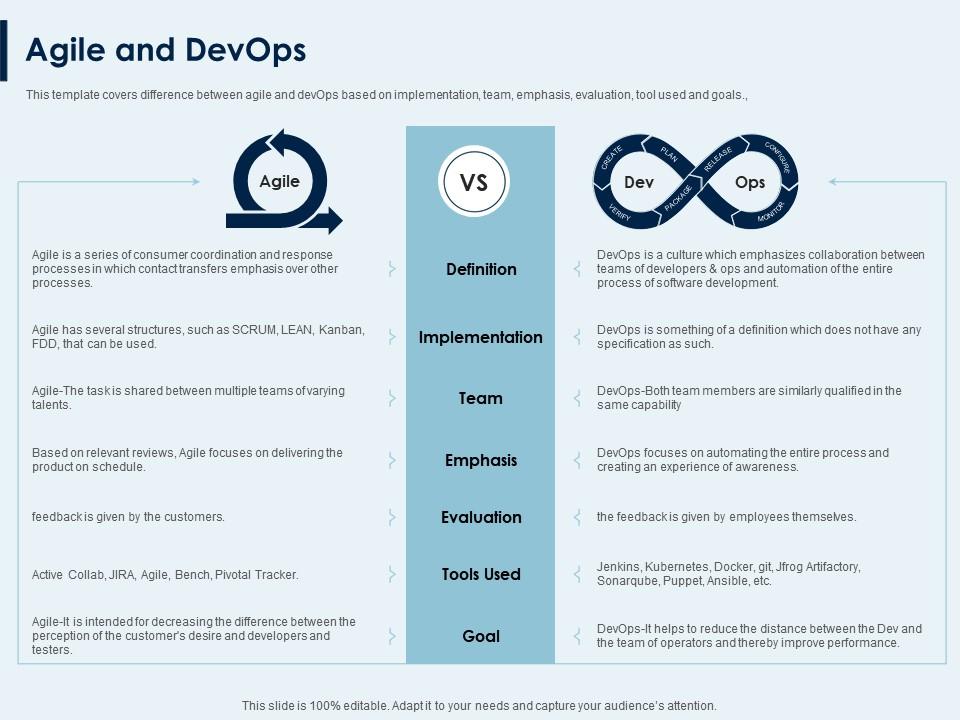
This template covers difference between agile and devOps based on implementation, team, emphasis, evaluation, tool used and goals. Present the topic in a bit more detail with this Agile And Devops. Use it as a tool for discussion and navigation on Team, Goal, Consumer, Contact Transfers, Team Members. This template is free to edit as deemed fit for your organization. Therefore download it now.

FAQs for

Agile DevOps core principles include continuous integration, automated testing, collaborative cross-functional teams, iterative development cycles, and rapid feedback loops. These methodologies streamline software delivery by reducing deployment times, minimizing manual errors, and enhancing team communication, with many technology organizations finding that this strategic combination ultimately delivers faster time-to-market and improved operational efficiency.

Organizations integrate Agile methodologies with DevOps practices through cross-functional teams, continuous integration pipelines, shared sprint planning, and automated testing workflows. This strategic combination streamlines development cycles, enhances communication between development and operations teams, and accelerates deployment frequency, with many enterprises finding that unified processes ultimately deliver faster time-to-market and improved product quality.

Essential Agile DevOps tools include Jenkins for continuous integration, Docker for containerization, Kubernetes for orchestration, Git for version control, and monitoring platforms like Prometheus or New Relic. These technologies streamline development cycles by automating deployments, enhancing collaboration, and enabling real-time feedback, with many organizations finding that this integrated approach delivers faster releases and improved operational efficiency.

Agile DevOps transforms team dynamics by breaking down traditional silos between development and operations, fostering cross-functional collaboration, shared accountability, and continuous communication throughout the software lifecycle. This integration enables teams to deliver faster releases, respond more effectively to customer feedback, and maintain higher quality standards, with many organizations finding that collaborative workflows significantly enhance productivity and reduce deployment risks.

Key Agile DevOps success metrics include deployment frequency, lead time for changes, mean time to recovery, change failure rate, and cycle time from development to production. These measurements enable organizations to track operational efficiency, delivery speed, and system reliability, with many enterprises finding that monitoring these metrics streamlines continuous improvement efforts while ultimately delivering faster releases and enhanced customer experiences.

Teams establish continuous feedback loops through automated monitoring systems, real-time collaboration tools, regular retrospectives, cross-functional stand-ups, and integrated testing frameworks that provide immediate insights. These practices enable development and operations teams to quickly identify issues, share performance data, and adapt processes collaboratively, ultimately delivering faster deployments and improved system reliability.

Organizations face cultural resistance, skills gaps, tool integration complexities, and process alignment difficulties when transitioning to Agile DevOps models. These challenges present opportunities for strategic transformation, with many companies finding that investing in cross-functional training, automated workflows, and collaborative frameworks ultimately delivers faster deployment cycles, improved quality, and enhanced competitive advantage in increasingly dynamic markets.

Agile DevOps accelerates time-to-market by integrating continuous integration, automated testing, rapid deployment cycles, and cross-functional collaboration throughout the development lifecycle. This strategic combination enables organizations to deliver software updates weekly rather than quarterly, streamline feedback loops, and respond to market demands faster than competitors, with many tech companies finding that automated pipelines reduce release times by 60-80%.

Automation serves as the backbone of Agile DevOps, streamlining code integration, testing, deployment, infrastructure provisioning, and monitoring processes. These automated workflows significantly reduce manual errors, accelerate release cycles, and enhance team productivity, with many organizations finding that CI/CD pipelines and infrastructure-as-code deliver faster time-to-market and improved operational efficiency.

Agile DevOps enhances software quality through continuous integration, automated testing, frequent feedback loops, and collaborative development practices that catch defects early. This approach enables organizations to deliver more reliable software, respond quickly to customer needs, and iterate based on real user feedback, ultimately resulting in higher customer satisfaction and competitive advantage in increasingly demanding markets.

Effective communication practices for remote Agile DevOps teams include daily video standups, shared digital workspaces, real-time collaboration tools, structured sprint reviews, and cross-functional pair programming sessions. These approaches streamline coordination by maintaining transparency, accelerating feedback loops, and fostering collaborative problem-solving, with many distributed organizations finding that consistent communication rituals ultimately deliver faster deployment cycles and stronger team cohesion.

Psychological safety in Agile DevOps teams develops through encouraging open communication, celebrating failure as learning, implementing blameless post-mortems, and promoting collaborative decision-making across development cycles. These practices enable teams to experiment with innovative solutions, share concerns without fear of retribution, and accelerate problem-solving, with many organizations finding that psychologically safe environments ultimately deliver faster deployments and higher-quality products.

Agile DevOps teams require technical skills like automation, CI/CD pipelines, containerization, and cloud platforms, alongside soft skills including cross-functional collaboration, continuous learning, and adaptive problem-solving. These competencies enable professionals to streamline development cycles, enhance deployment frequency, and deliver faster customer value, with many organizations finding that investing in comprehensive upskilling ultimately drives competitive advantage.

Organizations balance speed with security and compliance in Agile DevOps by integrating automated security testing, continuous compliance monitoring, and DevSecOps practices directly into development pipelines. Through shift-left security approaches, many financial services and healthcare organizations streamline vulnerability detection, accelerate compliance validation, and maintain regulatory standards, while ultimately delivering faster, more secure releases and enhanced competitive advantage.

Successful Agile DevOps transformations include Netflix's microservices architecture enabling rapid scaling, Amazon's continuous deployment delivering thousands of daily releases, and ING Bank's squad model accelerating digital banking services. These organizations demonstrate that combining cross-functional teams, automated testing, and continuous integration streamlines development cycles, reduces time-to-market, and enhances customer responsiveness, with many enterprises finding that cultural alignment ultimately delivers sustainable competitive advantage.

Ratings and Reviews

89% of 100
Review Form
Write a review
Most Relevant Reviews
  1. 100%

    by Denny Salazar

    Unique design & color.
  2. 100%

    by Joe Thomas

    Illustrative design with editable content. Exceptional value for money. Highly pleased with the product.
  3. 100%

    by Earl Contreras

    Excellent Designs.
  4. 80%

    by Charley Bailey

    Attractive design and informative presentation.
  5. 100%

    by Deshawn Schmidt

    Much better than the original! Thanks for the quick turnaround.
  6. 80%

    by Walsh Turner

    Understandable and informative presentation.
  7. 80%

    by Danial Fernandez

    Easily Understandable slides.
  8. 80%

    by James Rodriguez

    Awesome presentation, really professional and easy to edit.
  9. 80%

    by Robert Young

    Content of slide is easy to understand and edit.

9 Item(s)

per page: