Agile testing scrum approach ppt examples slides
Try Before you Buy Download Free Sample Product
Audience
Editable
of Time
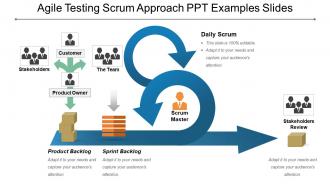
If you are looking for ways in which your organization can create a faster product delivery and the ability to understand customer requirements, then here is our Agile Testing Scrum Approach PowerPoint SlideShow. An iterative process is a process for calculating a desired result by means of a repeated cycle of operations. Use our scrum testing slide to project the importance of developing requirements gradually from customers and testing teams. Use our Scrum approach testing PowerPoint slide designed specifically to project a powerful visual story of the business chain to the viewers. We help you display the product backlog with keeping in check the needs of the stakeholder customer the team and the product owner. Once you move to the stage of constructing the iterations and releasing them, it is important to map the data of how many return cycles are run between construction iteration and release. With our scrum testing PPT, you will be able to manage the data that comes with the product development as this data helps your team to implement efficiency in product development. Use this slide to keep a tab on your production rates as soon as it completes the release cycle. Our Agile Testing Scrum Approach Ppt Examples Slides provide you with a vast range of viable options. Select the appropriate ones and just fill in your text.
People who downloaded this PowerPoint presentation also viewed the following :
Agile testing scrum approach ppt examples slides with all 5 slides:
Enlighten folks about creditable achievements with our Agile Testing Scrum Approach Ppt Examples Slides. Highlight any causes for celebration.
FAQs for Agile testing scrum approach
So basically you want to test early and often - don't wait until the end like those old waterfall days (ugh, what a mess that was). Get yourself into sprint planning meetings right away, that's where the magic happens. Work with your devs instead of hiding in a corner somewhere. Focus on stopping bugs before they happen rather than just hunting them down later. Oh and prioritize based on what actually matters to the business, not just random stuff. Keep your docs simple - nobody reads novel-length test plans anyway. The whole point is being flexible when things change, which they always do.
So basically you're testing as stuff gets built instead of waiting till everything's "finished" (which it never really is lol). Work closely with devs during sprints - catch problems early when they're not a nightmare to fix. Old school testing happened after coding was done, but Agile has you involved from day one. You'll write test cases from user stories rather than those giant requirement docs nobody reads anyway. Feedback happens in days, not months. Honestly, just start showing up to sprint planning so you know what's coming your way before it lands on your plate.
So in Agile you're basically part of the team from the start, not just waiting around to break stuff later. Work directly with devs and product people during sprint planning - help write acceptance criteria, create test cases, test things as they're being built. Way more collaborative than waterfall (which honestly was pretty soul-crushing). You'll do automation, exploratory testing, all that good stuff. The big difference? You're preventing bugs instead of just hunting them down afterward. Think of it like being a quality advocate for everyone, not the person who says "nope" at the end.
Look, automated testing is honestly a lifesaver for Agile teams. It handles all that boring repetitive stuff so you can actually focus on exploring new features and testing the weird edge cases. When something breaks, you'll know instantly instead of waiting days for manual testing cycles. Start small though - pick your most critical user flows first, then build out from there. I learned this the hard way trying to automate everything at once (what a mess that was). Your deployment anxiety basically disappears because you know the core stuff works. Focus on tests that run often and catch the big nasty bugs first.
Dude, the time crunch is brutal - you're always behind somehow. Requirements change constantly, usually right in the middle of a sprint which is super annoying. Short cycles mean you gotta test fast but still catch everything. Communication with devs gets messy, especially when stuff shifts around. Nobody wants to write documentation so you're flying blind half the time. Automation saves your life but takes forever to build out properly. Start by getting tight with your dev team first - that relationship makes or breaks everything. Then slowly work on automating more tests.
Honestly, agile testing is what makes CI/CD actually work - without it you're just crossing your fingers. Write your tests alongside the code, not after (learned that the hard way). Fast automated unit and integration tests are key because waiting around for feedback kills momentum. Nobody's got time for 30-minute test runs. Start small though - pick a few tests you can automate right now and build from there. Even baby steps help tons. The goal is getting that instant feedback loop so devs know immediately when something breaks instead of finding out later when it's a nightmare to fix.
Dude, collaborative communication in Agile is a game-changer because it kills those awful silos. You know how devs used to just toss requirements at testers? That's done. Now everyone's constantly chatting about what we're building and how it should actually work. Problems get caught super early - like realizing acceptance criteria are garbage during planning instead of after coding everything. Way better than my last job where we found issues at the very end. The whole team shares responsibility for quality now. Seriously, go to those daily standups and don't stay quiet if something seems weird about a story.
Honestly, I'd focus on a few key things. Your defect detection rate is huge - are you catching bugs early in sprints or scrambling at the end? Test coverage matters, but don't obsess over hitting 100%. Cycle time is where teams really feel the pain though - nobody wants to wait weeks for feedback. I always check customer satisfaction scores and production incidents too since those show what's actually making it through. The trick is finding that sweet spot between speed and being thorough. Maybe set up a weekly dashboard so you can actually see trends instead of just guessing what's working.
User stories are basically your roadmap for testing in Agile. Those "As a user, I want..." statements turn into your test scenarios through acceptance criteria. I always start by reviewing the acceptance criteria with my team first - saves so much headache later, trust me. High-value user journeys get tested before the weird edge cases, which makes sense for prioritizing. The best part? Stories keep you focused on what users actually need instead of getting stuck testing random technical stuff (been there, done that). Write your test cases straight from the conditions of satisfaction and you're golden.
Jump in from day one - don't sit around waiting for devs to finish. Work with them during planning to hash out user stories and acceptance criteria. I swear, catching stuff early saves so much headache later. Write your test cases while they're coding, not after. Do exploratory testing throughout the sprint, pair up with developers when you can. Everyone should feel responsible for quality, not just you. Get your CI pipeline running tight so it catches problems fast. Oh, and always test in environments that actually mirror production if possible.
Jira's your best bet for project management - integrates with pretty much everything. TestRail or Zephyr work great for test cases, though TestRail literally saved me last sprint with its reporting. Selenium + Jenkins is still the go-to for automation, but Cypress is getting popular because it's way faster. Oh, and grab Miro or Confluence for those planning sessions where everyone's throwing ideas around. Honestly? Just pick whatever plays nice with your current dev setup. I made the mistake of trying to build some perfect toolchain once - total waste of time.
Exploratory testing works great with Agile - you can adapt as you find weird stuff instead of sticking to boring scripts. Do it during sprints, not just at the end. Honestly, it's like being a detective which is way more fun than clicking through the same test cases over and over. Don't ditch your structured tests though, just pair them together. Timebox your exploring sessions so you don't go down rabbit holes for hours. Write down anything interesting right away or you'll forget. This covers your planned testing plus all the random things users will definitely break later.
Honestly, don't wait until sprint end - test throughout. Write your tests early, like before or while you're coding. Pairing with devs actually makes it way less boring too. Mix it up with unit, integration, and acceptance tests to hit different angles. When you're crunched for time (which, let's be real, is always), focus on the riskiest stuff first. Oh and here's the thing - make everyone on your team care about quality, not just QA people. That mindset shift alone will save you so much headache later.
So with agile testing, you're basically writing tests in short bursts alongside the actual coding. When requirements change (and they always do), you can pivot quickly instead of scrapping months of work. The secret sauce? Talk to your developers and product owners constantly - I can't stress this enough, communication literally makes or breaks everything. Focus on the high-priority stuff first. Keep your automation simple so you're not stuck when things shift. Oh, and forget those massive upfront test plans. You'll just end up rewriting everything anyway when new user stories come in.
Yeah, definitely get your QA folks in those sprint reviews! Show the actual test results - stakeholders eat that stuff up when they see those green checkmarks. Don't just demo the happy path either. I'd show edge cases and weird bugs you caught before they went live. Honestly, transparency works way better than trying to hide issues. Talk about any blockers or tech debt that'll bite you later. Oh, and make sure you're clear about test coverage gaps - helps the product owner figure out priorities for next sprint. Way better than just talking about testing without showing proof.
-
Amazing product with appealing content and design.
-
Nice and innovative design.